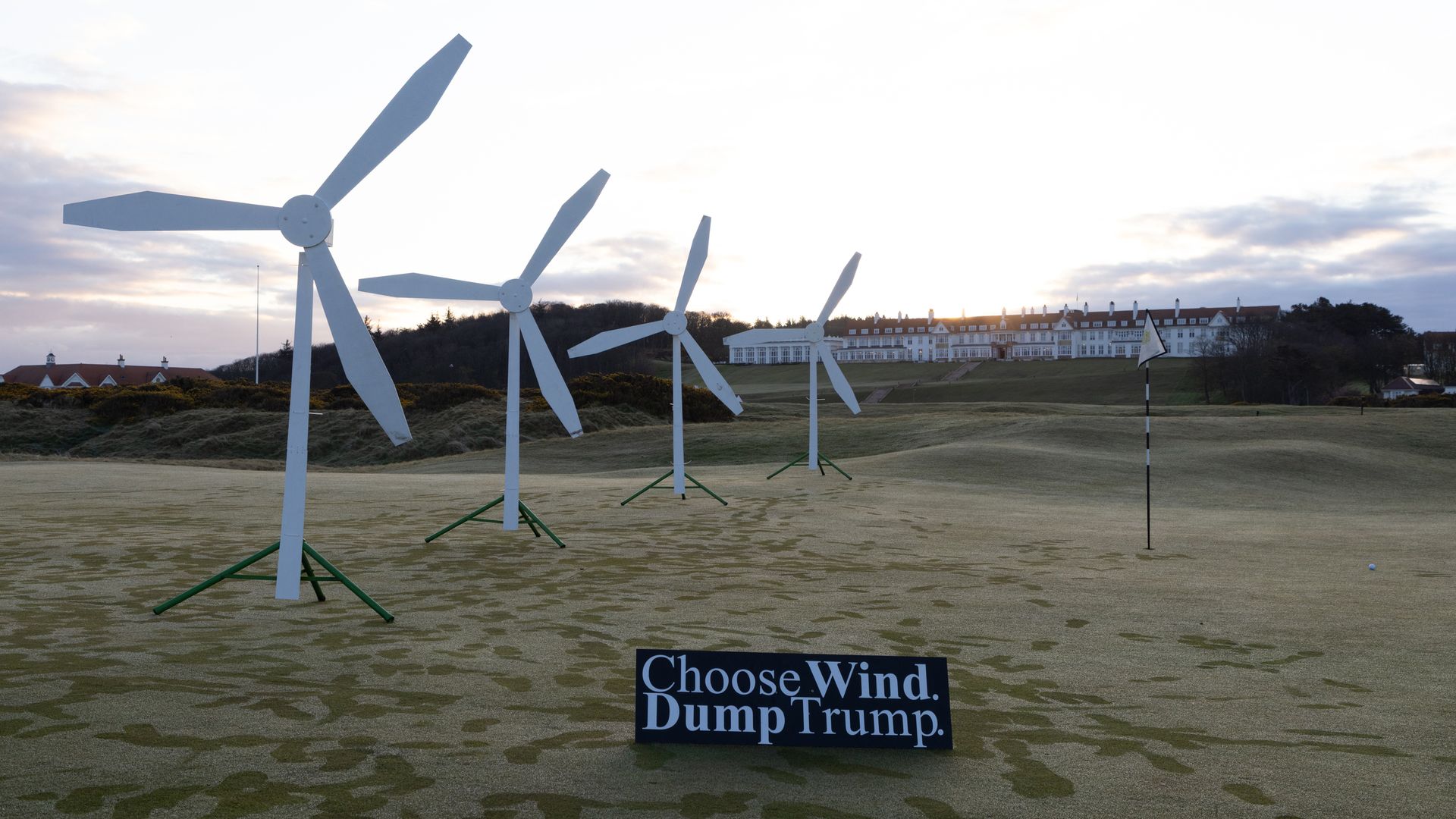
Environmental activism has a branding problem, and the latest stunt at a Trump-owned golf course in the UK is the perfect specimen of its decline. Protesters storm the greens, unfurl banners, and demand "climate justice" while the cameras roll. The media laps it up. The public sighs. Nothing changes.
The lazy consensus suggests these demonstrations are vital "wake-up calls" for the elite. They aren't. They are performative theater that targets the wrong variable in a complex ecological equation. If you want to actually save the planet, you need to stop obsessing over the manicured grass of a billionaire and start looking at the boring, unsexy reality of global logistics and energy density.
The Myth of the Symbolic Victory
Activists target golf courses because they are easy symbols of excess. They represent the "one percent," land privatization, and perceived waste. It makes for a great Instagram post. But symbolism is the enemy of efficacy.
When you protest a golf course, you are fighting an aesthetic, not a carbon footprint. In the grand hierarchy of environmental damage, the maintenance of a few hundred acres of turf—even with its pesticide use and water consumption—is a rounding error. It’s a drop in an ocean compared to the heavy industry, maritime shipping, and aging power grids that actually dictate our atmospheric future.
Focusing on Trump’s Scottish estates is low-hanging fruit. It’s safe. It’s popular. And it’s completely irrelevant to the actual warming of the planet. We have replaced rigorous environmental policy with high-visibility tantrums that prioritize "feeling right" over "being effective."
The Land Use Fallacy
The common argument against these courses is that the land should be "returned to nature" or used for more sustainable purposes. This sounds noble until you look at the economics of land management.
Managed estates, even luxury ones, often prevent the much more destructive alternative: suburban sprawl or industrial development. In many parts of the UK, if a golf course isn't there, the land becomes a prime candidate for high-density housing or commercial zoning. These developments require massive concrete pouring—a process responsible for roughly 8% of global $CO_2$ emissions—and permanent infrastructure that destroys local biodiversity far more effectively than a sand trap ever could.
Let’s look at the science of $CO_2$ sequestration. A well-managed grassland or "links" style course can actually act as a modest carbon sink.
$$C_{seq} = \int_{0}^{t} (R_{in} - R_{out}) dt$$
Where $C_{seq}$ is the carbon sequestered, $R_{in}$ is the rate of organic matter input, and $R_{out}$ is the rate of decomposition/respiration. While not as efficient as an ancient forest, a golf course is significantly better for the local ecosystem than a strip mall or a distribution center for the very goods these protesters likely ordered on their smartphones.
The Elite Hypocrisy Trap
The activists claim to be speaking truth to power. In reality, they are trapped in a feedback loop with the very people they hate. High-profile protests on luxury properties provide a convenient villain for the evening news, but they do nothing to address the structural dependencies of the modern world.
I have spent years analyzing the flow of capital in the energy sector. I have seen billion-dollar projects get greenlit because the public was too busy arguing about a golf course to notice a new pipeline or a massive deregulation of industrial runoff. The "Trump" factor is a massive red herring. It turns a scientific and logistical challenge into a personality clash.
If your environmentalism depends on who owns the land rather than what is happening at the molecular level of the atmosphere, you aren't an environmentalist. You’re a political hobbyist.
The Water Misconception
"They use millions of gallons of water!" is the standard cry.
Yes, they do. But in the UK, a land not exactly known for its droughts, the water used for irrigation is often drawn from private boreholes or recycled gray water systems. Unlike the agricultural sector, which accounts for the vast majority of global freshwater withdrawals, golf course irrigation is highly localized and often circular.
If activists were serious about water conservation, they would be blockading industrial meat processing plants or textile factories. But those don't have the "Trump" brand attached. They aren't "clickable."
The High Cost of Performance
Every hour spent planning a "die-in" on a fairway is an hour not spent lobbying for nuclear energy or researching grid-scale battery storage. We are facing a massive energy transition that requires the most sophisticated engineering and economic restructuring in human history.
Protesting a golf course is the equivalent of trying to put out a forest fire by yelling at a matchstick. It’s a category error. It confuses "luxury" with "damage."
Imagine a scenario where every person currently holding a sign at a golf course instead spent that time earning a degree in chemical engineering or urban planning. We would be decades ahead of where we are now. Instead, we have a generation of activists who can identify a villain but can’t explain the difference between base-load power and intermittent renewables.
Real Solutions Are Boring
If you want to disrupt the status quo, stop chasing the cameras.
- Energy Density is Everything: Support the expansion of nuclear power. It is the only way to provide the reliable, carbon-free energy required to run a modern civilization without carpet-bombing the landscape with inefficient solar arrays.
- Tax the Carbon, Not the Owner: Stop worrying about who owns the golf course. Advocate for a universal carbon tax at the source. If the course becomes too expensive to maintain because of its footprint, the market will kill it faster than any protestor ever could.
- Logistics Reform: Focus on the 50,000 merchant ships that burn bunker fuel—some of the dirtiest oil on the planet—to bring us the cheap electronics and fast fashion that fuel our lives.
The protest at the Trump course isn't a strike against the "establishment." It’s a gift to it. It keeps the conversation focused on personalities and aesthetics while the real drivers of ecological collapse continue unabated, hidden behind a veil of boring technicalities and complex supply chains.
Stop being a pawn in the spectacle. If you're on the green with a banner, you've already lost. The real fight isn't on the golf course; it’s in the reactor cores, the shipping lanes, and the tax codes.
Pick up a textbook and get to work.