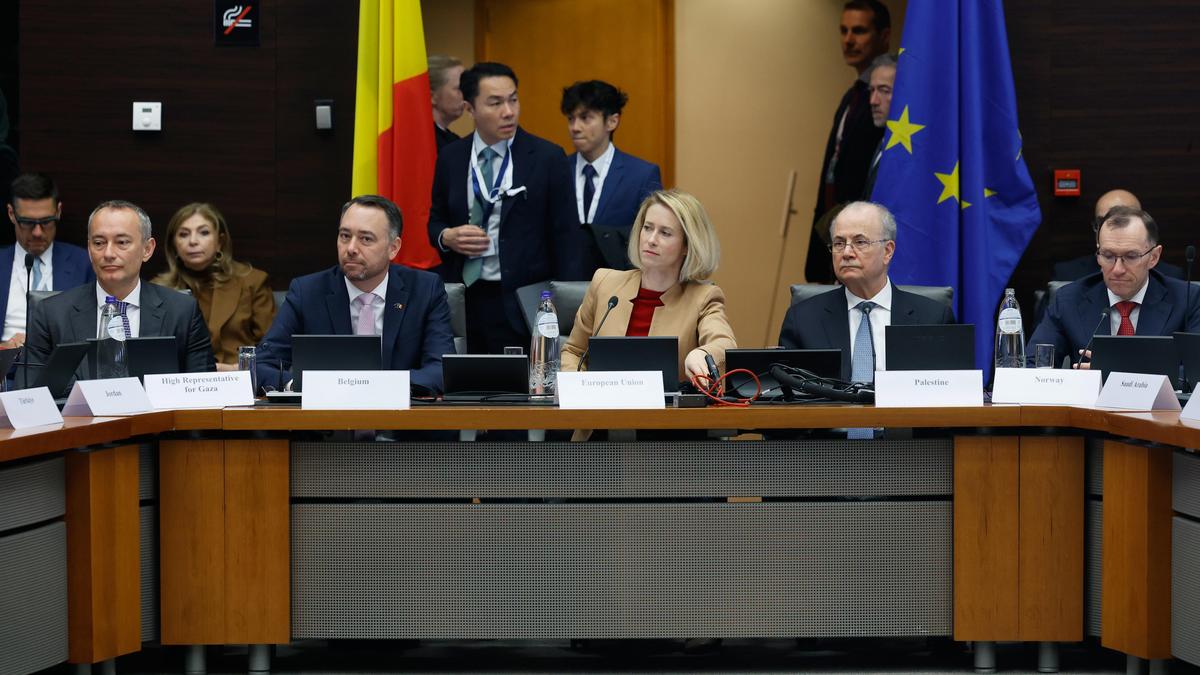
The air inside the Europa building in Brussels doesn’t smell like history. It smells like industrial floor wax and expensive espresso. It is a climate-controlled silence, a vacuum where the screams of the Mediterranean are filtered through double-paned glass and the polite rustle of briefing papers. But today, the silence was heavy.
When Mahmoud Abbas, the President of the Palestinian Authority, walked into the room to meet with the European Union’s foreign policy chiefs, he wasn’t just bringing a delegation. He was bringing the ghosts of a thousand shattered windows in Gaza and the suffocating dust of the West Bank. The meeting was framed by the media as a "security and peace conference." That is a sanitized phrase. It is a phrase that hides the jagged reality of what it actually means to try and build a state on top of a graveyard.
Europe is trying to find a pulse in a peace process that many have already declared dead and buried.
Consider a man in Ramallah. Let’s call him Omar. Omar doesn’t care about the specific phrasing of the European Council’s joint communique. He cares about whether the olive trees his grandfather planted are still standing behind a new concrete barrier. He cares about whether his daughter can get through a checkpoint to reach her university without being detained for four hours in the midday sun. For Omar, "security" isn't a policy goal discussed over sparkling water in a Belgian boardroom. It is the ability to breathe without permission.
The EU leaders sat across from Abbas with a difficult math problem written on their faces. They are the largest donor of aid to the Palestinian people, a financial lifeline that keeps schools running and hospitals lit. Yet, money is a poor substitute for sovereignty. You can buy the bricks for a house, but you cannot buy the right to stand on the land where the house is built.
The discussion centered on a "day after" plan for Gaza. It is a haunting concept. To speak of the day after implies that the current day—a day of fire and rubble—will eventually end. The EU is pushing for the Palestinian Authority to take the reins in Gaza, to somehow bridge the political and physical chasm between the two territories. It is a tall order for a leadership that has struggled with internal legitimacy and the relentless pressure of Israeli settlement expansion.
But the real problem lies elsewhere. It isn't just about who signs the checks or who patrols the streets. It is about the fundamental erosion of hope.
For decades, the "Two-State Solution" has been the North Star of international diplomacy. It is the phrase everyone says because they don't know what else to say. It has become a linguistic security blanket. If we stop saying it, we have to admit that we are drifting in the dark. In Brussels, the EU reaffirmed this commitment with the practiced ease of a choir singing a hymn they’ve known since childhood. Yet, on the ground, the geography of that solution is being carved into smaller and smaller fragments every single day.
[Image of Map of West Bank and Gaza]
The stakes are invisible until they aren't. They are invisible when they are just statistics about "settlement units" or "funding gaps." They become visible when a mother in Gaza City has to choose which of her children gets the last cup of clean water. They become visible when a young man in Nablus decides that a life under occupation is no life at all and picks up a stone or a rifle because he feels he has nothing left to lose.
Brussels is thousands of miles away from that desperation, but the tremors are felt in the halls of power. The EU is terrified of a total collapse. If the Palestinian Authority dissolves, if the West Bank descends into the same chaos currently consuming Gaza, the resulting explosion will not stay contained within the borders of the Middle East. It will spill over into the streets of Paris, Berlin, and London. It will fuel the very extremism that Europe is desperate to keep at bay.
So, they talk. They talk about "revitalizing" the PA. They talk about "security guarantees." They talk about "regional partners."
The European diplomats are experts at the art of the possible. They know that they cannot force Israel to the table, and they cannot force Hamas to vanish. They are playing a game of geopolitical Jenga, trying to remove the most dangerous blocks without the whole tower falling over. Abbas, aged and weary, represents the last vestige of a generation that believed a deal could be struck. He is a man who has bet his entire legacy on the idea that the world's pen is mightier than the local's sword.
Is he right?
The skepticism in the room was palpable, even if it wasn't voiced. How do you build a government in a place where the infrastructure is dust? How do you convince a population that has seen nothing but the failure of diplomacy that "this time it's different"?
The EU’s strategy is built on a foundation of incrementalism. They believe that by strengthening the Palestinian economy and building up civil institutions, they can create a "creeping peace." It is a logical, rational approach. It is also an approach that ignores the raw, bleeding emotions of the people involved. Logic does not survive long in a climate of trauma.
Consider the "security" aspect of the talks. For the EU, security means preventing terrorism and ensuring regional stability. For the Palestinian leadership, security means protection from settler violence and the end of military incursions. These are two different languages being spoken with the same words. When the EU asks Abbas to do more to curb militancy, he asks the EU to do more to curb the expansion that fuels that militancy.
It is a circular argument that has been happening in various rooms for thirty years.
The difference now is the scale of the catastrophe. Gaza has changed the calculus. The images coming out of the strip have radicalized a new generation and horrified the old one. The EU can no longer pretend that providing aid is enough. They are being forced to take a political stand, something the bloc—with its twenty-seven different voices—often finds agonizingly difficult.
Some member states are ready to recognize a Palestinian state tomorrow. Others believe doing so would be a reward for violence. This internal friction makes the EU a giant with deep pockets but tied hands. They can provide the bread, but they cannot provide the peace.
During the conference, there was a moment when the cameras were turned off and the delegates moved to a working lunch. Away from the flashbulbs, the conversation likely turned to the grim logistics of the "day after." Who clears the millions of tons of debris in Gaza? Who manages the borders? How do you prevent a power vacuum that would be immediately filled by the most radical elements?
These are not abstract policy questions. They are the difference between a future and a permanent state of war.
The meeting ended with the usual handshakes and the usual promises of continued support. Abbas left the Europa building and headed back toward a reality that Brussels can barely imagine. He left behind a group of leaders who are trying to manage a crisis that has outpaced their bureaucracy.
We often talk about "the peace process" as if it is a machine that just needs the right part replaced to start working again. It isn't a machine. It is a garden. And right now, the soil is salted.
The European Union is trying to plant seeds in that salt. It is an act of either profound bravery or desperate delusion. Perhaps it is both. But as the motorcades sped away through the rainy streets of Brussels, the fact remained that the only thing more dangerous than trying to build a state in a graveyard is giving up and letting the graveyard grow.
The handshake was firm, the suits were sharp, and the coffee was hot, but outside, the wind from the east was cold enough to crack bone.


