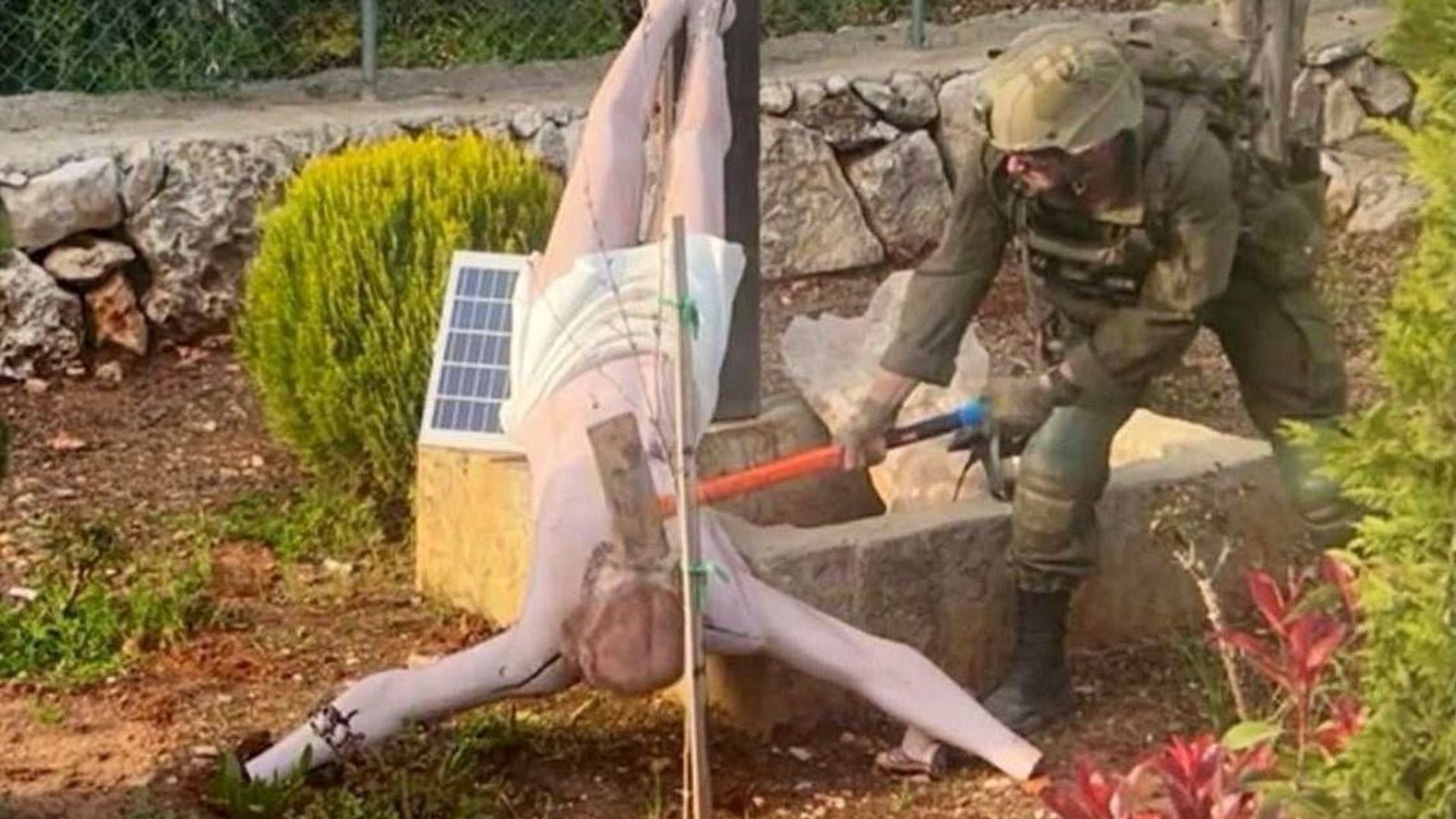
The image is unmistakable. A soldier in full Israeli Defense Forces gear, wielding a sledgehammer against a fallen statue of Jesus Christ in the southern Lebanese village of Debl. This single, visceral photograph, verified as authentic by the Israeli military, has ignited a firestorm that reaches far beyond the immediate shock of religious vandalism. It has forced Benjamin Netanyahu into a reactive posture of public condemnation, stripping away the veneer of total institutional control during a highly volatile ceasefire.
This is not merely a story about a rogue act of destruction. It is an examination of what happens when military discipline fractures in the field, exposing the immense gap between high-level diplomatic narrative and the raw reality of occupation.
The Anatomy of a PR Crisis
When an image of this caliber goes viral, the traditional playbook for crisis management often fails. The Israeli military, rarely hesitant to leverage its communications apparatus, faced a challenge that could not be spun away. By confirming the photograph’s authenticity, they inadvertently signaled a loss of containment.
Prime Minister Netanyahu’s statement, which described him as "stunned and saddened," was calibrated to preserve Israel’s standing among international allies who are particularly sensitive to the treatment of Christian populations. He invoked the language of tolerance and equality, attempting to draw a firm line between the state’s stated values and the actions of a single soldier. Yet, the rapid emergence of such a clear act of defiance highlights a deeper concern: the degree to which individual soldiers operate independently of, or even in direct opposition to, the directives issued by their high command.
Occupation and the Loss of Restraint
Southern Lebanon has historically served as a pressure cooker, defined by the proximity of villages like Debl to the Israeli border. The presence of Israeli troops in these areas, particularly during an active conflict, creates a environment where the standard rules of engagement are tested against the realities of fear, exhaustion, and ideological fervor.
When soldiers are deployed into civilian territories—particularly those with distinct religious or cultural markers—the risk of institutional failure rises exponentially. This is not the first instance where soldiers have been caught in behavior that contradicts official policy. However, the use of a tool of destruction against a religious icon carries a unique weight. It transforms a tactical operation into a symbolic assault.
The investigation promised by the Northern Command is now the primary mechanism through which the military hopes to restore its reputation. However, history suggests that internal inquiries often struggle to satisfy external observers who see the event as symptomatic of a broader culture rather than a singular deviation.
The Strategic Fallout
The incident arrives at a precarious moment. A tenuous ceasefire currently holds in Lebanon, following an intense period of fighting between Israel and Hezbollah. For mediators, the stability of this arrangement is the objective. Any occurrence that inflames public sentiment, particularly one involving the perceived desecration of a sacred Christian symbol, complicates the delicate process of stabilization.
The backlash from religious leaders and international observers puts Israel on the defensive. It forces diplomats to spend time explaining the actions of an individual rather than advancing their broader security agenda. This is a classic distraction that shifts the focus from military objectives to moral and ethical scrutiny.
The Disconnect at the Front
Observers familiar with the mechanics of the IDF have long noted the tension between centralized command and the autonomy granted to local units. In the heat of an operation, that autonomy is often necessary for tactical success. Yet, it creates a vacuum where personal prejudices can override established doctrine.
The soldier in Debl acted with a level of visibility that implies either a profound lack of oversight or a belief that such actions would not carry significant personal cost. Whether this is an isolated incident born of individual malice or a reflection of desensitization within the ranks is the question that currently dominates the discussion.
Addressing the aftermath requires more than just condemnation. It demands an acknowledgment that the chain of command, as currently structured, failed to prevent a highly provocative act during a period where restraint was explicitly required. Punishment of the individual involved is the expected next move. But the institutional damage, already visible in the international reaction, will take significantly longer to repair.
The villagers in Debl, for their part, have captured the sentiment succinctly, citing the biblical plea for forgiveness. For the Israeli leadership, the challenge remains clear: maintaining control over a military force that, when left to its own devices, can instantaneously undo months of diplomatic effort with a single, irreversible action. The struggle for authority is not just at the border; it is within the ranks.