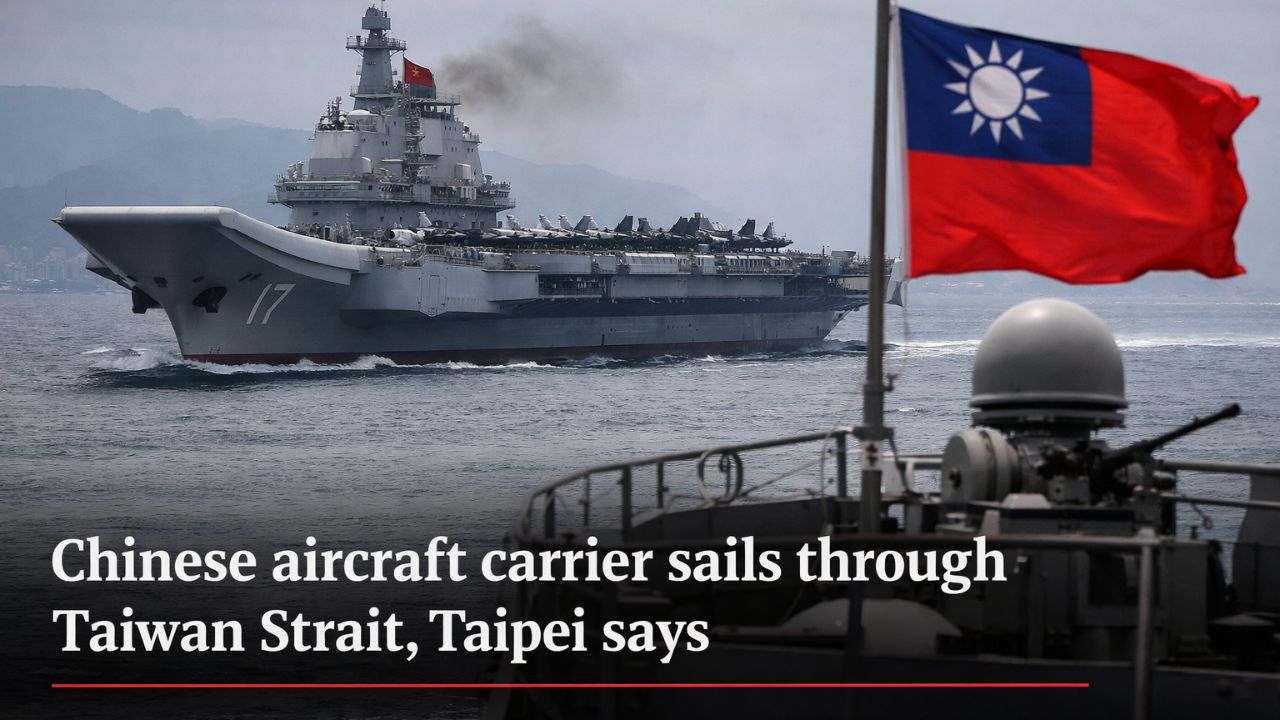
Every time a Chinese aircraft carrier decides to take a leisurely Sunday cruise through the Taiwan Strait, the media enters a state of collective hysteria. Pundits scream about escalation. Analysts draw red lines that do not exist. Investors panic-sell stocks. Everyone is looking at the horizon, waiting for a smoke plume or a missile launch that never comes.
It is time to puncture this theater of the absurd. You might also find this connected coverage useful: Why the Recent US Ship Seizure in the Gulf of Oman Actually Matters.
I have spent decades watching navies bloated by legacy thinking and politicians desperate for a boogeyman. I have sat in the briefing rooms where these maneuvers are actually planned. Let me let you in on a secret: the aircraft carrier transit is not a military signal. It is a marketing campaign. And if you are buying into the panic, you are the mark.
The Myth Of The Tactical Threat
The lazy consensus among mainstream talking heads is that sending a carrier through the Strait is a show of force, a tactical move to intimidate Taipei or a warning to the United States. This is fundamentally wrong. As extensively documented in recent articles by NPR, the implications are widespread.
Tactically, sailing a carrier group through the Taiwan Strait is an act of extreme vulnerability, not aggression. It is a massive, high-value, slow-moving target in a confined, shallow waterway where anti-ship missile batteries are practically begging for a fire solution. If Beijing actually wanted to threaten Taiwan, they would not put their crown jewels in a shooting gallery.
The transit is not a tactical deployment. It is a logistics exercise wrapped in a public relations stunt. It is designed to accomplish two things: generate headlines in the West to gauge reaction times, and convince the domestic populace in China that their military is, in fact, "projecting power." It is performative art.
The military reality is that carriers are becoming white elephants. The age of the massive, floating airfield, defensible only by a protective bubble of destroyers and frigates, ended the moment hypersonic cruise missiles became mass-producible. The Chinese People's Liberation Army Navy knows this better than anyone. They are building them because they have the budget and the vanity, not because they are the most effective tool for a cross-strait conflict.
Why The Media Loves The Panic
Why does the media keep selling you this "escalation" narrative? Because fear keeps eyes on screens. It is the easiest story to write. You do not need to understand naval doctrine, hydrography, or procurement budgets to report that "a big boat went through a narrow strip of water."
The "China Watcher" industrial complex has built an entire ecosystem around the idea of an inevitable, kinetic conflict. When nothing actually happens, they have to frame every mundane patrol as a step toward Armageddon. It justifies their existence. It validates the massive, unnecessary defense spending that keeps their favorite think tanks afloat.
Imagine a scenario where a corporate CEO takes a private jet from New York to Washington. Do you interpret that flight as an act of war against Philadelphia? Of course not. But when a Chinese ship sails through an international waterway, the media treats it like the first wave of a D-Day invasion. The cognitive dissonance is staggering.
The Real War Is Not On The Waves
If you want to know what actually matters, stop looking at the aircraft carriers. Stop checking the satellite imagery of naval shipyards. You are watching a 1940s movie in a 2026 world.
The real conflict is happening in the digital and economic sectors. It is about control of the semiconductor supply chain. It is about who owns the subsea data cables. It is about influence operations in the information sphere. While you are worrying about a carrier turning a corner, Chinese cyber-units are mapping the critical infrastructure of every city in the Pacific. That is the actual fight.
They do not need to invade an island if they can turn off its lights, crash its banking systems, and manipulate the public discourse to the point of social collapse. Carriers are for show. Code is for the kill.
The Flawed Premise Of The "Red Line"
People ask: "Should the West respond with a show of force every time this happens?"
This is the wrong question. It assumes the goal is to play a game of chicken where the biggest boat wins. If the US Navy responds by sending a destroyer, the Chinese media frames it as a "hostile encroachment." If the US Navy stays silent, the pundits scream about "weakness." It is a lose-lose scenario designed by the adversary to keep the US military chasing its tail in endless, costly patrols.
The smart move is to ignore the bait.
Do not play their game of visual theater. Treat these transits with the absolute indifference they deserve. A ship passing through the Strait should be treated like a bus driving down a street—a regular, boring, unremarkable event. When you stop reacting, you strip them of the only value the maneuver possesses: the psychological impact.
The Strategy Of The Silent Professional
I have seen companies blow millions on "threat analysis" that basically amounts to reading the same press releases you see on your phone. They waste talent and resources on defensive measures against ghosts.
Here is the truth:
- Carriers are targets: Stop viewing them as symbols of dominance. View them as expensive, vulnerable liabilities.
- Visuals lie: A photo of a ship is not a plan of attack. Military intent is found in logistical movements, fuel stockpiles, and hospital ship deployments—not in a photo-op through a strait.
- Ignore the signal: When a competitor or a rival nation does something performative, do not mirror it. That is exactly what they want. They want to draw you into their chaotic tempo. Maintain your own pace.
- Prioritize the unseen: If you are running security for a firm or assessing geopolitical risk, look at the fiber optics, the power grids, and the trade agreements. That is where the actual leverage exists.
The Cost Of Amateurism
The obsession with these naval maneuvers is a symptom of intellectual laziness. It is easier to talk about ships than it is to analyze the complex, boring, and messy reality of global supply chains.
The danger is that by hyper-focusing on the superficial, we miss the systemic rot. We are pouring billions into legacy platforms like carriers while our cyber-defenses are Swiss cheese. We are training our commanders for the Battle of Midway while our enemies are training for the Battle of the Grid.
Stop waiting for a fleet on the horizon. The adversary is already inside the network. They are not coming for the coastline; they are coming for the economy.
A Hard Lesson In Reality
Every time a headline screams about a carrier, ask yourself who benefits from you being afraid. The defense contractors benefit. The cable news producers benefit. The bureaucrats looking for a bigger budget benefit.
You? You just get a spike in anxiety and a distorted view of the world.
The Taiwan Strait will remain a flashpoint as long as we allow the flash to blind us. We need to stop equating presence with power. A ship in the water is just steel, fuel, and people. It does not dictate history. Policy dictates history. And right now, the policy of reacting to every naval stunt is a sucker’s bet.
Stop watching the horizon. Start looking at the data. The war is already being fought, and you are staring at the wrong end of the telescope.


