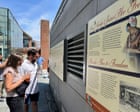
In the early hours of July 15, 2026, workers under federal direction quietly dismantled parts of one of the most significant public history installations in the United States. By morning, visitors to the President’s House site in Philadelphia—where George Washington lived while leading a young republic—found a thoroughly transformed exhibit.
This overnight swap represents the culmination of a fierce administrative and legal struggle over who controls the narrative of America’s founding. Acting under the authority of a 2025 executive order titled "Restoring Truth and Sanity to American History," the National Park Service removed a series of stark, uncompromising educational panels that detailed the lives of the nine enslaved people Washington held at the property in the 1790s.
The original installation, erected in 2010 after years of community activism and historical research, was designed to confront a central contradiction. It stood as a literal and figurative threshold on Independence Mall: a memorial to those held in bondage, positioned just steps from where the Declaration of Independence was signed. Critics argue that the new panels sanitize the past to protect historical figures from modern scrutiny. Meanwhile, federal officials maintain that the updated displays offer necessary context, shifting the focus back to the structural triumphs of the early presidency and the evolving legislative landscape of the era.
To understand how a patch of exposed brick foundation in Philadelphia became the frontline of a national culture war, one must look beyond the immediate political rhetoric and examine the legal mechanisms, the ideological shift, and the bureaucratic battle lines that made this overhaul possible.
The Legal Lever That Erased the Panels
The removal of the original exhibit was not a sudden impulse, but the execution of a highly coordinated legal strategy. In March 2025, President Trump signed an executive order directing federal agencies to review and strip out public-facing historical materials deemed to "inappropriately disparage" historical figures or promote "corrosive" ideological frameworks.
EXHIBIT CHANGES AT THE PRESIDENT'S HOUSE SITE
+-----------------------------------+-----------------------------------+
| Original Panels (Installed 2010)   | Replacement Panels (July 2026)    |
+-----------------------------------+-----------------------------------+
| Focus: Enslaved individuals,      | Focus: Legislative history, early |
| domestic life, systemic violence. | presidency, Washington's legacy.  |
+-----------------------------------+-----------------------------------+
| Headline: "The Dirty Business of | Headline: "Celebrating            |
| Slavery"                          | Independence Throughout the Years"|
+-----------------------------------+-----------------------------------+
| Key Feature: Comprehensive maps   | Key Feature: Focus on laws that   |
| of the transatlantic slave trade. | both limited and upheld slavery.  |
+-----------------------------------+-----------------------------------+
The city of Philadelphia immediately sued to halt the changes, pointing to a 2006 cooperative agreement in which the National Park Service had committed to presenting a thorough, community-guided representation of the enslaved people at the site. Local advocates argued that the federal government could not unilaterally alter an installation funded in part by local municipal dollars.
A lower court initially agreed, pausing the removal in February 2026. However, the federal government appealed, asserting that executive control over federal property and the National Park Service's educational mandate supersedes local municipal agreements. On July 3, 2026, a three-judge panel of the U.S. Court of Appeals for the Third Circuit ruled in favor of the administration, clearing the way for the physical removal of the old panels.
The ruling established a powerful precedent. It signaled that when local history clashes with a sitting administration’s federal directives, the federal government's authority over its own landmarks is nearly absolute.
Softening the Blow or Whitewashing the Past?
Supporters of the overhaul argue that the original exhibit, while well-intentioned, leaned too heavily into a singular narrative of national shame. The Department of the Interior defended the updated installation, noting that it still references the nine enslaved people and acknowledges the "evils of slavery".
Yet, the changes in tone are unmistakable. Gone is a prominent panel titled "The Dirty Business of Slavery," which laid bare the economic dependency of the early republic on forced human labor. In its place is a display titled "Celebrating Independence Throughout the Years".
- The omission of structural detail: Maps illustrating the global scale of the transatlantic slave trade and detailed timelines of slavery's legal expansion were entirely removed.
- The introduction of mitigating context: The new text emphasizes Washington’s private letters expressing discomfort with the institution of slavery, as well as his signing of the Northwest Ordinance of 1789, which restricted slavery's expansion into new territories.
- The minimization of conflict: The language describing the legal maneuvers Washington used to circumvent Pennsylvania’s Gradual Abolition Act—such as rotating enslaved workers out of the state every six months to prevent them from claiming their freedom—has been substantially toned down.
Historians and local activists view these subtle edits as a profound sanitization. By focusing on Washington's internal conflicts and the legislative milestones of the early presidency, the exhibit shifts from a stark memorial to those who suffered into a traditional narrative of institutional progress.
The Broader Campaign for the American Narrative
The conflict at the President’s House is not an isolated incident. It is a highly visible skirmish in a much larger, systemic campaign to reshape the public memory of the United States. Across the country, federal sites, national parks, and federally funded museums are quietly audit-proofing their exhibits.
At Lowell National Historical Park in Massachusetts, educational films detailing the harsh realities faced by 19th-century immigrant mill workers have faced administrative scrutiny. At Harpers Ferry, exhibits focusing on the violent divisions of the pre-Civil War era have been targeted for revision.
The administration’s strategy relies on a simple, powerful premise: public history should inspire national unity and civic pride rather than highlight historical grievances or deep-seated systemic injustices. To critics, this approach mirrors the very authoritarian tendencies the founders of the nation fought against. To supporters, it represents a long-overdue correction against a decades-long academic shift toward self-flagellation and divisive historical framing.
What remains clear is that public spaces are no longer neutral ground for historical consensus. They are highly contested political battlefields where the past is constantly weaponized to serve the ideological needs of the present.