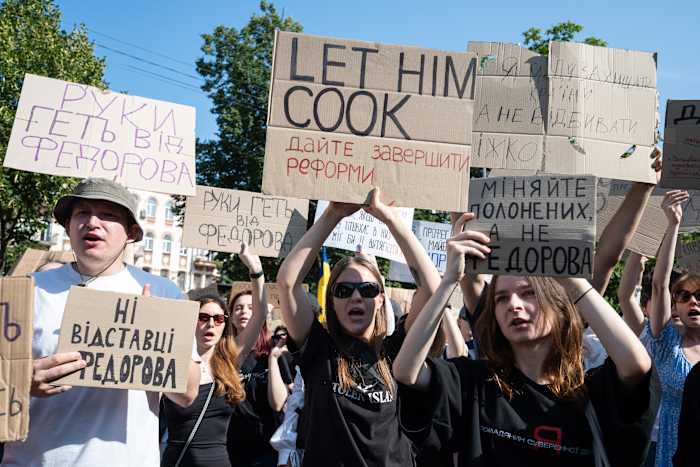
The consolidation of executive authority during existential conflict inevitably collides with the decentralized innovation networks that sustain modern defense. This structural tension crystallized in Kyiv’s Franko Square on July 16, 2026, when hundreds of Ukrainian citizens, military personnel, and technology advocates gathered in "cardboard protests" to contest the removal of Defense Minister Mykhailo Fedorov. The demonstration, occurring as the Verkhovna Rada prepared to vote on a broader cabinet reshuffle following the resignation of Prime Minister Yulia Svyrydenko, exposes a deeper strategic friction: the clash between legacy military hierarchies and agile, software-defined wartime procurement models.
Fedorov, the tech-minded architect of Ukraine’s drone and digital mobilization programs, served as a bridge between frontline volunteer networks and official defense architecture. His abrupt replacement reveals a calculated attempt by the political executive to centralize procurement, consolidate institutional control, and placate the traditional defense establishment, even at the cost of public trust.
The Structural Mechanics of Fedorov’s Defense Model
To understand why the removal of a civilian minister triggered public outrage, the structural design of his operational model must be analyzed. Fedorov's tenure was built on three interdependent pillars that bypassed traditional, bureaucratic military procurement:
- Asymmetric Technological Integration: Rather than relying exclusively on slow, state-managed arms acquisition, Fedorov championed decentralized, open-source technological deployment. By funding and scaling private drone manufacturing and software platforms, the ministry cut iteration cycles for frontline capabilities from months to days.
- Decentralized Supply Networks: The reliance on grassroots civic groups and military-adjacent NGOs allowed for rapid, unbureaucratic import of key technical components, from commercial-off-the-shelf microcontrollers to thermal optics.
- Wartime Administrative Autonomy: By operating outside the rigid vertical command structures of the Armed Forces, the ministry maintained a dual-track procurement system. This structure allowed innovative units to pilot robotic platforms and software tools directly on the battlefield without waiting for general staff authorization.
The efficiency of this model came with a critical institutional trade-off: it created a parallel authority structure that bypassed the General Staff and traditional command channels, directly challenging the military establishment led by figures like Commander-in-Chief Oleksandr Syrskyi.
The Centralization Friction: Why the Government Moved to Oust Fedorov
The executive decision to replace Fedorov reflects a classic consolidation strategy. Governments in prolonged conflicts often seek to centralize procurement, supply chain logistics, and strategic command. This behavior is driven by clear operational incentives:
$$\text{Command Efficiency} = f(\text{Centralized Authority}, \text{Standardized Logistics})$$
In this framework, decentralized innovation is treated as a high-variance variable that, while yielding local tactical successes, introduces systemic coordination challenges. By attempting to replace Fedorov with a figure aligned with standard security verticals, such as Interior Minister Ihor Klymenko, the Presidential Office aimed to achieve several objectives:
Standardizing Procurement Under Unified Control
The existence of independent procurement networks, while rapid, complicates long-term defense budgeting and international aid coordination. Standardizing all acquisitions under a unified, bureaucratic defense model makes tracking resources easier for external auditors, notably Western allies. However, this standardization introduces severe administrative drag, slowing down the acquisition of rapidly evolving technologies.
Resolving Command Rivalries
The friction between Fedorov’s tech-forward reformers and the traditional general staff created coordination bottlenecks. The slogan on one protester's sign—"Mice don't fear the cheese," referencing the administrative rivalry between Syrskyi and Fedorov—highlights this structural impasse. From the executive's perspective, neutralizing this administrative friction by removing the unorthodox civilian minister is seen as a prerequisite for unified command.
Re-establishing Institutional Gatekeeping
A decentralized ecosystem empowers mid-level officers, tech startups, and independent units. This dilutes the state’s monopoly on defense policy. Centralizing control under a standard bureaucrat re-establishes the state as the sole gatekeeper of defense contracts and strategic direction.
Quantifying the Civil and Military Backlash
The public response to Fedorov’s ouster demonstrates that Ukraine’s defense capability has become deeply co-dependent on civil society. The protests in Kyiv, Lviv, and Kharkiv were not merely symbolic; they represented a defense mechanism from a network that feels its survival is threatened by state centralism.
                  ┌──────────────────────────────┐
                  │ Executive Decision to Centralize│
                  └──────────────┬───────────────┘
                                 │
                     [Removes Fedorov's Tech Model]
                                 │
                                 ▼
         ┌──────────────────────────────────────────────┐
         │       Systemic Bottlenecks Created           │
         └───────┬──────────────────────────────┬───────┘
                 │                              │
                 ▼                              ▼
  ┌──────────────────────────────┐┌──────────────────────────────┐
  │  Bureaucratic Procurement    ││    Loss of Civil Trust       │
  │  - Longer iteration cycles    ││    - Decreased donations     │
  │  - Harder component imports  ││    - Military resignations   │
  └──────────────────────────────┘└──────────────────────────────┘
The consequences of this executive shift began to manifest almost immediately across three distinct vectors:
- High-Level Military Resignations: The resignation of Pavlo Yelizarov, Deputy Commander of the Ukrainian Air Force, directly links Fedorov's structural reforms in air defense to survival rates against Russian airstrikes. His departure signals that key military innovators view the removal of civilian reformers as a direct threat to operational effectiveness.
- The Procurement Velocity Bottleneck: Protesters carrying signs like "I should be repairing a ground robotic platform right now, but instead I have to be here" illustrate the human capital displacement caused by political instability. The disruption of reform pipelines delays the deployment of autonomous systems, giving Russian forces time to adapt to existing Ukrainian electronic warfare and drone tactics.
- Legislative Gridlock: The political calculation behind the reshuffle encountered immediate obstacles in the Verkhovna Rada, which initially lacked the necessary consensus to confirm the proposed replacement. This legislative resistance stalls executive operations, creating a power vacuum at the head of the country's most critical wartime ministry during an ongoing defense campaign.
The Strategic Path Forward
To resolve this institutional crisis, the Ukrainian state must reconcile the structural advantages of decentralization with the coordination requirements of central authority. Transitioning to a traditional, slow-moving bureaucratic model risks stalling the technological advantage that Ukraine relies on to counter Russia's industrial scale. Conversely, an entirely decentralized model lacks the administrative weight to manage multi-billion-dollar Western aid packages and long-term industrial production.
The optimal strategic path requires the formalization of a dual-track defense ecosystem. The Ministry of Defense must establish a legally protected, autonomous agency specifically dedicated to rapid technological procurement, insulated from the slow-moving regulations of the standard military bureaucracy. This agency must preserve direct channels of communication with civilian tech networks and volunteer organizations. If the executive continues to prioritize political compliance over operational agility, it risks decoupling the state's military apparatus from the very civic and technological energy that sustained its survival.