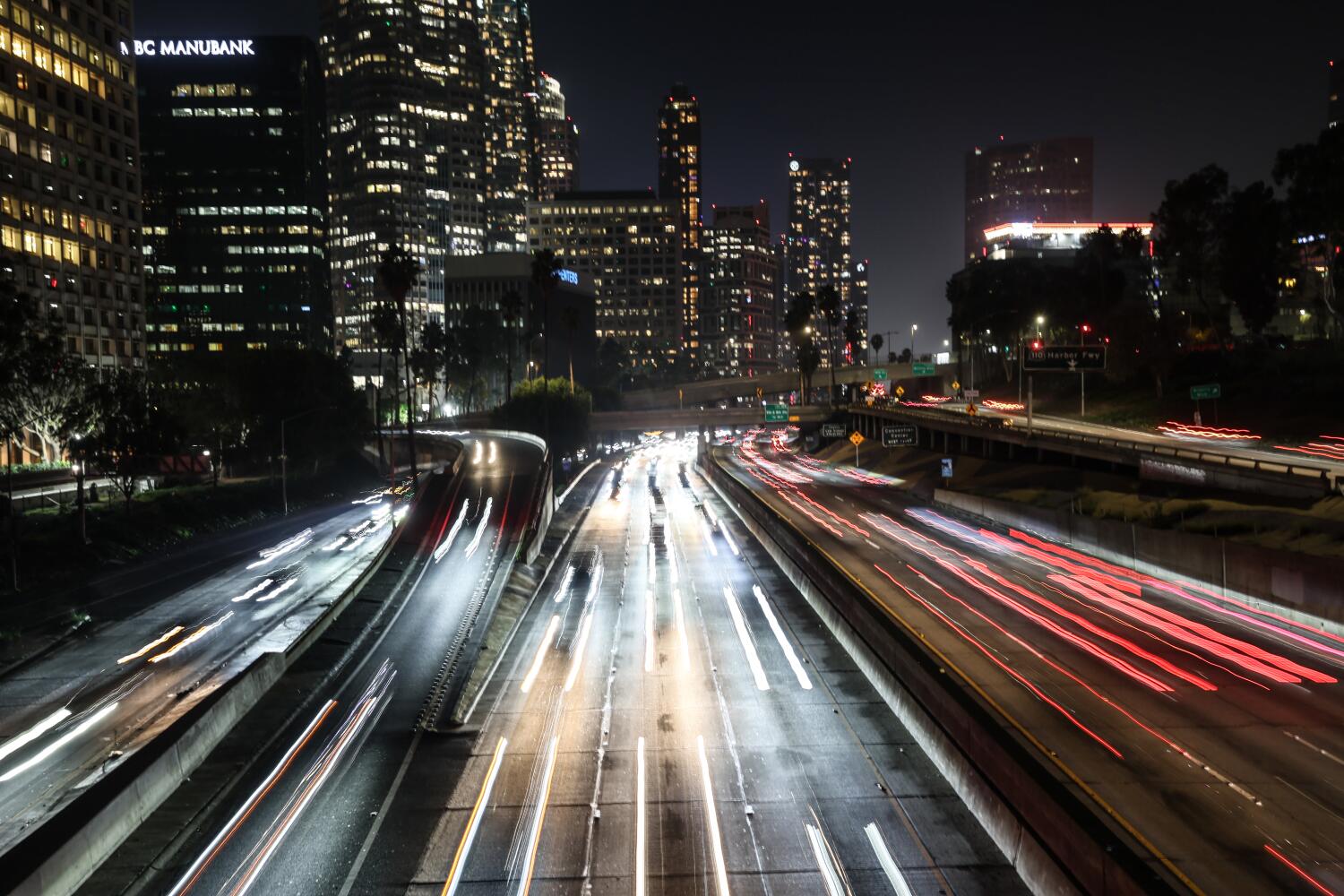
The morning air in the San Fernando Valley usually smells like asphalt and burnt espresso. It is the scent of a city in a hurry. You know the feeling. The light turns yellow at the intersection of Roscoe and Reseda, and for a split second, you make a calculation. It is a silent, subconscious gamble. You press the accelerator. The engine roans. You make it across just as the light turns a defiant shade of crimson, heart hammering against your ribs. You saved exactly forty-five seconds.
In that fleeting moment, you weren't thinking about physics. You weren't thinking about the 3,000-pound kinetic weapon you were piloting through a neighborhood where children walk to school. You were just late for a meeting. You might also find this related story useful: Strategic Asymmetry and the Kinetic Deconstruction of Iranian Integrated Air Defense.
But the city is changing the rules of that gamble. Los Angeles is installing 125 new automated speed enforcement cameras across its sprawling, sun-drenched grid. These are not the grainy, stuttering traffic cams of the nineties. These are silent, tireless sentinels equipped with LIDAR and high-resolution optics. They do not blink. They do not accept excuses about being late for a shift at the hospital or a daughter’s dance recital. They simply record the math.
The Anatomy of a Speed Trap
Consider a hypothetical driver named Elias. Elias is a good man. He pays his taxes and renovates his kitchen on weekends. He drives a silver sedan that he keeps meticulously clean. On a Tuesday afternoon, Elias is cruising down a stretch of Pacific Coast Highway where the speed limit suddenly drops. He is doing 51 in a 40. As reported in recent articles by USA Today, the implications are worth noting.
In the old world, Elias might have seen a patrol car, tapped his brakes, and felt a surge of adrenaline. Maybe he’d get pulled over; maybe he’d get a warning. In the new world, there is no patrol car. There is only a small, grey box mounted on a pole. It captures his license plate in a fraction of a second.
A few weeks later, Elias opens his mail to find a fine. If he was going 11 to 15 miles per hour over the limit, it’s $64. If he was pushing 16 to 25 over, the price jumps to $150. If he was truly flying—more than 25 miles per hour over the limit—the city demands $500.
The sting isn't just financial. It is the realization that the city has become a giant, algorithmic auditor. The Pilot Program, authorized by California Assembly Bill 645, allows Los Angeles, along with five other cities like Glendale and Long Beach, to test this automated discipline for five years. The goal is simple: slow down or pay up.
The Invisible Stakes of a Few Miles Per Hour
We often treat speed limits like suggestions, a baseline from which we negotiate based on our own perceived driving skill. We tell ourselves we are in control. But the math of a collision is indifferent to our confidence.
If a car hits a pedestrian at 20 miles per hour, the person has a 90% chance of surviving. They walk away with bruises, perhaps a broken bone, but they walk away. At 40 miles per hour—just twenty ticks higher—the survival rate flips. The pedestrian now has an 80% chance of dying.
The difference between a "close call" and a funeral is often the distance of a few heavy presses on the gas pedal. This is the "why" behind the cameras that the headlines often miss. Los Angeles has seen a terrifying spike in traffic fatalities, often surpassing the number of homicides in the city. The streets have become a war zone of convenience versus survival.
We talk about "traffic accidents," but the people who design these camera systems call them "preventable collisions." The word accident implies a lack of agency, a stroke of bad luck from the heavens. A camera, however, views a speeding car as a deliberate choice. It is a data point in a trend that the city is desperate to reverse.
The Ghost in the Machine
There is a visceral discomfort in being watched. We are a culture that prizes the open road as the last bastion of American freedom. The idea of a machine issuing a ticket feels cold, almost dystopian. It lacks the "human element" of a police interaction. There is no one to negotiate with, no one to explain that your mother is in the hospital or that you didn't see the sign behind the overgrown bougainvillea.
Critics argue these cameras are nothing more than "revenue generators," a high-tech way for a cash-strapped city to tax its residents. They point to the disproportionate impact these fines have on low-income drivers. For a wealthy commuter in a luxury SUV, a $64 fine is a nuisance, the price of a decent lunch. For a delivery driver working for tips, it is a catastrophic loss of a day’s wages.
The city has attempted to address this. The program includes "ability to pay" provisions, offering 80% discounts for those under the poverty line or the option to perform community service instead of paying the fine. But the burden of proof still rests on the driver. You have to navigate the bureaucracy to prove your struggle.
Then there is the privacy concern. Where does the data go? Who owns the image of your car? The law mandates that the data must be destroyed if no violation is found, and even if a ticket is issued, the information can't be used for other surveillance purposes. Yet, in an era of constant data breaches and creeping surveillance, that promise feels thin to many. We are inviting 125 more eyes into our daily commute, and they never look away.
The First Sixty Days
If you are worried about your mailbox filling up with tickets tomorrow morning, take a breath. The city isn't interested in a sudden ambush. For the first 60 days after a camera is installed, it won't issue actual fines. Instead, it will send out "warning notices."
Think of it as a grace period for our habits. It is a two-month window to retrain our brains to look at the speedometer instead of the GPS clock. Signs will be posted hundreds of feet before the camera locations, giving drivers ample warning to slow down. The city claims it doesn't want your money; it wants your compliance.
But after those sixty days? The warnings stop. The invoices begin.
The cameras are being placed strategically. They aren't just hidden on random corners. They are being deployed in "High Injury Networks"—the 6% of city streets that account for more than half of all traffic deaths and severe injuries. They are being placed near schools and in "Environmental Justice" communities where the toll of traffic violence has historically been the heaviest.
The Psychology of the Brake Pedal
Why do we speed? It is rarely about a love of velocity. It is usually about a perceived lack of time. We live in a city designed for cars, yet the cars have become our cages. We are stressed, we are tired, and we are trying to claw back minutes from a day that feels too short.
The camera system is designed to break that psychological loop. It introduces a new variable into our mental calculation. If the risk of a ticket is a certainty—not a possibility—the behavior changes. Studies in cities like New York and London have shown that speed cameras can reduce fatal and serious crashes by as much as 30% to 50%.
Imagine a street in South LA where residents have been begging for a stop sign for years. Drag racing happens at 2:00 AM. Commuters blow through the crosswalks at 8:00 AM. For those families, the camera isn't a "Big Brother" intrusion. It is a mechanical bodyguard. It is the only thing that might finally force the flow of steel to respect the people living on the sidewalk.
The Human Cost of a Ticketless World
I once spoke to a woman named Maria whose son was killed by a driver doing 45 in a 25. The driver wasn't drunk. He wasn't high. He was just "moving with traffic." He didn't see the boy until it was too late.
Maria doesn't talk about "revenue generation" or "privacy concerns." She talks about the silence in her house. She talks about the shoes in the hallway that will never be worn. When she hears about the 125 cameras, she doesn't see a grey box on a pole. She sees a chance for another mother to avoid her reality.
This is the tension at the heart of the L.A. speed camera program. On one side is the inconvenience of the individual—the fine, the surveillance, the loss of that "freedom" to push the needle slightly above the limit. On the other is the collective safety of the city.
The New Architecture of the Road
The L.A. streets are no longer just strips of concrete. They are evolving into digital ecosystems. Our movements are being measured, mapped, and audited. The cameras are the first sign of a future where we don't just "drive"—we participate in a system of managed mobility.
It will take some time to adjust. People will get angry. They will call for the cameras to be taken down, or they will spray paint the lenses. The city will defend the revenue, and the residents will defend their autonomy.
But as the sun sets over the Hollywood Hills, the first few cameras are already being calibrated. They are silent, expectant, and perfectly patient. They don't care if you had a bad day at the office. They don't care if the radio was too loud. They only care about the distance you travel in a second.
Next time you are at that intersection—the one where the light is about to turn—consider the choice. Is forty-five seconds worth the risk of a letter in your mailbox, or worse, the chance of a life-shattering impact? The eyes of Los Angeles are watching, and they are waiting to see what you decide.
Would you like me to create an image showing a map of the high-injury street networks in Los Angeles where these cameras are most likely to be deployed?