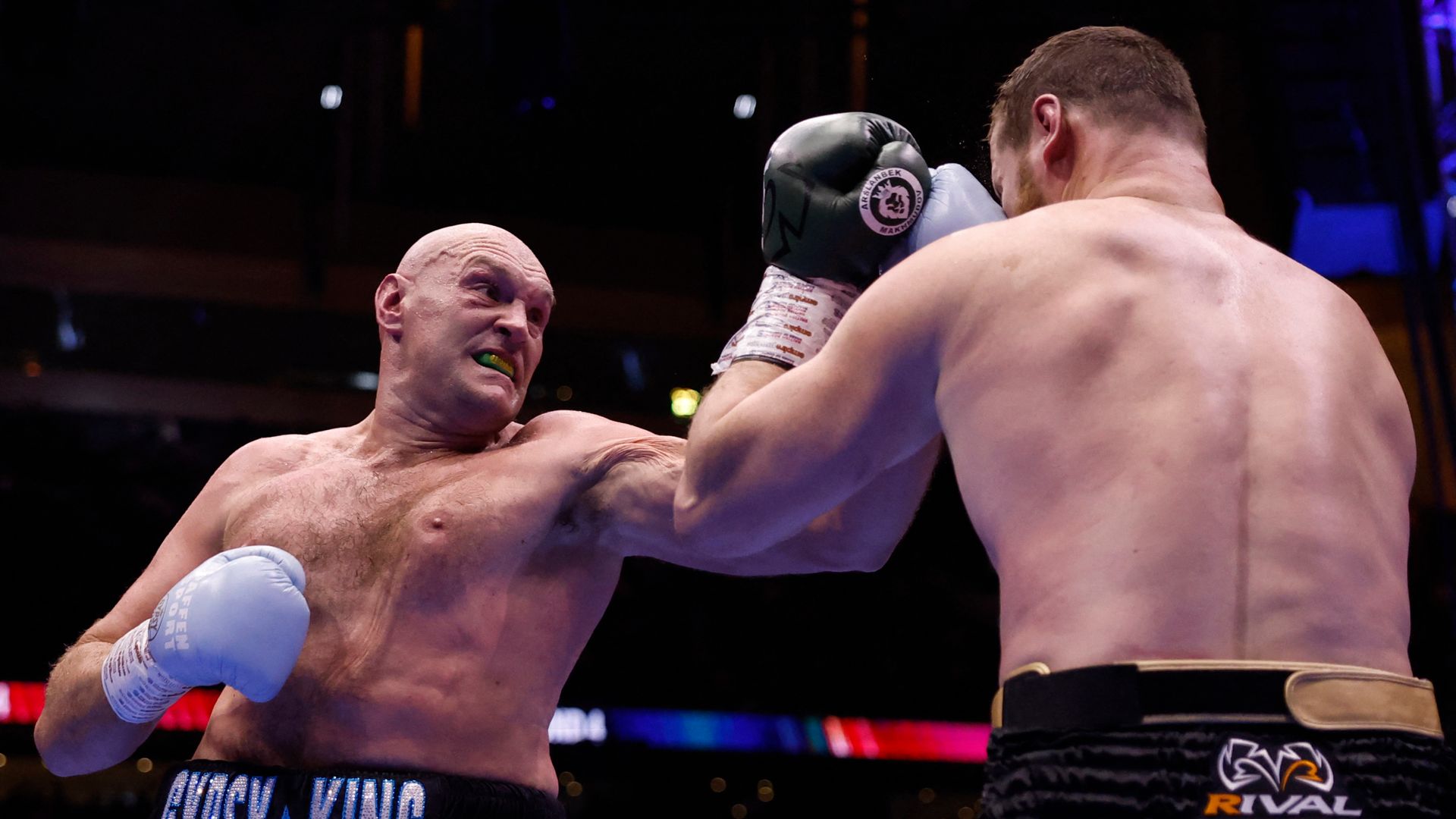
Tyson Fury didn’t just beat Arslanbek Makhmudov. He executed a heist.
The mainstream sports media is currently tripping over itself to herald the "return of the King," painting a picture of a revitalized giant who just dismantled a terrifying boogeyman. They want you to believe that a fight with Anthony Joshua is now the inevitable, glorious climax of a golden era. They are wrong. They are being sold a narrative by a man who understands the theater of the ring better than the physics of a punch.
If you watched that fight and saw a masterclass, you weren't looking at the feet. You weren't looking at the clinches. You were looking at the smoke and mirrors.
The Myth of the Makhmudov Boogeyman
The prevailing logic heading into this bout was that Makhmudov was the ultimate "litmus test." He was the Russian powerhouse with hands like sledgehammers, the man no one wanted to face. By beating him, the narrative goes, Fury proved he still has the reflexes to nullify raw power.
Let's dismantle that. Makhmudov is a primitive fighter. He is a linear, heavy-footed brawler whose entire career was built on flattening B-tier opponents who stood still for him. In boxing circles, we call this "selective matchmaking." His "invincibility" was a product of optics, not technical superiority.
Fury didn't beat a titan. He exploited a statue.
By choosing Makhmudov, Fury’s team picked a style that perfectly masks Fury’s own declining lateral movement. You don't need to be the "Gypsy King" of 2015 to beat a man who moves in straight lines. You just need to lean, tie up, and use the referee as a shield. Fury spent thirty percent of that fight leaning his 270-pound frame on a man whose gas tank was already suspect. That’s not "sweet science." That’s a veteran using weight-room tactics to survive a lack of conditioning.
The Joshua Mega-Fight is a Financial Mirage
The headlines are screaming about the Anthony Joshua "mega-fight." The logic is simple: Two British giants, one undisputed throne, the biggest purse in history.
But here is the truth the promoters won't tell you: Neither man actually wants this fight for the reasons you think.
For Fury, Joshua is the ultimate "cash-out" opponent. Fury knows his legs are gone. He knows the twitch fibers that allowed him to dance around Wladimir Klitschko have been replaced by survival instincts and veteran craftiness. He wants Joshua now because Joshua is equally flawed, equally vulnerable, and brings the biggest check.
The "nuance" the media misses is that this isn't a peak-versus-peak clash. It’s a collision of two declining brands trying to extract maximum value before the inevitable slide into obscurity. If Fury were truly the "lineal champion" he claims to be, he’d be hunting the young, hungry sharks who offer zero crossover appeal but 100% technical danger. Instead, he’s hunting the billboard.
Stop Asking if Fury is Back
People also ask: "Is Tyson Fury the greatest heavyweight of his generation?"
It’s the wrong question. The real question is: "Has Tyson Fury ever beaten a great heavyweight in their prime?"
Look at the resume. He beat an aging, gun-shy Klitschko in a fight where almost no punches were thrown. He beat Deontay Wilder—a man with a legendary right hand and the technical footwork of a novice. Now he’s beaten Makhmudov.
Fury’s brilliance isn't his boxing; it’s his ability to dictate the terms of his own legend. He picks opponents who look dangerous to the casual fan but are stylistically bankrupt against a giant who knows how to grapple. He wins the press conference, he wins the psychological war, and then he wins a messy, ugly decision or a late stoppage against a tired man.
I’ve seen this play out in dozens of gyms. A veteran who can't go ten rounds at a high pace will spend the first four rounds "feeling out" (read: resting) and the middle rounds "controlling the pace" (read: holding). We celebrate it as "ring generalship." In reality, it’s a physical necessity because the engine can’t redline anymore.
The Problem with the Heavyweight Ecosystem
The sport is currently obsessed with "0s." The undefeated record has become a cage that prevents the best fights from happening. Fury’s "undefeated" status is a marketing tool, not a reflection of dominance.
By beating Makhmudov, Fury essentially reset the clock on his own relevance without actually proving he can still handle a high-volume puncher with a jab. If you want to see Fury in trouble, don't put him in with a power puncher. Put him in with a 230-pound technician who won't let him clinch. But those fights don't sell PPVs in the UK, so they don't happen.
We are living in an era of "Event Boxing," where the spectacle outweighs the sport. The Makhmudov fight was a high-level sparring session dressed up as a world-title eliminator.
The High Cost of the "Gypsy King" Method
There is a downside to my cynicism. The "contrarian" view recognizes that what Fury does is actually incredibly difficult. Leaning on a 260-pound man for twelve rounds is exhausting. Navigating the politics of four different sanctioning bodies while maintaining a public persona of a "man of the people" is a full-time job.
But don't mistake difficulty for greatness.
Fury is a master of the "Ugly Win." He has figured out that the judges will reward activity, even if that activity is just slapping and grabbing, as long as you look like you’re in control. Makhmudov looked frustrated because he was playing a game of boxing while Fury was playing a game of human chess-wrestling.
The Joshua Fight Won't Be What You Expect
When the Joshua fight finally happens—and it will, because the money is too loud to ignore—don't expect a "Fight of the Century."
Expect a repeat of the Makhmudov fight, but with higher stakes.
- Fury will use the clinch early and often. He knows Joshua has a "stiff" upper body and tires when forced to work on the inside.
- The jab will be a distraction. Fury doesn't throw the jab to damage anymore; he throws it to blind the opponent so he can close the distance and lean.
- The psychological warfare will be the deciding factor. Joshua is a man of scripts; Fury is a man of chaos.
The media will call it a "tactical battle." I’m telling you now: it will be an ugly, foul-filled clinch-fest designed to protect two aging assets.
The Brutal Reality of the Makhmudov "Masterclass"
If you want to understand the state of heavyweight boxing, look at the punch stats from the Makhmudov fight. Look at the "clinch-per-round" ratio. Fury landed enough to win, but he never truly hurt a man who was supposed to be a sitting duck.
He didn't want to.
Why risk a counter-punch when you can win on the cards by being "clever"? Fury has transitioned from a fighter into a businessman who happens to wear gloves. He is protecting the brand. Makhmudov was a safe deposit box—high perceived value, low actual risk.
The industry wants you to buy the hype because the industry needs a superstar. They need the 6'9" giant with the gift of gab to be the savior of the sport. But the savior is a ghost. He is a man who hasn't been in a truly competitive, back-and-forth fight with a peer since the third Wilder bout, and even then, he was fighting a man with one weapon.
Tyson Fury is the best in the world at making you believe he’s the best in the world. That is his true genius. He just beat a guy who didn’t belong in the same zip code as him, and he’s got half the world convinced he’s ready to conquer the universe.
He isn't returning to greatness. He’s managing his exit.
Watch the Joshua fight if you want the party. If you want boxing, look elsewhere.
The King isn't back; he just never left the throne room, and he’s making sure the doors stay locked until he can leave with the crown and the gold.

.png?format=1500w)