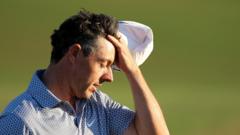
Rory McIlroy did not just win the 2025 Masters; he survived it. For over a decade, the Northern Irishman carried the weight of the career grand slam like a leaden rucksack, and when he finally slipped into the Green Jacket last April, it wasn't with a clinical Sunday stroll. It was a chaotic, heart-pounding playoff victory over Justin Rose that featured a double-bogey on the first hole and a ball dunked into Rae’s Creek. This was the definitive Rory experience: brilliance marred by baffling errors, rescued only by a stubborn refusal to break.
Now, as the 2026 Masters approaches, the narrative has shifted from the pursuit of history to the burden of defending it. To understand why McIlroy is the most polarizing figure in golf, one must look past the highlight reels and examine the mechanical and psychological scarring that makes his relationship with Augusta National so volatile. He is a golfer who lives on the edge of a catastrophe he creates for himself, yet possesses a ceiling so high that he can surrender six shots in a single round and still come out on top.
The Architecture of a Meltdown
Augusta National is a course that punishes the hesitant, but for McIlroy, the danger has always been his aggression. In 2025, his third round was a microcosm of his entire career at the Masters. He started with a massive lead, only to cough it up with a 73 that included a double-bogey and three bogeys. This isn't a lack of talent; it is a recurring technical glitch under extreme duress.
Analysis of his "rollercoaster" rounds reveals a specific pattern. When the pressure mounting from the leaderboard matches the internal pressure of his own expectations, McIlroy’s iron play—usually a strength—becomes erratic. In the 2025 final round, he was poised to win in regulation until he flared a wedge into a bunker on the 18th. These are "unforced errors" in tennis parlance. Most top-tier pros miss on the safe side of the flag. McIlroy tends to miss in the one spot that guarantees a dropped shot.
The statistics from his 2024 and 2025 campaigns tell a story of a man fighting his own DNA. While he leads the PGA Tour in Strokes Gained: Off-the-Tee, his performance on the greens at Augusta has historically fluctuated wildly. In his 2025 victory, he averaged a remarkable 0.593 Strokes Gained: Putting, a figure that sat well above his career average. He didn't win because he drove the ball better than everyone else—he always does that. He won because, for four days, his putter masked the inevitable "McIlroy Mistakes."
The Psychological Scars of 2011
You cannot discuss McIlroy at the Masters without invoking the ghost of 2011. That back-nine collapse, where a four-shot lead evaporated into an 80, didn't just cost him a trophy; it rewrote his mental hard drive. For years, every time he stepped onto the 10th tee, the world watched for the twitch.
Last year’s breakthrough was supposed to be the exorcism. "I'm proud of how I kept coming back and dusting myself off," McIlroy said after receiving his jacket. But the 2026 season has shown that the "eternal optimist" is still vulnerable to the same old demons. A back injury slowed his progress at the start of this year, and his performance at the Players Championship—where he was the defending champion—was a sobering reminder of how quickly his game can deconstruct. He struggled with putting and iron play, the two pillars he needs most to navigate the treacherous slopes of Augusta.
The Caddie Factor
One of the most overlooked elements of McIlroy’s victory was the intervention of his caddie, Harry Diamond. During the 2025 playoff, after McIlroy had just blown a lead in regulation, Diamond provided a grounding moment. He reminded a reeling McIlroy that he would have "taken this position at the start of the week."
This matters because McIlroy is a feel player in an era of spreadsheets. When he loses the "feel," he spirals. Diamond’s role isn't just about yardages; it’s about managing the emotional volatility of a man who plays golf like a poet rather than a physicist. Critics have often called for McIlroy to hire a "veteran" caddie, but the 2025 win proved that Diamond’s quiet presence is the only thing keeping the rollercoaster on the tracks.
The Reality of the 2026 Title Defense
Defending a Masters title is a feat rarely achieved. Only Jack Nicklaus, Nick Faldo, and Tiger Woods have done it. McIlroy enters this week with a target on his back and a game that looks suspiciously fragile. His recent results—a T15 at the Arnold Palmer and a T17 at the Genesis—suggest a player who is still searching for the "auto-pilot" mode that Scottie Scheffler seems to access so easily.
The brutal truth is that Rory McIlroy will never be a consistent champion in the mold of Tiger Woods. He lacks the clinical, joyless efficiency required to dominate without drama. Instead, he is a high-variance asset. He will likely continue to produce rounds that look like a car crash, only to follow them with a stretch of five birdies in six holes that leaves the field breathless.
Augusta National rewards this kind of audacity, but it also waits for the inevitable slip. Whether McIlroy can become the fourth man to defend the jacket depends entirely on whether his putter can once again bail out his erratic decision-making.
Watch the 13th hole on Sunday. If he’s leading, he will go for the green in two. He can't help himself. It is the very trait that makes him a Grand Slam winner and the same one that makes his fans watch through their fingers. He doesn't just play the Masters; he survives a four-day war with his own ambition. Any analysis that suggests he has finally "figured out" the course is ignoring a decade of evidence. Rory hasn't mastered the rollercoaster; he's just learned how to stay in the seat when it goes upside down.
Go to the practice green and watch his routine. He isn't looking for a new swing. He is looking for the version of himself that doesn't blink when the world is waiting for him to fail. If he finds it, the rest of the field is playing for second place. If he doesn't, we are in for another vintage McIlroy collapse, documented in high definition for a public that loves the tragedy as much as the triumph.


.png?format=1500w)