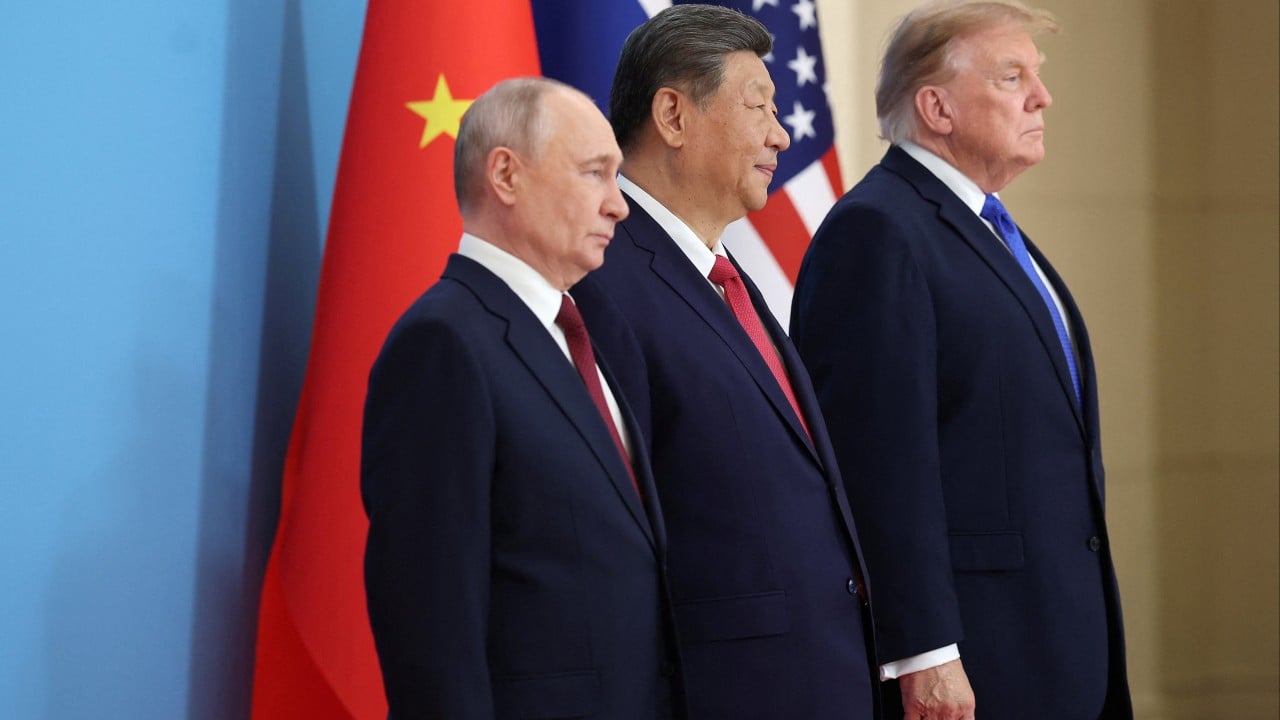
Diplomacy between nuclear superpowers operates on asymmetric bargaining leverage rather than shared sentiment. When Chinese President Xi Jinping invokes the World War II Allied coalition during trilateral discussions with U.S. President Donald Trump and Russian President Vladimir Putin, while Trump simultaneously introduces bilateral or trilateral nuclear arms reductions, both leaders are executing distinct strategic maneuvers. The underlying architecture of these three-way talks is defined by a fundamental mismatch in strategic objectives: Beijing seeks ideological legitimacy and multipolar parity through historical revisionism, Washington aims to cap emerging nuclear breakout capabilities while reducing defense expenditure, and Moscow attempts to break diplomatic isolation by positioning itself as the indispensable swing power in global security architecture.
Understanding the mechanics of these negotiations requires separating diplomatic signaling from verifiable military reality. Surface-level coverage treats historical references and disarmament proposals as conversational exchanges. In practice, they represent competing attempts to define the baseline unit of account for twenty-first-century strategic stability.
The Strategic Function of Historical Framing
In high-stakes statecraft, historical analogies serve as normative anchors. By invoking the World War II alliance—specifically the joint defeat of fascism by the United States, the Soviet Union, and China—Xi Jinping is deploying a calculated framing mechanism designed to achieve three operational objectives.
First, historical invocation establishes a baseline of co-equal legitimacy. The post-1945 international order, institutionalized through the United Nations Security Council, grants Beijing and Moscow permanent veto power alongside Washington. Emphasizing the wartime alliance reminds domestic and international audiences that China is not a revisionist newcomer attempting to dismantle global governance, but a founding architect entitled to a co-equal voice in rewriting its rules. This framing directly counters Western narratives that characterize the China-Russia partnership as an authoritarian axis threatening the rules-based international order.
Second, the World War II reference functions as a wedge strategy aimed at transatlantic and Indo-Pacific alliances. By highlighting a historical era in which Washington cooperated with Moscow and Beijing against Tokyo and Berlin, Chinese diplomacy subtly questions the permanence of modern U.S. security guarantees to Japan and European allies. The underlying message suggests that great-power concert—a system where major powers divide spheres of influence among themselves—is the natural state of international relations, rendering smaller alliance networks obsolete.
Third, invoking shared wartime sacrifice lowers the political cost of engagement for Washington and Moscow. Framing trilateral cooperation as a return to historic collaboration provides a domestic political justification for leaders facing internal skepticism over negotiating with strategic adversaries. However, this rhetorical bridge masks irreconcilable divergences in how each capital defines post-war security. For Washington, the post-1945 order is defined by open sea lanes, non-proliferation, and alliance commitments. For Beijing and Moscow, it is defined by non-interference in domestic governance and recognized spheres of regional hegemony.
Asymmetries in Tripolar Nuclear Arms Control
When Donald Trump raises nuclear cuts in a trilateral setting, he confronts the central mathematical problem of modern deterrence: the transition from a bilateral nuclear dyad to a tripolar nuclear system. Throughout the Cold War and the subsequent three decades, arms control treaties such as START and New START relied on numerical parity between two superpowers—the United States and the Soviet Union, later the Russian Federation. Introducing a third major nuclear peer breaks this bilateral calculus.
The core friction stems from radical disparities in current arsenal sizes and force postures:
- The United States and Russia: Both nations maintain massive, mature nuclear triads consisting of land-based intercontinental ballistic missiles (ICBMs), submarine-launched ballistic missiles (SLBMs), and strategic bombers. Under the framework of New START, deployed strategic warheads were capped at 1,550 per side, supported by extensive stockpiles of non-deployed and tactical nuclear weapons.
- The People's Republic of China: Historically, Beijing maintained a posture of "minimum deterrence," keeping a small arsenal estimated in the low hundreds, designed solely to survive a first strike and inflict unacceptable retaliatory damage. However, Pentagon assessments and independent satellite analyses indicate an ongoing, rapid expansion of China's silo fields and dual-capable missile forces, projecting a trajectory toward 1,000 or more operational warheads by the 2030s.
This disparity creates an immediate structural deadlock in trilateral disarmament talks. If Washington proposes percentage-based reductions from current baselines, Beijing rejects the framework because cutting from a smaller base locks China into permanent numerical inferiority. Conversely, if Beijing demands that Washington and Moscow reduce their arsenals down to Chinese levels before China joins a formal cap, both the United States and Russia refuse. Washington argues that reducing its arsenal to Chinese parity would leave it vulnerable to a combined Sino-Russian nuclear force, violating the extended deterrence guarantees provided to allies like Japan, South Korea, and NATO members. Moscow refuses because its nuclear arsenal remains the primary guarantor of its superpower status, compensating for conventional military attrition and economic constraints.
The Two-Peer Problem and Extended Deterrence
For U.S. defense planners, trilateral talks are driven by the "two-peer problem"—the requirement to deter two major nuclear-armed adversaries simultaneously. In a bilateral world, deterrence stability relies on mutually assured destruction between two actors. In a tripolar system, a conflict between the United States and Russia could deplete U.S. strategic reserves, leaving Washington vulnerable to nuclear coercion by China, or vice versa.
Raising nuclear cuts in a three-way forum is therefore a mechanism to arrest China's vertical proliferation before Beijing achieves full numerical parity. By pulling China into an arms control dialogue early, Washington attempts to impose transparency, data exchanges, and upper ceilings on Chinese warhead production. Yet without offering substantive concessions—such as limits on U.S. missile defense systems or conventional precision-strike capabilities—Washington lacks the leverage to compel Beijing to freeze its expansion voluntarily.
The Bargaining Matrix of the Three Capitals
To evaluate the probability of actionable agreements emerging from three-way talks, each participant's non-negotiable constraints must be mapped against their potential concessions.
Washington's Cost-Benefit Equation
The U.S. executive branch views arms control through a dual lens of fiscal efficiency and strategic risk reduction. Modernizing the U.S. nuclear triad—replacing aging Minuteman III ICBMs with the Sentinel program, building Columbia-class submarines, and deploying the B-21 Raider—carries a projected multi-decade cost exceeding $1.5 trillion. Securing a verified trilateral cap could theoretically moderate future procurement requirements. However, U.S. negotiators face severe domestic ratification hurdles; any formal treaty requires a two-thirds majority in the Senate, making informal executive agreements or politically binding moratoriums the only viable near-term instruments.Beijing's Opacity Advantage
China's primary strategic asset in nuclear diplomacy is ambiguity. Unlike Washington and Moscow, which have decades of institutional experience with on-site inspections, telemetry exchanges, and warhead counting rules, Beijing treats the exact size, composition, and alert status of its rocket force as a core state secret. Opacity complicates enemy targeting and forces adversaries to plan against worst-case scenarios. Entering a verification regime would strip China of this asymmetric advantage while yielding minimal strategic benefits in return, unless tied to major U.S. concessions on Taiwan or regional military deployments.Moscow's Linkage Strategy
Russia approaches trilateral nuclear discussions not as an isolated technical issue, but as one component of a broader European and global security settlement. Having suspended participation in New START, Moscow holds the expiration of bilateral limits as leverage. Putin's willingness to entertain trilateral discussions serves to validate Russia's status as an indispensable global power, countering Western isolation. However, Moscow consistently insists that any future nuclear reductions must account for the nuclear arsenals of U.S. allies—specifically the United Kingdom and France—as well as U.S. missile defense infrastructure in Europe and Asia, and non-nuclear strategic weapons capable of hitting Russian command-and-control nodes.
Verification Bottlenecks and Technical Barriers
Even if political alignment were achieved at the leadership level, translating a three-way nuclear reduction pledge into an operational reality faces severe technical obstacles. Arms control relies on the principle of "trust, but verify," operationalized through National Technical Means (satellites and remote sensors) and intrusive on-site inspections.
Defining the Unit of Account
Previous treaties counted delivery vehicles—heavy bombers, ICBM launchers, and SLBM tubes—and attributed a set number of warheads to each. Modern weapons technology has eroded these clean categories:
- Dual-Capable Systems: Systems like China's DF-26 intermediate-range ballistic missile can be fitted with either conventional or nuclear warheads, and their payloads can be swapped rapidly in the field. Counting launchers no longer equates to counting nuclear capability.
- Hypersonic Glide Vehicles and Fractional Orbital Bombardment: New delivery systems operate on depressed or orbital trajectories that bypass traditional early-warning radar networks, blurring the distinction between strategic and theater-range weapons.
- Non-Strategic Nuclear Weapons: Russia maintains a significant numerical advantage in tactical, non-strategic nuclear warheads—estimated between 1,000 and 2,000 weapons—which fall outside the purview of traditional strategic treaties. Washington will not accept deep strategic cuts without addressing non-strategic stockpiles, while Moscow refuses to negotiate tactical weapons while U.S. B61 gravity bombs remain deployed in Europe.
The Inspection Deficit
Establishing a trilateral verification regime requires building an inspection infrastructure from scratch with China. During the Cold War, the U.S. and the Soviet Union spent decades negotiating the precise mechanics of portal monitoring, warhead tagging, and challenge inspections. Beijing has historically viewed on-site inspections as legalized espionage. Without mutually agreed-upon verification protocols, any trilateral commitment to nuclear cuts remains a declaratory pledge—easily reversible and impossible to audit during periods of heightened geopolitical tension.
Geopolitical Spillover and Alliance Dynamics
Trilateral great-power summits do not occur in a vacuum; they directly impact the security calculations of secondary powers. When Washington engages Beijing and Moscow directly on strategic stability, U.S. allies in Europe and the Indo-Pacific monitor the proceedings for signs of "decoupling"—the fear that the United States might trade away regional security interests to secure a bilateral or trilateral deal with rival superpowers.
In East Asia, discussions of nuclear caps or historical wartime alliances trigger acute anxiety in Tokyo and Seoul. If Japan and South Korea perceive that Washington is prioritizing nuclear arms control with Beijing over countering regional missile threats, domestic political pressures within both allied nations to develop indigenous nuclear weapons will intensify. Proliferation among U.S. allies would collapse the global non-proliferation regime, directly undermining the stated goal of U.S. arms control policy.
Similarly, in Europe, bilateral or trilateral U.S.-Russian engagement over the heads of European capitals risks fracturing NATO cohesion. European leaders remain focused on conventional deterrence along NATO's eastern flank and view Russian nuclear posturing as an instrument of coercion designed to deter Western support for Ukraine and Eastern Europe.
Operational Pathways Forward
Given the structural incompatibilities between U.S., Chinese, and Russian strategic postures, a comprehensive, legally binding trilateral nuclear reduction treaty is unachievable in the immediate term. Negotiators attempting to force a grand bargain across all three capitals will encounter immediate deadlocks over baseline parity, verification, and alliance exclusion.
To extract tangible risk reduction from three-way diplomatic engagement, U.S. policymakers must decouple strategic stability measures from formal warhead reductions and pursue a sequenced, asymmetric approach:
- Establish Bilateral Crisis Communication Channels First: Before negotiating force structures, Washington and Beijing must formalize dedicated, resilient nuclear risk-reduction hotlines and missile-launch notification agreements, mirroring the protocols established between Washington and Moscow during the Cold War. Preventing accidental escalation during a regional crisis is an immediate operational necessity that requires zero concessions on arsenal size.
- Pursue Parallel, Non-Identical Commitments: Rather than forcing China into a treaty structure built for U.S.-Russian parity, diplomacy should aim for parallel executive declarations. Washington and Moscow can negotiate a bilateral follow-on framework to preserve strategic predictability and cap deployed strategic warheads, while Beijing commits to a separate, parallel pledge regarding warhead ceiling transparency, fissile material production moratoriums, or non-deployment of space-based nuclear weapons.
- Maintain Modernization Leverage: Arms control historically succeeds only when adversaries conclude that an unconstrained arms race leaves them worse off than a negotiated cap. Washington must continue funding the modernization of its nuclear triad and conventional long-range strike capabilities. Demonstrating the industrial capacity to upload reserve warheads onto existing delivery vehicles provides the necessary coercive leverage to convince Beijing and Moscow that capping arsenals is preferable to competing against an unconstrained U.S. defense industrial base.
- Integrate Allied Consultations: Every phase of trilateral dialogue must be preceded and followed by structured consultations within NATO and the U.S.-Japan-South Korea trilateral framework. Explicitly reaffirming extended deterrence commitments ensures that diplomatic engagement with Beijing and Moscow does not inadvertently trigger allied nuclear proliferation.