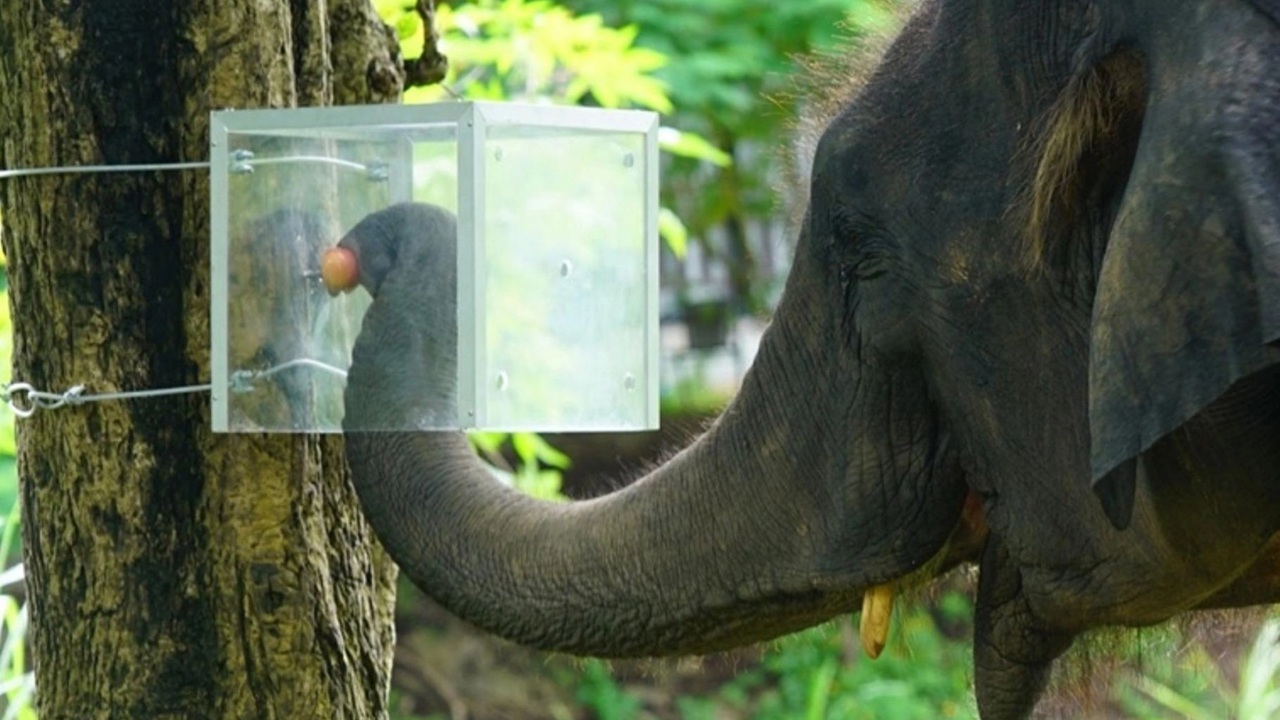
The dust of a quiet enclosure in rural Thailand settles slowly in the afternoon heat. A single wooden box sits on the earth, its sides painted opaque, hiding its contents completely from view. To a human observer, it looks like a simple prop, a low-stakes puzzle left in the dirt. To an Asian elephant named Suda, it is a riddle wrapped in timber and shadowed by expectation.
Inside that box lies a piece of ripe fruit. A sweet, fragrant prize. But Suda cannot see it. She cannot smell it directly through the thick panels. She must rely on something far more profound than raw instinct or immediate sensory gratification. She must remember. She must reason.
When researchers first placed opaque boxes before sixteen captive Asian elephants in Thailand, they were not merely testing whether animals enjoy treats. They were probing the architecture of a mind that has walked the earth for millions of years, carrying memories passed down through matriarchal lines across generations. We often measure intelligence by our own metrics, looking for tools built with hands or symbols scratched into stone. We forget that a mind can be vast, patient, and heavy as a boulder, operating on an entirely different frequency of time and space.
Consider what happens next in the dust.
Suda approaches the box. Her trunk extends, a muscular, hyper-sensitive appendage feeling the edges, the corners, the subtle weight distribution. She does not rush. Elephants do not live in the frantic, frantic blur of modern human existence. They move with deliberate grace, their massive feet absorbing seismic vibrations through the earth. She pushes the box. It slides along a predetermined track. She tracks its movement with her dark, intelligent eyes, her large ears fluttering to cool her blood against the tropical sun.
She understands that the fruit is still inside, even though it is hidden.
This simple realization is deceptively profound. Psychologists call it object permanence, a milestone we usually measure in human infants around the age of eight to twelve months. Yet here, standing beneath the acacia trees, a multi-tonne animal demonstrates a sophisticated grasp of hidden mechanics. The box is moved. The elephant adjusts her trajectory. She follows the path of the hidden reward, pushing, steering, and anticipating its final destination with astonishing spatial accuracy.
Out of the sixteen elephants tested, the learning curve was not a straight line of cold data. It was a collection of individual stories. There was Wan, older and fiercely independent, who approached the puzzle with skepticism, testing the seams with a cautious tip of her trunk before committing her weight. There was Boon, younger and more impulsive, who shoved the apparatus too hard on the first attempt, learned from the resistance, and softened his touch on the second try.
Watching them, you realize how much of their daily survival depends on this exact kind of mental cartography. In the wild, an Asian elephant does not navigate by road signs or GPS coordinates. They navigate by a mental map of ancient riverbeds, fruiting trees that bloom only once every few seasons, and waterholes that vanish beneath the dry-season dust. The opaque box in the Thai enclosure was just a miniature version of the world they have always inhabited: a world where vital resources are frequently hidden, scarce, and guarded by distance.
We have spent centuries convincing ourselves that we hold a monopoly on abstract thought. We built laboratories, invented IQ tests, and drew bright lines between human ingenuity and animal instinct. Yet every time we look closer at creatures like elephants, crows, or cetaceans, those bright lines begin to blur. They grieve their dead with silent vigils. They communicate across miles using infrasonic rumbles that ripple through the soil beneath our feet. And now, as this experiment proved, they can solve complex spatial puzzles, tracking unseen objects through a series of logical deductions.
The implications stretch far beyond a wooden box in a research facility.
As human populations expand across Southeast Asia, forests shrink. Roads fragment ancient migration corridors. Elephants are forced into frequent, often tragic contact with human agriculture, raiding crops like sugarcane and maize because their ancestral pathways have been paved over. In this high-stakes reality, problem-solving is not an academic exercise for these animals. It is a survival mechanism. An elephant that can figure out how to manipulate human structures, navigate unfamiliar obstacles, and adapt to changing environments is an animal trying desperately to bridge the gap between two incompatible worlds.
When the sixteenth elephant successfully navigated the box to its endpoint, lifted the lid with the tip of its trunk, and retrieved the sweet fruit inside, there was no triumphant cheer from the observation deck. Just the low, resonant rumble of a stomach, the soft scuff of a heavy foot on dry soil, and the rustle of leaves overhead.
The box is empty now. The dust has settled back onto the earth. But the footprint remains, deep and wide, a quiet reminder of what walks beside us in the shadows of the modern world.