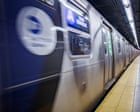
Catastrophic failures in mass transit environments rarely emerge from a single isolated error. Instead, they represent the convergence of mechanical tolerances, human observational latency, and operational design limits. When a commuter died at the Utica Avenue station in Brooklyn after an item became trapped in a departing train's doors, public discourse immediately polarized around proximate blame. A more rigorous approach requires examining the mechanical physics, the sensory bottlenecks of the transit architecture, and the probabilistic risk functions governing high-density rail systems.
The Kinematics of Door Sealing and Obstruction Detection
Modern heavy rail door mechanisms are designed to optimize conflicting operational parameters: speed of throughput versus absolute object detection. Pneumatic or electric door operators rely on resistance thresholds to determine whether an obstruction prevents a proper seal.
When a thin, pliable object—such as a fabric strap, a plastic handle, or a dense bag—is introduced into the closing path, it presents a minimal cross-sectional thickness. If the object falls below the sensitivity cutoff of the door edge sensor, the control system registers a closed circuit.
The mechanical chain operates on binary logic:
- Obstruction Threshold Exceeded: The door reverses or halts.
- Obstruction Threshold Undershot: The system confirms a positive seal, unlocking the propulsion circuit.
When a strap is caught without triggering the electronic interlock, the train's propulsion control unit receives a false-positive safety clearance. The interlock loop, which prevents motor activation unless all doors report closed, is satisfied by the rubber edge compressing around the thin material. The train is mathematically cleared to move despite an external physical tether connecting the interior car body to an individual on the platform edge.
Human Observational Latency and Crew Constraints
The operational safety of a departing train relies on a distributed surveillance model divided between the train operator and the conductor. The conductor occupies a designated mid-train position or station pulpit, tasked with performing a visual sweep of the platform-train interface before authorizing door closure and train departure.
This workflow introduces critical vulnerabilities governed by human factors engineering:
- Visual Parallax and Line of Sight: Conductors rely on direct sightlines or platform monitors. Lighting variations, curvature, and crowd density during rush-hour peaks create blind spots.
- Confirmation Bias: Once doors cycle and close, cognitive focus shifts from monitoring obstruction risks to monitoring signal lights and track clearance ahead.
- Response Window: The time delta between train motion initiation and the point of irreversible kinetic energy transfer is measured in fractions of a second. A human observer monitoring a mirror or monitor cannot process an anomalous tethering event, locate an emergency stop cord, and execute an override before the physics of momentum overcome human reaction times.
Unlike fully automated systems equipped with continuous optical curtain sensors or platform edge doors that physically isolate the track bed, legacy heavy rail networks depend heavily on administrative controls. Administrative controls possess the highest failure rate in safety-critical systems because they rely on unvarying human vigilance in high-frequency environments.
The Probability Curve of Transit Incidents
Statistical analyses published by transit authorities like the Metropolitan Transportation Authority indicate that large-scale transit networks handle millions of passenger journeys daily. While the absolute number of customer-side accidents fluctuates marginally year-over-year, macro-level safety improvements are typically measured by per-capita trip ratios.
However, system-wide averages mask localized risk spikes:
- Throughput Pressure: High passenger density during peak hours compresses boarding windows, increasing the statistical likelihood of last-second boarding or exiting behaviors.
- Geometry of Risk: Stations with high foot traffic volume experience increased stochastic anomalies where human behavioral variance intersects with fixed mechanical cycles.
When evaluating system safety, risk management frameworks categorize incidents not by frequency alone, but by severity potential. A low-frequency, high-severity event points to structural vulnerabilities in the failsafe architecture rather than routine operational drift.
Systemic Intervention Vectors
Mitigating transit dragging mechanics requires shifting away from reliance on visual observation toward hard engineering controls.
First, sensor architecture at the door leaf level must evolve. Replacing simple resistive rubber edges with active infrared light curtains or continuous capacitive sensing along the entire door height ensures that even millimeter-scale textiles or straps impede the closure validation signal.
Second, platform-side physical separation remains the definitive architectural solution. Platform screen doors create a physical barrier between passengers and the track bed, making it mechanically impossible for a person or an attached object to be dragged by a departing train, regardless of whether interior door sensors register a false-positive closure.
Until capital infrastructure upgrades enable universal platform isolation, transit risk management remains bound to the tolerances of legacy interlocks and the limits of human supervision.
This video provides on-the-ground news coverage and witness accounts of the Brooklyn subway incident, illustrating the immediate aftermath and public response discussed in the analysis.