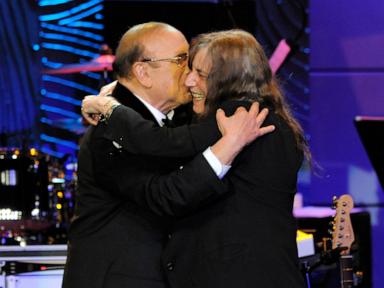
The room is always quiet before the needle drops. For decades, across plush corner offices in Manhattan and dimly lit playback studios in Los Angeles, that silence belonged to one man. Musicians, iconic figures who commanded stadiums of screaming fans, would sit on the edge of their seats, sweating through their expensive jackets, waiting for a nod. A tap of the foot. Anything. When that man stopped listening, an entire epoch of American music ended with him.
Clive Davis is gone.
To the casual observer of modern pop culture, executives are just suits. They are the background noise of the creative world, the spreadsheet pullers who care more about profit margins than poetry. But anyone who ever tuned a guitar or sang until their throat bled knew better. Clive Davis was the architect of the soundtrack of our lives. When news broke of his passing, it didn't just trigger a wave of corporate press releases. It felt like a sudden, jarring power outage in a house that had been blasting music for sixty years.
The grief from the artists he championed didn't carry the polite, manufactured tone of industry obligation. It arrived with the heavy weight of genuine devastation.
The Shape of a Voice
Consider the sheer impossibility of his radar. Most music moguls find a lane and stay in it. They understand rock, or they understand disco, or they wrap their arms around hip-hop. Clive didn't have a lane. He had an internal tuning fork that vibrated whenever raw human emotion met a melody.
Barry Manilow was one of the first to feel the tectonic shift of Clive's belief. In the early 1970s, Manilow was a commercial jingle writer and an accompanist, a brilliant musical mind working in the shadows. Clive saw the spotlight waiting for him before Barry did. He handed him a song called "Brandy," changed the title to "Mandy," and watched a superstar ignite.
Manilow’s remembrance of his mentor wasn't about the chart-topping singles or the platinum plaques coating the walls. It was about the late-night phone calls. The obsessive attention to a single chord change. It was about a man who believed in the power of a soaring, unapologetic pop chorus when critics were turning up their noses at sentimentality. Without Clive, the world never sings along to "Copacabana." We never get those grand, sweeping anthems that soundtracked a millions heartbreaks and weddings.
But a pop hitmaker is only half the story.
Turn the dial completely to the left, away from the glittering lights of mainstream pop, into the sweat and smoke of the New York punk scene. Think of Patti Smith. She was the high priestess of the underground, a fiercely independent poet who spat in the face of commercialism. By any traditional metric of the 1970s music business, she was unmarketable.
Yet, when Clive founded Arista Records, one of his very first signings was Smith.
He didn't try to clean her up. He didn't ask her to sing pop ditties. He understood that her raw, jagged edges were precisely what made her magnificent. Smith’s tribute to Davis cut through the standard industry noise, reflecting on a man who protected her artistry like a fortress. He gave a radical poet the keys to a global megaphone. That requires a rare brand of courage from a corporate executive. It demands an absolute reverence for the holy fire of creativity.
The Resurrection of a Legend
Then there is Carlos Santana.
By the late 1990s, the music industry had largely written off the guitar god of Woodstock. The business had moved on to boy bands, teen pop, and shiny hip-hop production. A middle-aged virtuoso playing Latin-infused rock solos didn't fit into the rotation of MTV.
Clive refused to accept the expiration date the industry tried to stamp on genius.
He reconnected with Santana, masterminding an album that seemed utterly absurd on paper. He paired the legendary guitarist with young, contemporary voices like Rob Thomas, Lauryn Hill, and CeeLo Green. The result was Supernatural. It didn't just succeed; it consumed the culture. It won eight Grammy Awards in a single night. It introduced the blistering warmth of Santana's guitar string to a generation that hadn't even been born when he played "Soul Sacrifice" in the mud of 1969.
Santana's reaction to the loss of Clive wasn't focused on the massive commercial rebirth. He spoke of Clive as a spiritual brother, a visionary who could see the invisible threads connecting different eras of human expression.
That was his true superpower. He could hear the future in an old soul, and he could find the timeless soul in a brand-new kid.
The Weight of the Empty Chair
It is easy to look at the history of modern music and assume it was inevitable. We listen to Whitney Houston—perhaps Clive’s most legendary discovery—and think that a voice that pristine would have found its way to the top regardless of who was running the record label.
But history is fickle. Talent is fragile.
Without the right guardian, the most beautiful voices can get swallowed by the machinery of the business, chewed up by bad contracts, or steered toward trends that smother their true essence. Clive Davis was the buffer between the brutal commerce of the entertainment industry and the delicate magic of the human voice. He was the ultimate filter.
The tributes pouring in from every corner of the musical universe—from rock royalty to R&B divas—reveal a shared truth. These artists didn't just lose a boss. They lost their anchor.
The music industry today is a digital wilderness of algorithms, viral clips, and streaming data points. Decisions are made by data scientists analyzing user retention rates on fifteen-second video snippets. It is a cold, calculated ecosystem.
Clive Davis belonged to an era where the ultimate authority wasn't a computer program. It was a pair of ears. It was a gut feeling that told him a girl from Newark named Whitney, or a weird art-rock band from Athens, Georgia called R.E.M., had something essential to tell the world.
The industry will keep moving forward. Songs will still be uploaded by the millions every single day. New stars will rise and fall with the speed of a scrolling thumb. But the golden age of the visionary record man, the executive who operated with the soul of an artist and the precision of a surgeon, has officially drawn to a close.
The next time a song makes the hairs on your arms stand up, remember that someone had to believe in it first. Someone had to sit in a quiet room, hear the rough demo through the static, and decide it was worth fighting for. That was the life of Clive Davis. The room is quiet again, and this time, the silence stays.