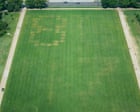
National mainstream media is panicking over a number. Specifically, the number 8647, which someone etched into the grass of the National Mall right between the Washington Monument and the Capitol.
The immediate consensus from local newsrooms and federal law enforcement was predictable. They treated it as a security breach, an act of malicious vandalism, or a cryptic message from a fringe political group. The National Park Service immediately rolled out the heavy machinery, looking to patch up the sod, while federal investigators began combing through security footage to track down the "perpetrators."
They are missing the entire point.
This wasn’t a security failure. It wasn’t a political protest. And it certainly wasn’t traditional vandalism. The frantic outrage over a number in the grass exposes a massive blind spot in how we perceive public infrastructure, high-altitude mapping, and the quiet war currently being fought over physical space by digital entities.
The Myth of the Sacred Lawn
Every year, millions of tourists walk the National Mall, treating it as a pristine, static monument to American history. The media buys into this romantic narrative every time a blade of grass is disturbed. They treat the Mall like a museum floor.
It isn't. The National Mall is one of the most heavily monitored, digitally mapped, and physically manipulated pieces of land on the planet. It is an active grid.
To understand why "8647" appeared, you have to stop looking at the ground and start looking at the sky. For decades, satellite imagery and aerial mapping relied on permanent, government-sanctioned ground control points (GCPs)—physical markers on the earth with known coordinates used to calibrate aerial photography and radar.
But we don’t live in the era of standard government satellites anymore. We live in the era of commercial drone fleets, autonomous navigation, and hyper-local spatial computing.
When a massive number is etched into a highly visible, open area like the National Mall, it usually serves a very specific, technical function: a high-contrast ground marker designed for algorithmic calibration.
The Mechanics of Ground Calibration
Let’s break down how spatial mapping actually functions under the hood.
Autonomous systems—whether they are commercial surveillance drones, private orbital satellites, or computer vision models mapping urban environments—frequently suffer from drift. GPS alone is not accurate enough to pin down location data to the centimeter. To correct this, systems use visual anchors.
When an algorithm processes a satellite feed or a high-altitude drone scan, it looks for high-contrast, geometric anomalies with distinct edge-detection signatures to verify its positioning matrix.
[Satellite / Drone Sensor]
         │
         ▼ (Visual Scan Data)
┌─────────────────────────────────┐
│ Edge-Detection Algorithm        │
│ Identifies High-Contrast Matrix │
└─────────────────────────────────┘
         │
         ▼ (Calibration Check)
[Matches Ground Control Marker: "8647"]
         │
         ▼
[System Corrects Positional Drift]
The number 8647 wasn’t spray-painted; it was etched. By altering the reflectivity and depth of the turf, whoever did this created a marker that remains visible to multi-spectral imaging sensors even in low-light conditions or under light snow cover. Standard paint washes away or blurs; cutting into the root structure of the turf ensures the geometric edges of the numbers remain sharp for computer vision processing over several weeks.
Who Actually Benefits From an Etched Grid?
The lazy assumption is that a rogue actor did this to cause chaos. But let’s look at the logistics. Etching a massive, perfectly proportioned four-digit sequence into the most heavily patrolled lawn in Washington, D.C., requires time, precision, and an absolute lack of fear regarding standard security patrols.
This points to two distinct possibilities that the current investigation is entirely ignoring:
- A Gray-Hat Spatial Audit: Independent tech actors or mapping firms frequently find gaps in public sector spatial data. Creating a highly visible, unapproved GCP in the heart of the capital forces private mapping databases to update their algorithmic layers, highlighting how easily public infrastructure can be co-opted for digital navigation indexing.
- Internal Bureaucratic Silos: The federal government is not a monolith. It is entirely possible that a sub-contractor working for a federal agency—perhaps testing autonomous defense sensors, agricultural health drone sweeps, or crowd-density algorithms—placed the marker there with a permit that didn't clear the main National Park Service public relations desk. The left hand genuinely does not know what the right hand is mapping.
I have spent years analyzing how corporate and state entities interact with physical infrastructure. The civilian public thinks infrastructure is made of concrete and grass. The technology sector knows infrastructure is made of data streams, coordinates, and visual anchor points.
When a tech company wants to test an autonomous vehicle array or an automated aerial platform in a high-density area, they don't ask for permission from every low-level municipal department. They find the optimal location, deploy the asset, and handle the administrative fallout later.
Dismantling the Panic
The questions being asked across cable news networks right now are completely fundamentally flawed.
- "Is this a threat to national security?" No. A physical number on a lawn does not compromise a secure facility. If anything, it exposes that our current security framework is obsessed with physical fences while remaining totally blind to how the physical world is harvested for digital modeling.
- "How much will it cost to repair the damage?" This is the wrong metric. The cost of a few square yards of sod is irrelevant. The real cost is the intellectual deficit of an administration that views spatial orchestration as simple property damage.
The true vulnerability isn't that someone ruined the grass. The vulnerability is that our public spaces can be modified to serve as digital beacons for third-party systems without the overseers of those spaces even understanding what they are looking at.
The Reality of Spatial Occupation
Stop looking for a political manifesto attached to the number 8647. There isn't one. This isn't the work of an activist group looking for a headline. Activists want their names known; they want a clear message that can be parsed by a human viewer on the ground.
This message was meant for a camera lens pointing straight down from the troposphere.
It is an act of digital colonization. By converting a piece of national history into a functional node for machine learning and spatial orientation, the creators proved that physical ownership of land is secondary to digital utilization of that land.
The National Park Service can replant the grass. They can lay down new turf, pour water over the soil, and pretend the Mall is pristine once again. But the coordinates have already been logged. The algorithms have already run their calibration cycles. The data has been indexed, stored, and integrated into whatever system needed it.
The media is still crying over spilled milk while the tech sector is busy rewriting the utility of the jar. The etching isn't a scar on a monument. It’s a software patch applied directly to the earth.


