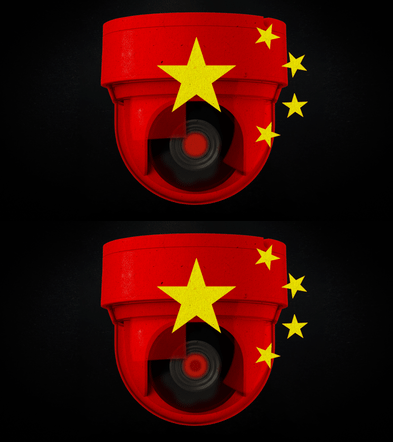
A massive server sits exposed to the open internet, humming silently in a commercial facility outside Beijing. Inside, nearly a terabyte of data continuously updates in real time, scraping, indexing, and profiling tens of thousands of individuals across the globe. This is not a hypothetical intelligence threat. It is the reality of a recently uncovered Chinese state-aligned database that tracks foreign journalists, cybersecurity researchers, and political targets from the deep web to mainstream social platforms. While the West focuses on corporate data breaches, Beijing has quietly perfected a contractor-driven espionage apparatus designed to catalog, deanonymize, and profile individuals deemed a threat to the state.
For decades, the standard playbook for international espionage involved high-value human assets or highly targeted network intrusions. The modern reality is far more industrial. By leveraging private cybersecurity contractors like Knownsec and state-backed intelligence aggregators, Chinese security agencies have built a vertically integrated espionage stack. This system does not just steal data. It maps entire networks of human relationships, infrastructure, and political sentiment across Western nations, Taiwan, India, and Japan.
Understanding how this specific database operates requires looking past the shocking headlines of mass surveillance and into the exact mechanics of how China uses commercial entities to conduct national security operations.
The Illusion of Corporate Independence
The exposed database belongs to a network of private Chinese security firms that present themselves to the global market as ordinary defensive software vendors. They sell vulnerability management, penetration testing, and cloud security. Beneath this corporate veneer lies a shadow organization built explicitly to service the Ministry of Public Security and the People's Liberation Army.
Internal documents from these contractors reveal an organizational structure split into specialized cells. One team focuses on "public-security support," which translates to building entity-fusion platforms that combine disparate data streams into unified intelligence profiles. Another department handles "cyberspace mapping," a continuous, high-speed reconnaissance effort that scans the entire IPv4 space every seven to ten days.
This is not a rogue hacking operation. It is a formalized, state-funded commercial ecosystem where private companies compete for government intelligence contracts. The state provides the funding lines, and the contractors provide the engineering talent, shielding the official apparatus from direct attribution.
Scraped Identities and the Target Index
The true value of the intercepted database lies in its indexing strategy. It does not merely dump raw text; it categorizes targets using precise internal annotations. Profiles are explicitly tagged with markers such as "counter-revolutionary speech," "political rumors," or "China-related seller."
A granular breakdown of the targeted profiles reveals a highly deliberate selection process.
- Mainstream Cyber Journalists: Reporters covering data breaches and state-sponsored espionage are heavily indexed, allowing the state to monitor upcoming investigations before they go live.
- Deep Web Vendors: Individuals trading data or tools on criminal forums are tracked to harvest exploit code and monitor vulnerabilities that could threaten Chinese infrastructure.
- Diaspora Activists: Groups operating on encrypted messaging platforms like Telegram are scraped continuously, mapping their networks of associates back to real-world identities.
The database tracks hundreds of thousands of Telegram channels, Facebook groups, and dark web forums. By deploying automated scraping engines, the system recursively discovers new targets. If an indexed user joins a new group, the scraping engine follows, widening the net automatically.
From Username to Real Name
The ultimate objective of this data collection is deanonymization. An abstract username on an obscure forum is of little use to an intelligence agency. To bridge this gap, the database utilizes entity-fusion algorithms to cross-reference leaked dark web data with public infrastructure.
Imagine a user who registered a forum account a decade ago using a personal email address. That email address subsequently leaks in a routine commercial data breach, revealing a mobile phone number and a real name. The state-aligned database ingests these commercial breaches, correlates the identifiers, and instantly updates the target profile.
The system maps the target’s digital footprint against physical reality. It links their online activity to real-world ID numbers, domestic travel records, and family relations. When a target steps off a plane in a domestic airport, the system can instantly alert local authorities by matching their visa information with their pre-existing digital profile.
The Fragile Architecture of Mass Surveillance
Despite the sophisticated scope of these operations, the infrastructure supporting them is surprisingly fragile. The very fact that independent research teams can locate and analyze these databases points to a systemic flaw within China’s rapid data accumulation strategy.
In the rush to build comprehensive predictive policing tools, data quality and security are frequently treated as secondary priorities. Software components are left unpatched. Databases are left exposed without basic credential requirements. The internal data structures often feature conflicting date formats, missing fields, and corrupted entries that require manual coding to fix.
This reveals a crucial paradox in the state's intelligence strategy. Beijing has mastered the art of mass data ingestion, but it consistently struggles with data governance. The pressure to deliver immediate results to government clients leads to rushed deployments, leaving the state's most sensitive intelligence assets vulnerable to accidental exposure.
The Recruiting Trap on Professional Networks
The surveillance network does not stop at passive observation. When passive scraping fails to deliver deep insights into foreign policy, defense infrastructure, or emerging technologies, the apparatus pivots to active human targeting. This manifest via professional networking platforms.
Using sophisticated cover companies that mirror legitimate corporate consultancies, intelligence officers pose as corporate recruiters or talent acquisition specialists. They target western government officials, defense contractors, and geopolitical analysts. The approach is slow and calculated.
The fake recruiter offers a well-compensated opportunity to write a policy report or provide "professional insights" on an industry trend. The initial topics are benign, designed to test the target's willingness to share information. Once a financial relationship is established, the conversation moves to alternative messaging applications, where the demands for proprietary or classified information become explicit.
Disrupting the Espionage Stack
Defending against an adversarial apparatus that treats the global internet as an open-source intelligence feed requires a fundamental shift in defensive doctrine. Relying on basic perimeter security is no longer sufficient when an adversary is systematically collecting public, gray-market, and leaked data to profile your workforce.
Organizations must look at their data through the lens of an entity-fusion engine. This means recognizing that personal information exposed in an unrelated commercial breach can be used to compromise enterprise security. Minimizing the digital footprint of high-value employees, enforcing strict separation between personal and professional identities, and educating staff on the mechanics of synthetic recruiting campaigns are the only viable methods to degrade the effectiveness of this global surveillance architecture.