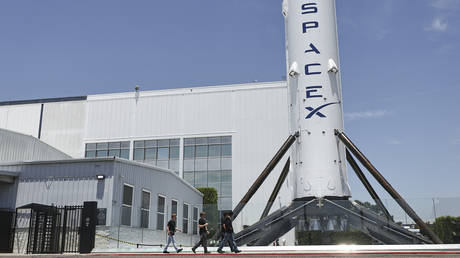
The tech press is drooling over a massive number. Thirty billion dollars. That is the headline figure slapped across the joint announcement between SpaceX and Google, a deal framed by mainstream commentators as a masterstroke that solidifies Elon Musk’s dominance in both low-Earth orbit and autonomous computing. The tech media is buying the hype hook, line, and sinker. They see two giants pooling resources to create an unstoppable orbital data powerhouse.
They are completely misreading the room. Don't forget to check out our recent post on this related article.
This partnership is not a sign of strength. It is a massive, flashing red indicator of structural vulnerability for both parties.
When you strip away the public relations gloss, this $30 billion agreement is a defensive marriage of convenience. SpaceX is burning through capital to keep Starlink ahead of a rising tide of terrestrial and orbital competition, while Google is desperate to find a captive, industrial-scale customer for its lagging cloud infrastructure and AI hardware. To read more about the background of this, MIT Technology Review offers an informative breakdown.
To understand why this massive capital deployment is fundamentally flawed, you have to look past the balance sheets and analyze the brutal reality of orbital mechanics, hardware constraints, and the physics of data transmission.
The Starlink Bandwidth Illusion
The lazy consensus assumes that putting more AI compute into the Starlink ecosystem will magically optimize satellite constellations and unlock new revenue streams. The argument goes like this: by utilizing Google’s machine learning models, SpaceX can perfectly route data through its laser cross-links, predict atmospheric interference, and maximize throughput.
It sounds brilliant on a slideshow. In the real world, it violates basic principles of network engineering.
Starlink’s primary constraint has never been software optimization. It is, and always will be, available spectrum and physical hardware limitations. Having spent fifteen years auditing enterprise network deployments and watching companies throw billions at software patches for physical infrastructure problems, I can tell you exactly how this plays out. You cannot code your way out of a hardware bottleneck.
Consider the physical reality of a satellite constellation. Each spacecraft has a fixed number of optical laser links and a strictly limited allocation of radio frequency spectrum. No amount of neural network optimization can force a transmitter to broadcast beyond the Shannon-Hartley theorem’s theoretical limits.
$$\ C = B \log_2 \left(1 + \frac{S}{N}\right) $$
Where $C$ is the channel capacity, $B$ is the bandwidth, and $S/N$ is the signal-to-noise ratio. Google’s algorithms cannot alter this fundamental equation. They cannot magically create more spectrum where none exists, nor can they reduce the physical noise of Earth's atmosphere.
When mainstream analysts ask, "How will Google’s AI optimize Starlink’s routing?" they are asking the wrong question. The real question is: "Why is SpaceX spending billions on software optimization when their actual limit is the physical number of ground stations and satellite dishes they can manufacture and deploy?"
The Edge Computing Fallacy in Orbit
The core of the SpaceX-Google deal relies on the premise of orbital edge computing. The narrative suggests that by deploying Google’s specialized AI chips—Tensor Processing Units (TPUs)—directly into Starlink satellites or regional ground gateways, SpaceX can process data in real-time, high above the earth.
This is a profound misunderstanding of the harsh environment of space.
Space is actively hostile to semiconductor hardware. Terrestrial data centers consume vast amounts of electricity and require industrial-grade liquid cooling systems to keep high-performance AI chips from melting. A modern data center rack packed with AI processors can pull upwards of 40 kilowatts of power.
Now look at a satellite. A Starlink spacecraft relies entirely on solar panels and batteries. Its total power budget is measured in watts, not kilowatts. Furthermore, space is a vacuum. There is no air to conduct heat away from a screaming hot AI processor. Dissipating heat in a vacuum requires massive, heavy thermal radiators that rely purely on radiation, which is the least efficient form of heat transfer.
- Terrestrial AI Rack: 40+ kW power draw, active liquid cooling, infinite airflow.
- Orbital AI Nodes: <1 kW available power, zero airflow, heavy reliance on passive radiative cooling.
Then there is the radiation issue. Galactic cosmic rays and solar energetic particles wreak havoc on sub-nanometer silicon chips. Terrestrial chips experience single-event upsets (SEUs) that cause data corruption or system crashes. To prevent this in space, you must use radiation-hardened components, which are typically several generations behind commercial hardware in terms of raw processing power, or employ massive physical shielding that adds prohibitive weight to the launch vehicle.
If SpaceX attempts to fly standard commercial Google TPUs without extreme modifications, the hardware will fry within months. If they modify them for space survivability, the performance drops significantly, completely undermining the cost-to-performance ratio that justified the $30 billion price tag in the first place.
Google’s Hidden Desperation
To understand the true mechanics of this deal, we must turn the lens toward Mountain View. Google is trapped in a brutal, multi-front war for AI dominance, trailing behind competitors who have secured more lucrative enterprise partnerships.
By locking SpaceX into a long-term, multi-billion-dollar commitment, Google secures a massive, guaranteed buyer for its infrastructure. This artificially inflates Google Cloud’s enterprise metrics, giving Wall Street the illusion of organic growth in the highly competitive cloud sector.
It is a classic enterprise accounting maneuver. I have watched legacy tech giants execute this exact playbook for decades: when you cannot win the open market on product merit alone, you buy a massive customer through a highly structured, reciprocal partnership. Google gets to claim its infrastructure powers the most advanced space network on earth. SpaceX gets a massive cash infusion or equivalent credit to offset its staggering operational burn rate.
But what happens to the actual technology?
SpaceX has historically succeeded by maintaining total vertical integration. They build their own rockets, Merlin engines, Starship prototypes, and satellite buses. They write their own flight software from scratch using lean, high-performance C++ code. By outsourcing their AI and data infrastructure to Google, SpaceX is breaking its own golden rule. They are introducing a massive, third-party dependency into their core technology stack.
When you build your ecosystem on top of another company’s proprietary machine learning frameworks, you are no longer independent. You are a tenant.
Dismantling the Practical Premise
Let's address the inevitable pushback from the tech optimists by tackling the questions currently dominating the trade publications.
Can’t orbital AI dramatically reduce latency for financial trading?
This is a marketing myth. The speed of light in a vacuum is roughly 30% faster than it is through fiber optic cables. This gives Starlink a genuine physical advantage for transoceanic data transmission. However, processing data inside the satellite adds computational latency that completely wipes out the physical transmission advantage.
A packet of financial data does not need to be analyzed by a deep neural network at 500 kilometers altitude. It needs to be routed to the ground as fast as humanly possible. Adding complex AI inference steps mid-flight introduces serialization delays and processing overhead. The fastest route from Point A to Point B is a straight line, not an intellectual detour through an orbital AI chip.
Won't this deal revolutionize military reconnaissance and earth observation?
The argument here is that satellites can use AI to analyze imagery onboard and only send down the critical data, saving bandwidth. It sounds logical until you look at the economics of modern launch costs.
SpaceX has reduced the cost of launching payloads to orbit by orders of magnitude. Because launching hardware is cheaper than ever, the economically rational move is not to build hyper-complex, fragile, AI-powered spy satellites. The rational move is to launch more simple satellites and dump the raw data down to massive, cheap, liquid-cooled data centers on Earth where thousands of chips can analyze it without power constraints. Downlinking raw data is a solved problem; processing it in a vacuum is an expensive nightmare.
The Financial Reality of the $30 Billion Figure
We must also look at the structure of these mega-deals. The public sees "$30 billion" and imagines a giant vault of cash being transferred from Google to SpaceX. That is almost never how these agreements operate.
The vast majority of this figure is likely structured as "in-kind" service commitments, cloud credits, and long-term infrastructure provisioning stretched over a decade or more. It is a commitment to spend, not a liquid capital injection.
[Google Cloud Credits / Infrastructure] ----> Confined to Google Ecosystem
                                                 |
                                                 v
                                      Restricts SpaceX Innovation
SpaceX is locking themselves into Google’s hardware roadmap for the next ten years. In the fast-moving world of artificial intelligence hardware, a decade is an eternity. By tying their horse to Google’s proprietary architecture, SpaceX loses the agility to pivot to more efficient, specialized hardware architectures that may emerge from nimbler silicon startups or open-source hardware movements.
The Real Winner Isn't Who You Think
If this deal isn't the transformative leap forward the media claims, who actually wins?
The winner is Google's marketing department, which now has a shield to deflect criticism that they are losing the enterprise enterprise computing race. The winner is SpaceX’s short-term balance sheet, which looks far more stable to private equity investors who are beginning to grow weary of the endless capital requirements of the Starship development program.
The loser is the engineering purity that made SpaceX successful in the first place.
By complicating their lean, vertically integrated architecture with corporate cloud bloat, SpaceX is introducing the very friction they have spent two decades avoiding. They are trading engineering elegance for financial engineering.
Stop looking at the press release. Stop celebrating the arbitrary billions. The moment a hardware company tries to solve a physical capacity problem with an expensive, outsourced software partnership, the peak of its innovation cycle has passed. SpaceX didn't just sign a tech deal; they signed a confession that physical scaling is getting harder, more expensive, and less efficient than they ever wanted to admit.