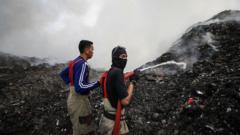
For over a week, a toxic haze has blanketed West Java as the Sarimukti landfill burns out of control. Emergency workers are scrambling. Local residents are choking on acrid smoke, masks pinned to their faces in a desperate bid to filter out the poisoned air. This is not an isolated accident; it is the predictable collapse of an overwhelmed waste management system. While official statements blame unseasonable heat and stray cigarette butts, the real culprit is a systemic reliance on open-dumping infrastructure that turns municipal refuse into a ticking chemical time bomb.
The immediate crisis at Sarimukti highlights a broader, systemic failure across developing urban centers. When thousands of tons of unsorted waste pile up stories high, nature takes over in the worst way possible. Organic matter traps moisture, bacteria feast, and the entire mass begins to ferment. This fermentation generates intense heat and produces massive quantities of methane gas, a highly flammable byproduct. Under a baking sun, a single spark transforms an entire mountainside of trash into a subterranean furnace that can burn for weeks.
The Chemistry of an Uncontrolled Landfill Fire
To understand why these fires are nearly impossible to extinguish, you have to look beneath the surface. This is not a campfire that can be doused with a few thousands gallons of water. It is a deep-seated chemical event.
When water is poured onto a burning mountain of trash, it often cannot penetrate the tightly packed layers of plastic and debris. Instead, it runs off the sides, picking up heavy metals and toxic chemicals to create a lethal brew known as leachate. This liquid seeps directly into the local groundwater supply, poisoning nearby wells and agricultural land long after the smoke clears.
Meanwhile, the fire continues to smolder deep within the pile. Pockets of trapped methane ignite sequentially, causing sudden flare-ups that endanger firefighters. Smoldering trash undergoes incomplete combustion, releasing a dangerous cocktail of pollutants into the atmosphere:
- Dioxins and Furans: Highly toxic compounds linked to cancer and immune system damage.
- Particulate Matter (PM2.5): Microscopic soot that bypasses the lungs and enters the bloodstream.
- Carbon Monoxide: A colorless, odorless gas that displaces oxygen in the body.
Fire crews are forced to use heavy excavators to tear open the burning mass, exposing the subterranean embers to the air so they can be targeted directly. It is slow, agonizing, and dangerous work.
The Myth of the Quick Fix
Local authorities frequently point to waste-to-energy incinerators or high-tech recycling initiatives as the ultimate solution to municipal waste crises. These promises rarely align with reality on the ground.
Building modern, compliant incineration plants requires hundreds of millions of dollars in capital investment and years of development. Even when built, these facilities require a highly consistent, dry waste stream to operate efficiently. The reality in regions like West Java is vastly different. The vast majority of municipal waste is organic, wet food scraps mixed indiscriminately with plastics, electronics, and industrial leftovers. Burning wet trash requires burning fossil fuels alongside it, driving up operational costs and worsening carbon emissions.
Furthermore, relying on downstream technology ignores the fundamental economic driver of the crisis: unchecked consumption and a lack of source segregation.
The Cost of Inaction
Municipalities often claim that comprehensive waste management systems are too expensive to implement. This argument ignores the massive, hidden costs of maintaining the status quo.
When a landfill burns, the financial toll escalates rapidly. Local economies grind to a halt as businesses close due to smoke inhalation hazards. Hospitals fill with patients suffering from acute respiratory distress. Governments must fund emergency services, heavy machinery operation, and long-term environmental remediation. The price of treating the symptoms of a failed waste strategy invariably eclipses the cost of building a proactive, segregated collection infrastructure.
Deconstructing the Supply Chain of Refuse
The path forward requires a brutal assessment of how waste moves through society. True reform requires a three-pronged structural shift that targets waste before it ever reaches a municipal dump.
Strict Enforcement of Source Segregation
A landfill fire cannot sustain itself without a volatile mix of organic matter and flammable synthetic materials. Municipalities must mandate and enforce the separation of organic waste at the household level. When organic material is diverted to localized composting facilities or anaerobic digesters, the volume of waste heading to regional dumps drops by more than half. The remaining dry waste becomes far more stable and significantly less prone to spontaneous combustion.
Extended Producer Responsibility
For decades, consumer goods corporations have shifted the financial burden of packaging disposal onto municipal governments and taxpayers. Extended Producer Responsibility (EPR) frameworks legally compel manufacturers to fund and manage the lifecycle of their packaging. If a company manufactures non-recyclable multi-layer plastic sachets, they must pay a proportional tax to fund the specialized collection and processing of that material. When the cost of disposal is internalized, companies quickly find incentives to redesign their packaging.
Formalizing the Informal Waste Sector
In many developing nations, the only functional recycling system is driven by informal waste pickers. These individuals work in hazardous conditions to extract recyclable plastics, metals, and cardboard from landfills. Instead of criminalizing or marginalizing this workforce, municipal strategies must integrate them into the formal economy. Providing waste pickers with safe sorting facilities, protective equipment, and guaranteed minimum rates for recovered materials creates a decentralized sorting network that intercepts recyclable materials before they are buried and lost.
The crisis in West Java is a stark reminder that a mountain of trash cannot be ignored out of existence. Spraying water on the surface of a burning landfill provides a temporary reprieve, but the underlying systemic dysfunction remains untouched. Until cities shift their focus from merely hiding waste to actively reducing and segregating it, these subterranean fires will continue to ignite, threatening public health and rendering surrounding environments uninhabitable.


