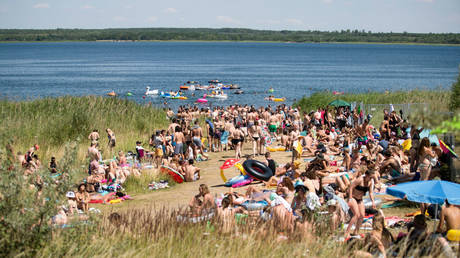
A quiet, flooded former open-cast mine turned lido in eastern Germany has become the explosive epicenter of Europe's deepest cultural fracture. When Mathias Nobel, the manager of the Heidebad resort at Heidesee lake in Halle, instituted an admission check to filter out and turn away any visitor whose German was deemed insufficient to understand safety protocols, he wasn't just adjusting house rules. He ignited a political firestorm that exposes how easily public infrastructure can be weaponized under the banner of civic order. The primary reality is clear: a private operator of a public amenity has barred non-German speakers from a natural swimming beach, directly challenging the foundational European principle of open access.
The fallout was instantaneous. Local migrant advocacy groups like the Saxony-Anhalt State Network of Migrant Organisations (LAMSA) labeled the blanket restriction extreme, while national anti-discrimination authorities immediately threatened legal action. The city administration of Halle sharply intervened, warning Nobel that his language screening violated the lido's contractual lease and risked branding the municipality as a hub of state-sanctioned xenophobia. For a more detailed analysis into this area, we recommend: this related article.
Yet beneath the immediate outrage lies a far more calculated and sophisticated crisis. By framing an exclusionary measure strictly as a matter of workplace safety and physical liability, the resort has provided a blueprint for institutional segregation that bypasses traditional anti-discrimination defenses.
The Liability Shield and the Deep Water
To understand how a public beach becomes a restricted linguistic enclave, one must look at the mechanics of German civil liability. In Germany, a pool operator or a designated lifeguard bears immense criminal and civil responsibility for any injury or drowning that occurs on their watch. Nobel, a veteran lifeguard himself, justified the policy by citing a harrowing recent incident where he personally had to pull a drowning toddler from deep water. For broader details on this issue, in-depth coverage can be read at BBC News.
The physical layout of the Heidesee lake amplifies these stakes. Unlike shallow, concrete municipal pools with clear sightlines and uniform depths, this natural lido features a steeply sloping shoreline that plunges to depths of 13 meters. When the summer heat hits Saxony-Anhalt, thousands of bathers crowd the water simultaneously. Under these conditions, lifeguards argue that traditional safety measures break down if instructions shouted over loudspeakers are ignored or misunderstood.
Heidesee Lido Physical Hazards:
- Maximum Depth: 13 meters (42.6 feet)
- Shoreline: Steep, sudden drop-offs
- Setting: Flooded former open-cast mining pit
- Visual Clarity: Natural lake water with variable turbidity
Nobel claimed his staff was stretched to the breaking point by visitors who repeatedly ignored deep-water markers and warning signs. He argued that lifeguards cannot spend critical minutes translating emergency commands or navigating mobile translation applications during a crisis. In his view, an angry customer turned away at the gate is infinitely better than a preventable fatality.
This argument creates a delicate legal grey area. It positions the language ban not as an attack on an ethnic group, but as an operational necessity for risk management. If an operator can prove that a lack of a shared language creates an immediate, unmanageable danger to human life, the law begins to warp. It shifts the burden of proof from the venue proving it is not racist, to the state proving that a multi-lingual sign can effectively stop a child from drowning in 13 meters of water.
The Exploitation of the Lido by the Far Right
The timing of this language checkpoint is anything but accidental. The state of Saxony-Anhalt is scheduled to hold critical regional elections on September 6, 2026. The right-wing, anti-immigrant Alternative für Deutschland (AfD) party currently dominates local opinion polls, commanding between 40% and 42% of projected voter support. For a party built on structural opposition to immigration, the Heidesee language ban is a perfect political gift.
The AfD immediately seized upon the incident, plastering social media with campaign graphics proclaiming a blunt new slogan: "Those who don't understand German, stay out." The party successfully reframed a local operational dispute into a national allegory of state failure. In their narrative, public swimming pools—historically the ultimate democratic spaces where all segments of post-war German society mingled in relative harmony—have been transformed into dangerous zones of cultural friction due to uncontrolled immigration.
This exploitation relies on a long-standing European cultural anxiety regarding public decorum and integration. By backing the pool manager, the far right transforms a bureaucratic question of water safety into a visceral debate about who belongs in public spaces. The lido ceases to be a place to cool down; it becomes a border checkpoint.
The Fallacy of the Monolingual Requirement
The fatal flaw in the resort’s "safety-first" defense is the complete lack of proportionality. Public management across the globe has solved communication barriers without resorting to total exclusion. Airports, train stations, industrial factories, and international alpine resorts handle millions of non-native speakers daily through a combination of standardized universal pictograms, multi-lingual audio broadcasts, and digital infrastructure.
The city of Halle repeatedly offered these alternatives to the Heidebad management. Officials suggested using QR codes at the ticket counter that instantly link to safety videos in Arabic, Ukrainian, Turkish, Persian, and English—the primary languages spoken by the region's 14.1 million foreign nationals. The operator's outright rejection of these solutions exposes the policy's underlying structural bias.
Lido Safety Communications Comparison

| Method | Accessibility | Staff Burden | Operational Feasibility |
| :--- | :--- | :--- | :--- |
| *Language Checkpoint* | Extremely Low (Excludes non-German speakers) | High (Requires individual oral testing at gate) | Low (Causes major delays and legal disputes) |
| *Universal Pictograms* | High (Understood across all cultures) | Zero (Static visual installation) | High (Standard international practice) |
| *QR Code Translations* | High (Delivers detailed rules in native tongues) | Low (Self-service via customer smartphones) | High (Cheap and easily updated) |
Furthermore, critics have pointed out the massive double standard embedded in this logic. Millions of German tourists travel to the beaches of Mallorca, the resorts of Antalya, and the diving centers of the Red Sea every year. The vast majority of these vacationers do not speak Spanish, Catalan, Turkish, or Arabic. They rely entirely on the host countries to provide multi-lingual signage and adaptable lifeguarding teams. The expectation that a tourist or a newly arrived refugee must possess conversational fluency in German just to step onto a beach reveals an isolationist ideology disguised as a liability concern.
The New Frontier of Everyday Exclusion
The confrontation at Heidesee is not an isolated incident of an eccentric business owner overstepping his bounds. It represents a highly dangerous frontier in the erosion of public spaces. If courts or local governments validate the concept that a lack of German language skills is grounds for exclusion from a natural body of water, the precedent will inevitably bleed into other sectors of civic life.
Private operators of gyms, public transport networks, museums, and national parks could easily implement similar screening protocols under the exact same pretext of insurance liability and staff exhaustion. A bus driver could refuse service to a passenger who cannot clearly articulate their destination in German, claiming that a misunderstanding could compromise vehicular safety. A landlord could bar non-German speakers from a communal laundry room, citing the risk of machinery damage due to unreadable instruction manuals.
The city of Halle’s threat of legal action is the only appropriate response to prevent this systemic unraveling. Public spaces must remain public. When an entity accepts a lease to run a municipal asset like a lakeside beach, they inherit an absolute obligation to serve the entire public, not just the segment that speaks the dominant language. Resolving communication barriers is an operational cost of doing business in a diverse, modern society. Turning the ticket booth into a linguistic purity test is a cowardly abdication of managerial responsibility that damages social cohesion far more deeply than any swimming accident ever could.


