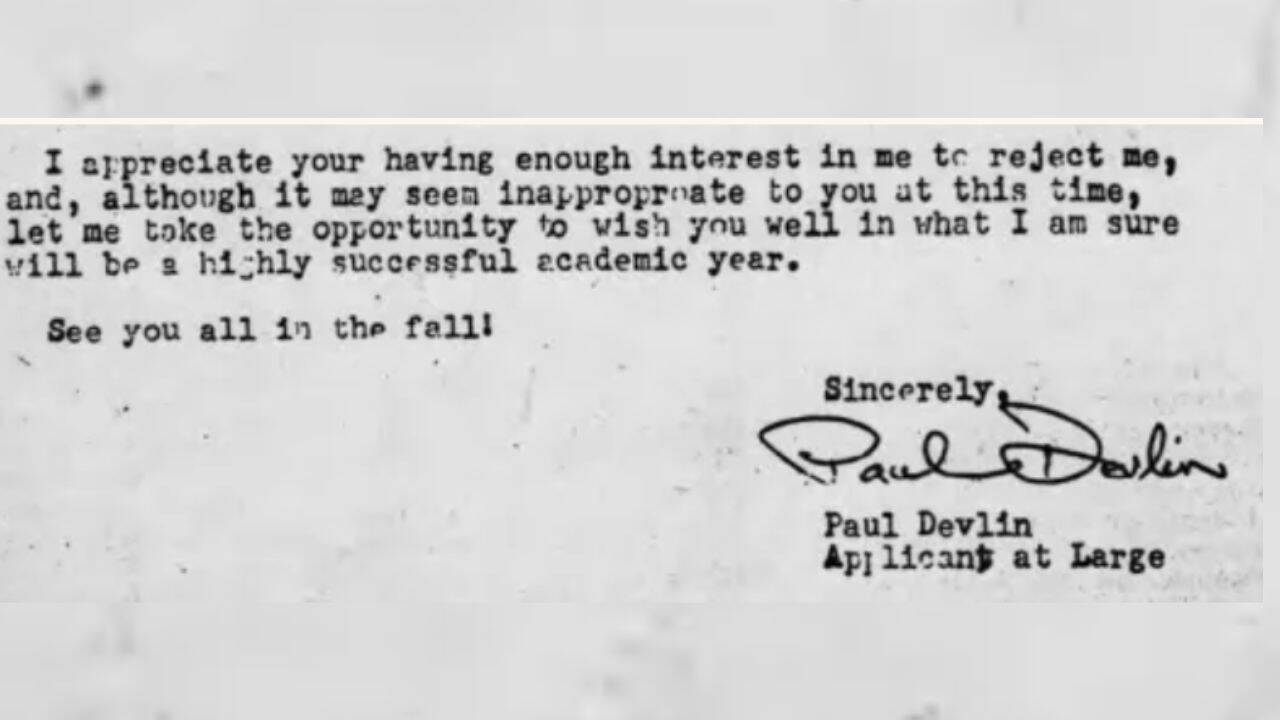
The internet loves a good underdog story. Someone gets rejected by an elite institution, fires off a cheeky or defiant response, and the digital mob goes wild with applause. We are conditioned to root for the cheeky rebel who flips the bird to the establishment. People share the screenshots. People write glowing commentary about grit, audacity, and rewriting the rules.
It is pure, unadulterated theatre. And it is completely wrong.
When Paul Devlin supposedly received his rejection letter from Harvard back in 1981 and mailed back a cheeky retort declining their rejection, the lazy consensus framed it as a masterclass in personal branding. Let us dismantle that fantasy right now. Writing a snarky letter back to a university admissions office does not signal strength. It signals an inability to process rejection without throwing a tantrum.
I have watched dozens of applicants and professionals try this exact tactic in the corporate world, weaponizing snark to mask their sting. They think they look like visionaries. To everyone actually reviewing the file, they look exhausting.
The Psychology of the Institutional Rejection
Elite institutions like Harvard do not read rejection retorts. The mailroom staff sorts the incoming correspondence. Administrative assistants shred the witty comebacks. The decision-makers never even blink.
The core illusion here is that a rejection letter represents a dialogue. It does not. A rejection letter is a transaction closure. When a school or a company says no, they are shutting a door. Standing outside that closed door yelling clever insults does not pick the lock. It just ensures security remembers your face.
Imagine a scenario where a high-performing corporate recruiter issues a standard pass to a candidate. The candidate replies with a sarcastic monologue about how the company is missing out on generational talent. Does the recruiter suddenly realize the error of their ways, throw open the hiring gates, and hand over a corner office?
Of course not. They forward the email to their internal network with a quiet warning.
Snark is the armor of the fragile. True autonomy does not require a witty sign-off. True power looks like silence, speed, and moving on to somewhere that actually recognizes your value without needing to be convinced by a performance.
The Cult of Audacity vs. The Reality of Execution
We have built a cultural obsession around the idea that stubbornness equals competence. If you yell loud enough at a brick wall, the brick wall will eventually crumble. Physics disagrees.
Let us look at the actual data on how admissions and elite hiring pipelines operate. At a place like Harvard, acceptance rates sit well below single digits. The rejection stack contains thousands of candidates who are every bit as qualified as the ones who get in. The choice often comes down to institutional priorities, geographic distribution, or random variance in a committee room.
When you treat a statistical lottery as a personal insult requiring a witty rebuttal, you misunderstand the game entirely. You are treating a system like a person who has hurt your feelings. Institutions do not have feelings. They have quotas, endowments, and legal compliance teams.
A witty comeback to an admissions committee is the equivalent of yelling at an automated teller machine because it swallowed your card. The machine does not care. It has no capacity for reflection.
The Cost of Performing for the Crowd
Why do people pull these stunts? Because the internet rewards performance over outcomes.
If you mail a sarcastic rejection of your rejection, you get immediate social validation. Friends tell you that you owned them. Strangers on social media hit the retweet button. You get a temporary dopamine spike that feels remarkably like winning.
Meanwhile, the actual winners are three steps ahead, building alternative paths that render the original rejection irrelevant.
I have seen founders blow millions of dollars and years of runway trying to break into legacy partnerships that publicly rejected them, all driven by wounded ego masked as hustle. They spend months crafting the perfect stinging email to a corporate giant, hoping for a cinematic moment of redemption.
Here is a hard truth from the trenches: nobody in power remembers the person who wrote the clever comeback letter six months later. They remember the person who quietly built a competing platform and took half their market share.
Stop Fighting the Gatekeepers
The real question you should be asking yourself is why you care so much about a brand that explicitly told you they do not want you.
When you write back to dispute a rejection, you validate their authority. You are acknowledging that their judgment matters so much to you that you cannot bear to let it stand unchallenged. You are begging them to change their mind while pretending you are the one doing the rejecting. It is transparently defensive.
Drop the performance. Stop trying to script a movie scene out of a bureaucratic administrative task.
If a school, a fund, or an employer says no, your response should be a blank stare followed by immediate redirection of your energy toward an asset that actually compounds. The market does not care about your clever retort. It only cares about leverage.
Build something they cannot ignore, and let the silence do the talking.