Fluorescent lights hum above a quiet desk in Beijing, casting a pale glow over thick binders filled with technical specifications, safety thresholds, and latency benchmarks. Someone adjusts a pair of reading glasses. Another person turns a page. Outside the glass walls, rain streaks down a gray afternoon, blurring the traffic into long red and white ribbons.
Inside, a different kind of traffic is being mapped.
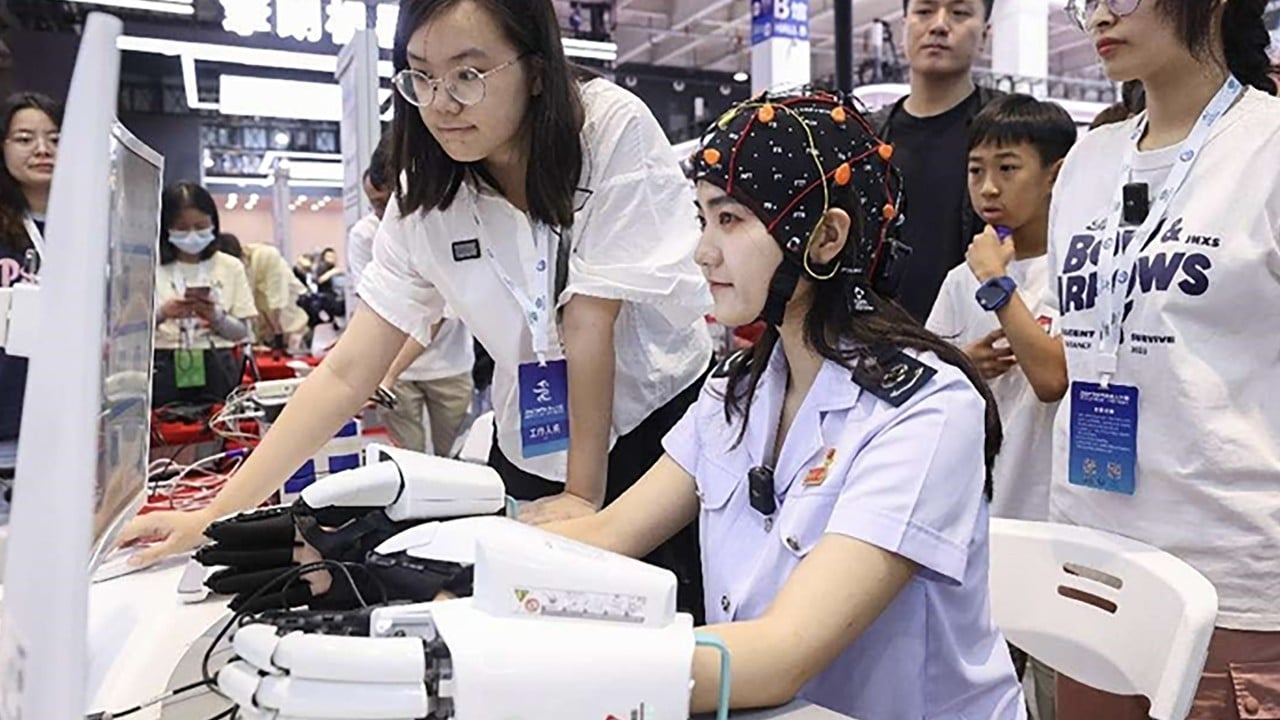
It does not move on asphalt. It moves along microscopic pathways where human biology meets silicon. For years, brain-computer interfaces felt like science fiction reserved for late-night movies and speculative essays—a distant promise that a person locked inside a silent body might one day move a cursor or speak a sentence simply by thinking it. Now that promise is crossing a threshold. The brain-computer interface boom is entering its next phase, moving from isolated laboratory experiments toward scalable clinical tools, commercial products, and something far quieter yet just as consequential: the race to write the global rulebook.
China is pushing hard to shape those standards.
That phrasing sounds dry on paper. Standards. Protocols. Compliance. Most of us skip right over words like that because they feel bureaucratic, like building codes or USB cable shapes. Yet the rules governing how a machine reads a neuron—and how a neuron responds to a machine—decide everything that follows. They determine what counts as safe, how data is formatted and stored, how clinical trials are judged, and which hardware ecosystems become the default global language.
I have spent years watching technology policy collide with human vulnerability, sitting in rooms where engineers talk in milliseconds while families talk in decades. It can be dizzying. Even for people who read technical reports for a living, the speed of neurotechnology is unsettling. Sometimes I catch myself wondering if we are moving faster than our wisdom allows. Still, looking closely at what is happening right now reveals stakes that are deeply personal, even if you never plan to place an electrode near your head.
The Invisible Architecture of Thought
To understand why standards matter so much in brain-computer interfaces, consider a hypothetical scenario. Imagine a man in his late forties named Lin, living in a coastal city. A severe spinal injury has left him unable to move his legs and barely able to lift his right hand. For three years, his world has shrunk to the ceiling above his bed, the cadence of a nurse's footsteps, and the glow of a tablet propped on an adjustable arm.
Lin is a hypothetical character created to illustrate a real-world inflection point, though his situation mirrors the experiences of thousands of patients living with paralysis, ALS, or stroke recovery globally.
Now suppose Lin is offered an implant or a high-precision non-invasive system that translates neural signals into movement commands for a robotic arm or a communication screen. Hope returns, sharp and fragile. He wants to pour his own glass of water. He wants to type a message to his daughter without waiting for someone else to guess the letter.
Here is the catch that rarely makes the headline: a brain-computer interface is not just a piece of metal or a clever algorithm. It is a chain of translations. Electrical impulses or hemodynamic signals have to be captured, amplified, filtered, decoded, and turned into an action. Every link in that chain needs rules. How much electrical current is safe over five years? How is neural data encrypted so it cannot be scraped or misread? How do two devices built by different teams talk to each other without glitching?
Think of it like railroad gauges in the nineteenth century. When every region lays tracks a different width, trains cannot cross borders without stopping, unloading, and starting over. Whoever sets the gauge shapes the entire network that grows on top of it. In neurotechnology, the "gauge" is a set of technical, ethical, and clinical standards governing signal quality, device interoperability, biocompatibility, and data governance.
When a country pushes to shape those standards early, it is not merely flexing industrial muscle. It is trying to make sure its hospitals, laboratories, and domestic manufacturers set the baseline that the rest of the world has to reckon with.
Why Beijing Is Moving on the Rulebook Now
Why has this push accelerated right as the sector enters its next phase? Because early breakthroughs proved the concept, and the next phase is about scale, standardization, and integration.
For a long time, brain-computer interface research lived mostly in university labs and specialized pilot programs. A handful of participants could spell words slowly or steer a cursor across a screen under heavy supervision. Those moments were extraordinary, proof that the human nervous system could form a working bridge with external electronics. Yet moving from a dozen carefully monitored cases to broader clinical adoption and commercial viability requires repeatability. Repeatability demands standards.
China brings several distinct pressures and advantages to this moment. First is sheer scale in healthcare demand and clinical infrastructure. With an aging population and high numbers of patients dealing with neurological conditions, stroke aftermath, and spinal injuries, there is powerful domestic urgency to turn promising research into practical medical tools. Large hospital networks can coordinate trials and gather data at a pace that smaller or more fragmented systems often struggle to match.
Second is industrial coordination. Standards do not emerge in a vacuum; they grow alongside supply chains, chip design, materials science, and regulatory sandboxes. By aligning research institutes, medical device makers, and standards bodies early, Chinese stakeholders aim to influence international guidelines before rival frameworks harden into place.
Third is geopolitical timing. Across artificial intelligence, telecommunications, electric vehicles, and biotechnology, nations increasingly treat technical standards as strategic terrain. If one ecosystem defines how neural devices are tested, certified, and connected, companies elsewhere face a choice: adapt to those specifications or build parallel tracks that cost more time and money.
None of this means global standards are decided overnight or dictated by a single capital. International standard-setting is slow, contentious, and full of compromises among engineers, regulators, clinicians, and industry groups from many countries. Still, showing up early with concrete proposals, working hardware, and clinical data changes the center of gravity in those rooms.
The Stakes Beneath the Specifications
It is easy to treat standards battles as a chessboard where superpowers move pieces around. That misses the human tremor in the room.
Consider what happens next: a child with severe cerebral palsy or an older adult losing speech after a neurological event relies on an assistive communication device. If standards prioritize rapid deployment over long-term hardware durability or strict data privacy, who pays the price when a firmware update fails or a signal profile is mishandled? Conversely, if rules are so fragmented that every system is a closed island, a patient who moves or switches care teams could lose access to tools calibrated to their specific neural patterns.
Privacy is another fault line that makes even seasoned technologists pause. Neural data is uniquely intimate. Unlike a password you can reset or a credit card you can cancel, patterns tied to attention, motor intent, or cognitive states touch the very seat of agency. Standards around consent, storage, and secondary use of brain-related data will shape whether patients trust these technologies or view them with deep suspicion.
There is also a quiet question of access. Will emerging standards help lower costs and widen clinical reach so people outside major tech hubs can benefit, or will they create a two-tier world where only wealthy institutions can navigate compliance and maintenance?
I do not pretend to have neat answers to all of those questions. Anyone who claims neurotechnology standards are simple is either ignoring the science or ignoring human nature. What feels clear is that silence from the public is risky. When only specialists and policymakers pay attention to technical standards, decisions that affect millions of lives get made behind closed doors under technical headings that sound too boring to protest.
Beyond Hardware Toward Shared Ground
If we step back from the rivalry angle for a moment, there is a more constructive way to read this turning point. Standards are not inherently weapons; they are also bridges.
Medicine has long relied on shared benchmarks so a clinical result in one country means something reliable in another. Safety margins, sterilization protocols, and reporting formats let doctors compare outcomes and spot problems early. As brain-computer interfaces move closer to broader medical and assistive use, shared baselines around safety, signal clarity, and ethical oversight can protect patients regardless of where a device is made.
The real test is whether competing pushes to shape global standards turn into a race to the bottom on safety or a constructive push toward clarity, interoperability, and accountability. That outcome will depend on transparency, open scientific exchange, and whether patient safety and human dignity remain central rather than treated as afterthoughts.
A raindrop hits the windowpane in that quiet Beijing room, sliding slowly past a stack of fresh drafts. Outside, life goes on—people walking with umbrellas, checking phones, carrying worries no machine has ever read. Inside, pages of proposed rules wait to be debated, revised, and tested against reality, deciding how the next chapter of human-machine connection is written.