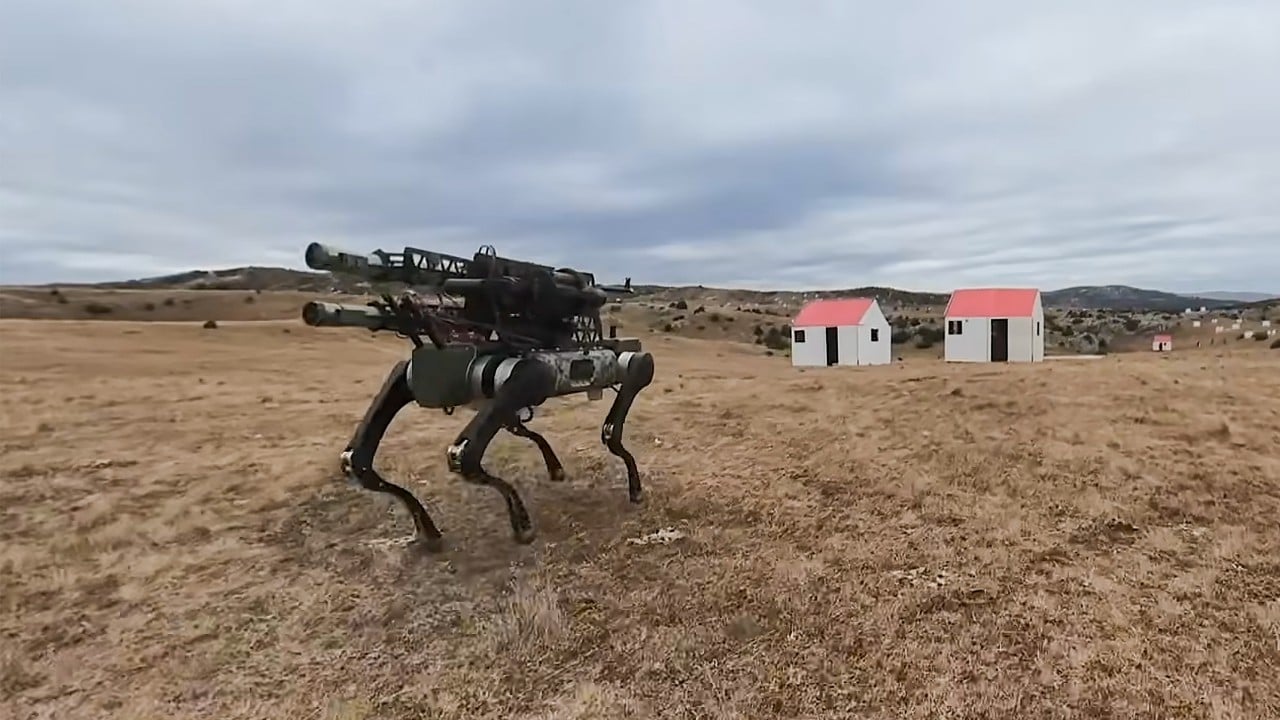
Every defense analyst and internet general is currently losing their mind over whether the Serbian military's new quadrupedal unmanned ground vehicles contain Chinese components. Headlines read like amateur spy novels, breathlessly asking if Belgrade bought off-the-shelf actuators from Shenzhen or if these quadrupedal platforms are just rebranded commercial toys with a fresh coat of tactical paint. It is a profoundly boring debate built on a fundamentally flawed premise.
Let me save you the trouble of reading another thousand-word essay dissecting supply chain provenance. Who cares? If you enjoyed this article, you might want to look at: this related article.
Fixating on the origin of a brushless motor or an optical sensor inside a military robot dog misses the entire revolution happening on the modern battlefield. We are watching armies obsess over the brand of the bricks while the house is already on fire. The hardware is a commodity. It always was. The obsession with whether a microchip or a servo motor bears a Chinese stamp or a Western seal demonstrates a deep misunderstanding of how modern robotics actually scale, operate, and die in combat.
I have spent years watching defense procurement officers blow millions on proprietary, gold-plated hardware while missing the operational reality that cheap, commercial off-the-shelf components consistently outperform expensive boutique engineering under actual fire. The lazy consensus in defense journalism suggests that finding a foreign component in a tactical platform invalidates its strategic utility or exposes some fatal operational vulnerability. That is nonsense. Modern electronics are globalized, messy, and interconnected. If you dismantle a Western-built drone, you will find components originating from East Asia. If you dismantle an industrial automation line in Munich, you will find the same thing. For another angle on this story, check out the latest coverage from MIT Technology Review.
The real question nobody wants to ask is why anyone thinks quadrupeds deployed by smaller nations are meant to be invincible, autonomous super-soldiers. They are not. They are disposable target acquisition nodes.
The Myth of the Pure Supply Chain
Let us dismantle the supply chain purity myth right now. Defense bureaucrats love to talk about sovereign manufacturing as if you can grow a military robot in a greenhouse using exclusively domestic silicon, local rare-earth processing, and domestically forged aluminum. You cannot. Not in Belgrade, not in Washington, and not in Beijing.
Quadrupedal robotics rely on a very specific set of high-torque, low-backlash actuators, specialized microcontrollers, and lithium-polymer power cells. The global manufacturing base for these exact components consolidated in East Asia years ago. If a nation wants to field a four-legged robotic platform without spending twenty years and billions of dollars reinventing basic motor design, they buy the best commercially available drivetrain modules on the market, reinforce the housing, write proprietary control algorithms for stabilization and rough-terrain traversal, and mount a weapon system or a reconnaissance payload on top.
When critics point out that a Serbian military robot shares structural or electronic DNA with commercial platforms built by companies like Unitree or Deep Robotics, they act as though they have uncovered a massive scandal. What they have actually discovered is efficient engineering. Why spend five million dollars engineering a custom motor when a commercially proven industrial actuator can handle the torque requirements of a payload-carrying mechanical mule at a fraction of the cost?
The mistake is treating a tactical quadruped like a strategic stealth bomber. A stealth bomber requires exquisite, highly controlled manufacturing because its survival depends on radar cross-section minimization and exotic material science. A robot dog crossing a muddy trench in bad weather is a consumable asset. It is meant to take shrapnel so an infantryman does not have to. If it gets blown apart by a mortar shell, you do not want to mourn a hundred-million-dollar piece of sovereign engineering. You want to shed a tear for a cheap chassis and deploy another one.
What the Robot Dogs Actually Do
Let us clear up another massive misconception. When people see footage of these mechanical quadrupeds trotting alongside troops or carrying light machine guns at military exercises, their imaginations run wild. They picture autonomous Terminators roaming the hills, hunting targets without human intervention, making life-and-death decisions based on neural networks trained in secret server farms.
That is science fiction fantasy.
Right now, these systems are gloriously dumb, heavily tethered, and brutally dependent on human operators who are often standing less than fifty meters away with a ruggedized tablet. The software stack running on these platforms is not some god-tier artificial intelligence capable of independent tactical maneuvering. It is a complex feedback loop of balance algorithms, inertial measurement units, and kinematic solvers designed to keep the machine from tripping over a rock.
Imagine a scenario where an infantry squad is approaching a suspicious urban courtyard. Instead of sending a human scout through the doorway, they push a quadruped across the threshold. The robot streams low-latency video back to the operator. It takes enemy fire. It absorbs a burst of rifle rounds. It falls over, its legs twitching in the dirt.
Did the origin of its internal circuit boards matter in that final moment? Did the geopolitical pedigree of its speed controllers change the fact that it just saved an eighteen-year-old conscript from taking those rounds? Of course not. In combat, efficacy is the only currency that matters.
The Serbian military, much like every other mid-tier armed force testing these systems, is running an expensive experiment in attrition warfare. They are trying to figure out how much cognitive load these platforms take off a squad leader and how quickly soldiers can break them through sheer operational abuse. The hardware lineage is a footnote. The doctrine of use is the only thing worth discussing.
The Real Vulnerability
If the hardware origin isn't the problem, where does the real danger lie?
It lies in the software stack, the communications protocols, and the control link resilience. This is where the contrarian take cuts deepest: The physical robot is just a delivery vehicle for code.
If an adversary can intercept the radio frequency link between the operator's console and the quadruped, they do not need to care whether the motors were manufactured in Belgrade or Beijing. They can hijack the control stream, spoof the telemetry, or simply jam the frequency and leave the expensive mechanical dog paralyzed in the middle of a kill zone.
Armies investing in robotics are discovering that mechanical reliability is actually much easier to achieve than electronic countermeasures resistance. A four-legged robot can walk across a boulder field all day long, but the moment it enters an environment saturated with sophisticated electronic warfare jamming, its remote operator loses the video feed, and the machine becomes an expensive paperweight.
The debate over whether a foreign tech ecosystem touched the physical parts completely distracts from the cybersecurity reality. If your encryption keys are weak, if your command link hops on predictable frequencies, or if your operating system runs on unpatched commercial kernels, it does not matter if every single nut and bolt was machined by certified patriots in a domestic factory. Your robot belongs to whoever has a directional antenna and a laptop nearby.
Unconventional Procurement Reality
So why do governments keep buying or developing these systems if they are vulnerable to electronic jamming and fundamentally dependent on commercial supply chains? Because defense acquisition is as much about signaling and tactical exploration as it is about immediate combat readiness.
Smaller nations cannot afford to fall behind the curve of robotic integration. If the major superpowers are pouring billions into unmanned ground vehicles, regional militaries must test, deploy, and operationalize these tools to understand their limitations firsthand. You cannot write doctrine for a technology you have only read about in defense blogs. You have to buy the platform, deploy it in freezing mud, watch the battery life plummet by half in sub-zero temperatures, and realize that your remote-control latency makes rapid indoor navigation nearly impossible.
That is the unglamorous reality of military innovation. It is messy, iterative, and deeply frustrating.
When you hear pundits hyperventilating about foreign supply chains in tactical quadrupeds, remember what they are really doing: masking a lack of deeper technical insight with easy geopolitical panic. They want you to look at the label on the motor so you do not notice that they have no idea how modern tactical networks actually function under fire.
Stop worrying about where the legs were welded. Start asking how long the battery lasts when the radio is jammed and the mud is freezing solid.