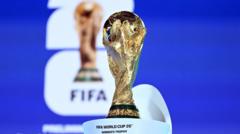
The narrative being sold by the governing bodies is a fairy tale about inclusivity. They want you to believe that more teams equals more "magic," more "global reach," and a better product for the fans. It is a lie rooted in spreadsheet-driven greed rather than sporting integrity.
By bloating the World Cup to 48 teams, the organizers haven't opened the doors to a festival; they’ve invited a crowd to a high-end dinner party and watered down the wine until it tastes like tap water. We are about to witness the systematic destruction of the most prestigious tournament on earth, all in the name of chasing television markets that don’t actually care about the quality of the football.
The Myth of the Cinderella Story
The "lazy consensus" among pundits is that adding more teams from underrepresented regions will lead to more "Morocco 2022" moments. This is a fundamental misunderstanding of how elite performance works. Morocco didn't succeed because the tournament was big; they succeeded because they were a compact, tactically superior unit that emerged from a grueling, high-stakes qualification process.
When you lower the barrier to entry, you don't get more elite competitors. You get more fodder.
The group stages, which used to be a nerve-shredding tightrope walk, will now become a tedious formality for the giants and a desperate scramble for the mediocre. We are trading the "Group of Death"—the most exciting mechanic in tournament sports—for a series of low-intensity matches where three points are virtually guaranteed for any team with a top-20 ranking.
Dilution Is Not Development
I have watched football federations pour money into stadium infrastructure while their youth academies rot. The argument that World Cup participation "fuels growth" in developing nations is a fallacy used to justify political votes.
True development happens in the four years between tournaments. It happens in coaching education and domestic league stability. Handing a ticket to a nation that hasn't earned it through a rigorous 32-team filter is like giving a participation trophy to a marathon runner who skipped the first 20 miles. It devalues the achievement for everyone involved.
Consider the technical gap. In a 32-team format, the delta between the top seed and the bottom seed is manageable. In a 48-team format, we are looking at matches where the tactical disparity is so vast that the "lower" team has no choice but to deploy a low block and pray for a scoreless draw. We aren't getting more goals; we’re getting more "anti-football."
The Math of Mediocrity
The proposed 3-team group structure (which they’ve backtracked on slightly because it was a mathematical disaster) or the bloated 4-team groups both lead to the same outcome: the "Dead Rubber" problem.
- Collusion Risks: When three teams are involved, the final match often allows two teams to play for a specific result that eliminates the third. This isn't a theory; it’s a historical fact (see: Gijón, 1982).
- Third-Place Qualification: Allowing the best third-place teams to advance turns the group stage into a math problem rather than a knockout battle. It rewards safety. It rewards the team that loses 1-0 instead of 3-0.
In the old format, every goal felt like a life-or-death event. In the new format, a loss in the opening game is a minor inconvenience. We are removing the stakes, and without stakes, sport is just expensive exercise.
The Physical Toll Nobody Mentions
The human body is not a machine, though the schedule-makers seem to think otherwise. We are asking elite players—who are already playing 60+ games a season for their clubs—to navigate an extended tournament with an extra knockout round.
Data from sports science firms like Catapult shows that the risk of soft-tissue injury skyrockets when recovery times drop below 72 hours in high-pressure environments. By extending the tournament, we aren't seeing the "best against the best." We are seeing the "healthiest against the healthiest." The stars you pay to see will be shadows of themselves by the quarter-finals, hamstrung by fatigue and tactical caution.
Stop Asking if Everyone Can Play
The most common question in "People Also Ask" sections is: "Does the new format help smaller nations?"
The answer is a brutal "No."
It helps the politicians of those nations. It gives them a platform to claim success without having to actually improve their national football programs. For the players, getting thrashed 6-0 on a global stage does nothing for their confidence or their market value. It exposes a gulf that they aren't prepared to bridge.
If we actually cared about the "global game," we would invest in regional tournaments and intercontinental playoffs that take place outside the World Cup window. We would make the path to the top 32 harder, not easier. Excellence is curated through scarcity.
The Economic Mirage
The organizers point to record revenues. Of course the revenue is higher; there are more tickets to sell and more minutes of advertising to auction off. but this is short-term thinking.
They are liquidating the "brand equity" of the World Cup. Part of what makes the trophy the most coveted prize in sports is that it is nearly impossible to get your hands on it. When you make the tournament a bloated, month-long slog through 104 matches, you invite viewer fatigue.
Even the most die-hard fans have a limit. When the "World Cup" feels like just another endless league season, the prestige vanishes. And once the prestige is gone, the premium sponsors will follow.
The Uncomfortable Truth
The 32-team format was the perfect equilibrium. It balanced global representation with high-level competition. It was a masterpiece of sporting design.
We are trading that masterpiece for a sprawling, disorganized mess because the people in charge prioritize quantity over quality. They are betting that you are too distracted to notice the drop in standard. They are betting that "more" will always be perceived as "better."
They are wrong.
The first time a powerhouse team rests its entire starting eleven for a meaningless third group match, or the first time a "best third-place" team shuffles into the semi-finals after winning only one game, the illusion will shatter.
Football is supposed to be about the pursuit of perfection, not the management of a crowded calendar. By opening the gates to everyone, the World Cup has ensured that, eventually, it will mean nothing to anyone.
The crown is being turned into tin. Stop pretending this is progress.