The dirt on a West Texas ranch does not merely sit on the earth; it tests you. It bakes until it cracks open like old leather, then it catches a north wind and strips the paint right off your truck doors. My grandfather used to say that owning land out here is less like being a master and more like being a long-term tenant who has to pay for all the repairs. Every post you sink into caliche clay requires a pickaxe and a prayer. Every well you drill pulls water that tastes like the bottom of a galvanized bucket.
For generations, the math of ranching has been a cruel one. You measure your wealth in head of cattle and your poverty in inches of missing rain. When a drought hits—and out here, a drought is not an event but a season that forgot to end—the numbers stop making sense. You sell off half your herd at a loss just to keep the remaining cows from starving on dust. You watch the auction barn prices drop while your feed bills climb. You wonder how many more years your children will want to inherit a mortgage disguised as a homestead.
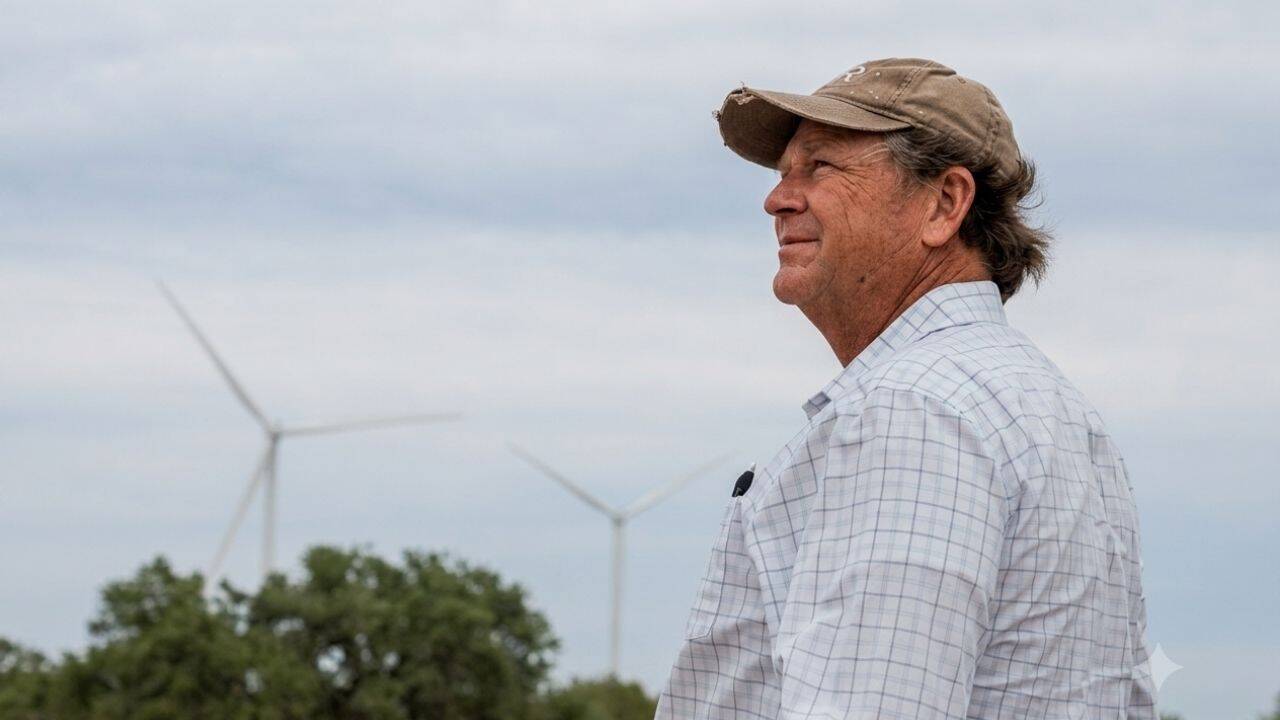
Then the white towers started marching across the horizon.
They arrived on massive flatbed trailers, hauled by trucks that took up both lanes of the two-lane highway. To a lot of old-timers, those towering steel monoliths looked like foreign invaders. They were clean, white, and humming with a quiet, industrial thrum that had no business being out where the coyotes howl at night.
I remember when the first leasing agent knocked on the door. He wore shiny boots that had never touched cow manure and carried a leather portfolio filled with promises. Wind royalties. Guaranteed monthly checks. Passive income that would flow whether the grass grew or the sky stayed bone-dry.
My first instinct was no. Almost every rancher I know reacted the exact same way. We said no twice.
We said no because our pride is bound up in the dirt. We take care of the land, and the land, in its own stubborn way, takes care of us. Inviting a corporate energy firm to string cables across your pastures felt like selling off a piece of your family's history. It felt like an admission of defeat. If you need wind turbines to keep the ranch afloat, are you really a rancher anymore, or are you just a landlord renting space to a machine?
Besides, the skepticism runs deep. You hear stories about promises made and broken. You worry about heavy machinery tearing up the root systems of native grasses, compacting the soil until nothing grows back. You think about the hawks and the golden eagles that ride the thermals above the arroyos.
So, we slammed the gate. Literally.
But a mortgage does not care about your pride. A tax assessment does not soften its blow because you love your grandfather’s branding iron.
The turning point did not come from a slick presentation or a higher financial offer. It came from a cracked windmill and a dry stock tank. It came from looking at the ledger at the end of a brutal summer and realizing that the traditional ways of surviving were vanishing faster than the underground water table. The cattle market had dipped, the diesel prices had doubled, and the bank was asking questions that my checking account could not answer.
When the leasing agents came back the third time, the anger had burned down to exhaustion. We sat at the kitchen table over lukewarm coffee and actually looked at the fine print. Not as a surrender, but as a trade.
Modern wind energy development on private land is not an eviction; it is an easement. The turbines take up a remarkably small footprint at the base—just a fraction of an acre per tower—while the massive blades spin hundreds of feet above the grazing cattle. The cows do not care about the noise. They stand right beneath the spinning towers to catch the shadow on a hundred-degree July afternoon.
Signing that contract changed the geometry of our survival.
The first royalty check arrived on a Tuesday. It did not make us rich. It did not buy a fleet of new trucks or fund a vacation to the coast. What it did was infinitely more valuable. It paid the property taxes. It bought four new solar pumps for remote water troughs. It meant that when the spring calf crop brought disappointing prices, we did not have to panic-sell a parcel of ancestral pasture just to keep the lights on.
For the first time in thirty years, the wind was not just something that blew the roof off the barn or dried out the topsoil. It was a crop we could harvest without dropping a single seed in the ground.
People in cities often look at rural landscapes as museums. They want them frozen in sepia tones, untouched by modern technology, populated by rugged individualists who never check a bank balance. But real conservation requires capital. You cannot preserve open space, protect wildlife corridors, and keep a multi-generational ranch intact on grit alone. Grit does not pay the veterinarian. Grit does not fix a blown-out transmission on a tractor.
The wind turbines became the silent partner we never knew we needed. They took the volatility out of the weather. When the sky refuses to rain, the wind still blows across the plains of West Texas. It is relentless, fierce, and dependable.
Now, when I walk out the back door at dusk and look across the rolling scrub toward the ridge, I see those white giants turning slowly against the bruised orange sky. They do not ruin the view. To me, they look like fence posts holding up the future. They are the reason my daughter can look at the same pastures her great-grandfather walked and know, with absolute certainty, that she will be the one passing them down to her own children.



.jpg?itok=Ly4V6nyd)