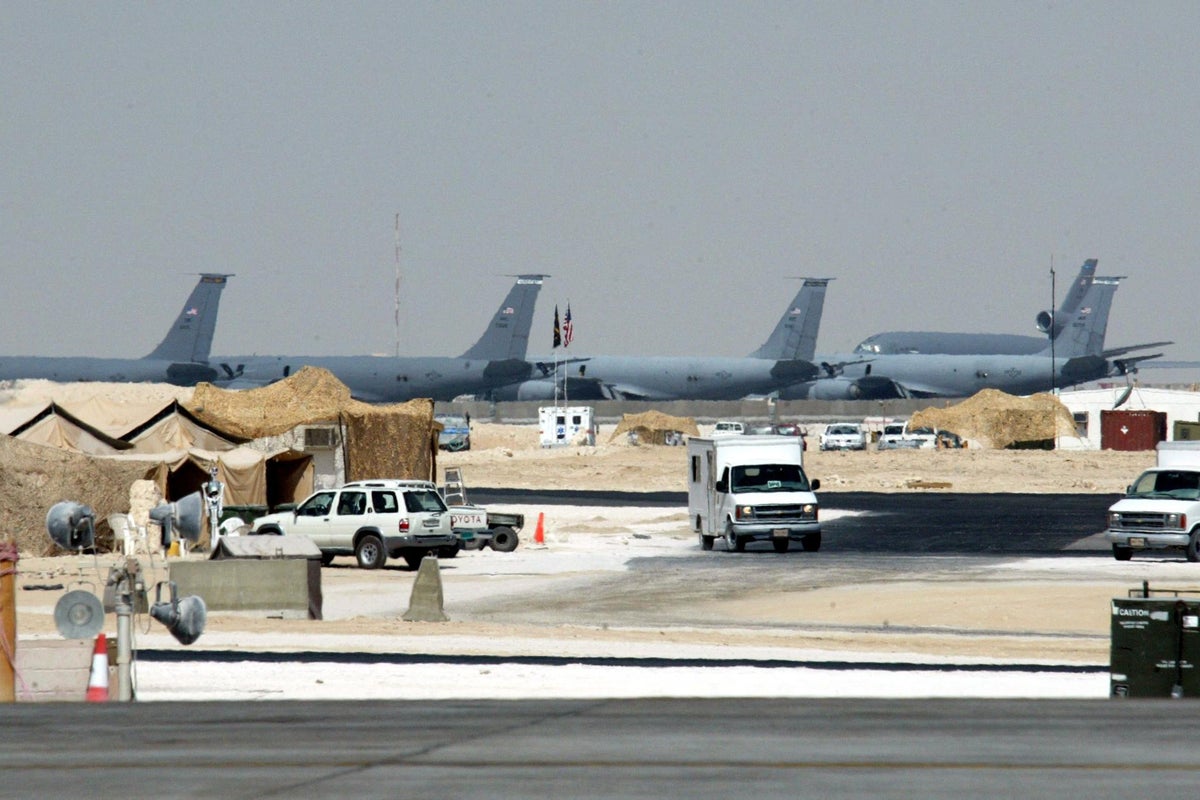
The map of American and British power in the Middle East isn't a secret. It's an open ledger of decades-long geopolitics, written in concrete runways, radar domes, and heavily fortified perimeter walls. But the recent eruption of direct combat operations between the West, Israel, and Iran has flipped the script on these installations. Overnight, bases built to project overwhelming strength have transformed into highly visible, static targets.
When you look at the sheer scale of the Western presence, it’s easy to get distracted by the big numbers. We’re talking about over 50,000 American personnel and thousands of British troops scattered across more than a dozen countries. For years, the conventional wisdom was that this sprawling footprint guaranteed stability. It didn't. Instead, as the conflict has escalated into a series of massive missile exchanges and drone barrages, these bases have become massive liabilities. They are right in the crosshairs of an adversary that has spent thirty years perfecting the art of cheap, asymmetric saturation strikes.
Understanding the current vulnerability of these sites requires looking past the official press releases. You have to look at where these troops actually sleep, fly, and coordinate operations.
The Persian Gulf Ring of Fire
The core of American strategic reach sits right on Iran’s doorstep along the Persian Gulf. This is where the heavy logistics happen, and honestly, it’s the most precarious real estate on earth right now.
Qatar hosts Al Udeid Air Base. This facility holds more than 10,000 American personnel and serves as the forward headquarters of U.S. Central Command. It features a massive two-mile runway and acts as the nerve center for the entire air war. When Iranian missiles started flying, Al Udeid didn't just coordinate the regional air defenses—it had to scramble to defend its own airspace. Qatari forces and U.S. Patriot batteries have been working overtime to knock down incoming threats, turning this massive logistics hub into an active front line.
Further up the coast, Kuwait holds the highest concentration of ground troops, with roughly 13,500 soldiers stationed across facilities like Camp Arifjan and Ali Al Salem Air Base. Kuwait has historically been the staging area for major ground movements. In a missile-dominated conflict, these expansive bases provide huge footprints that are incredibly difficult to miss.
Then there’s Bahrain. This tiny island nation hosts the U.S. Navy’s Fifth Fleet headquarters in Manama. It's the crown jewel of maritime power projection in the region, managing everything from the Red Sea to the Strait of Hormuz. But as tensions boiled over, the vulnerability of keeping warships tied to a pier in a narrow gulf became painfully obvious. Fleet command had to pull most of its naval assets out of port to give them maneuvering room, leaving behind a heavily reduced skeleton crew of critical personnel on shore to ride out the strikes.
Down in the United Arab Emirates, Al Dhafra Air Base provides critical reconnaissance and refueling capabilities. Like its neighbors, Al Dhafra has seen its air defenses pushed to the absolute limit. Even non-military commercial infrastructure used by Western forces, like Dubai’s Jebel Ali Port and Oman’s Duqm Port, has faced targeting. The lesson here is simple. If an American uniform walks through the gate, the location is on the target list.
The Fragile Outposts in Iraq, Syria, and Jordan
While the Gulf bases deal with high-end ballistic missiles, the smaller outposts in Iraq and Syria face a completely different kind of nightmare: constant, grinding drone and rocket attacks from local paramilitary groups.
About 2,500 U.S. troops remain in Iraq, primarily at Ain al-Asad Air Base in the west and an airfield in Erbil. Officially, they're there in an advisory capacity to prevent an ISIS resurgence. Practically, they are surrounded. These outposts don't have the luxury of deep strategic depth. They rely on close-range air defense systems to survive near-daily harassment from rocket pods and low-flying suicide drones.
Across the border in Syria, around 900 American troops occupy a string of small, isolated facilities in the eastern oil fields and the remote Al-Tanf garrison near the Jordanian border. These locations are completely dependent on air supply lines. They have zero room for error. If a coordinated drone strike successfully knocks out their local air defenses, these troops are left dangerously exposed without immediate heavy reinforcement.
Jordan has quietly become the true bedrock for Western air operations outside the Gulf. Muwaffaq al-Salti Air Base hosts American F-15E Strike Eagles and various reconnaissance assets. Jordan’s airspace has essentially become a giant interception zone where U.S. and allied jets hunt down drones before they can reach deeper targets. But this vital role has put a massive target on Jordan's back, dragging a key Western ally directly into the line of fire.
The British Connection and the Mediterranean Shield
The UK's military footprint is smaller than the American machine, but it’s deeply integrated and arguably just as exposed. The most critical piece of British military real estate in this fight isn’t even in the Middle East proper. It’s on Cyprus.
RAF Akrotiri serves as the primary launchpad for the Royal Air Force. Eurofighter Typhoons fly from this Mediterranean outpost to conduct patrols, strike missions, and interception runs. Because Akrotiri has been used so heavily to support regional operations, it became the target of unprecedented long-range drone attacks launched by regional groups. This marks a massive escalation, proving that the conflict can easily spill out of the immediate Gulf region and strike sovereign European territory.
Beyond Cyprus, the UK maintains a regular naval presence in the Gulf through its base in Bahrain (HMS Jufair) and coordinates closely with the U.S. at Al Udeid in Qatar, where RAF personnel are embedded in the combined air operations center. When the regional air defense network activates, British and American officers are looking at the exact same radar screens.
Why Air Defenses Aren't a Magic Bullet
People look at systems like the Patriot, THAAD, and naval Aegis destroyers and assume they create an impenetrable dome. They don't. Military planners know that air defense is a math problem, and currently, the math favors the attacker.
A single Patriot interceptor missile costs millions of dollars. A mass-produced, garage-built suicide drone can cost less than a used car. When an adversary launches dozens of drones, cruise missiles, and ballistic missiles simultaneously, they aren't expecting every weapon to hit. They are trying to overwhelm the radar systems and force the defense batteries to empty their magazines. Once a base runs out of ready-to-fire interceptors, it takes time to reload the launchers. That window of vulnerability is exactly what the adversary is looking for.
Furthermore, these bases are fixed positions. They cannot move. Satellite imagery reveals every hangar, every fuel bladder, and every barracks block with pinpoint accuracy. The Western military strategy in the region has long relied on deterrence—the idea that no one would dare strike an American or British base because the retaliation would be devastating. Now that deterrence has eroded, these static facilities are discovering that their thick concrete walls and advanced radars can only buy them so much time.
To understand where this heads next, watch the movement of naval assets. The US Navy has deployed multiple carrier strike groups to the Red Sea and Arabian Sea for a reason. Ships can move; airfields cannot. The immediate priority for Western forces isn’t expanding their footprint on land, but rather pulling back to safer distances, relying more on sea-based aviation, and focusing entirely on upgrading the point-defense systems protecting the troops already trapped on the front lines.