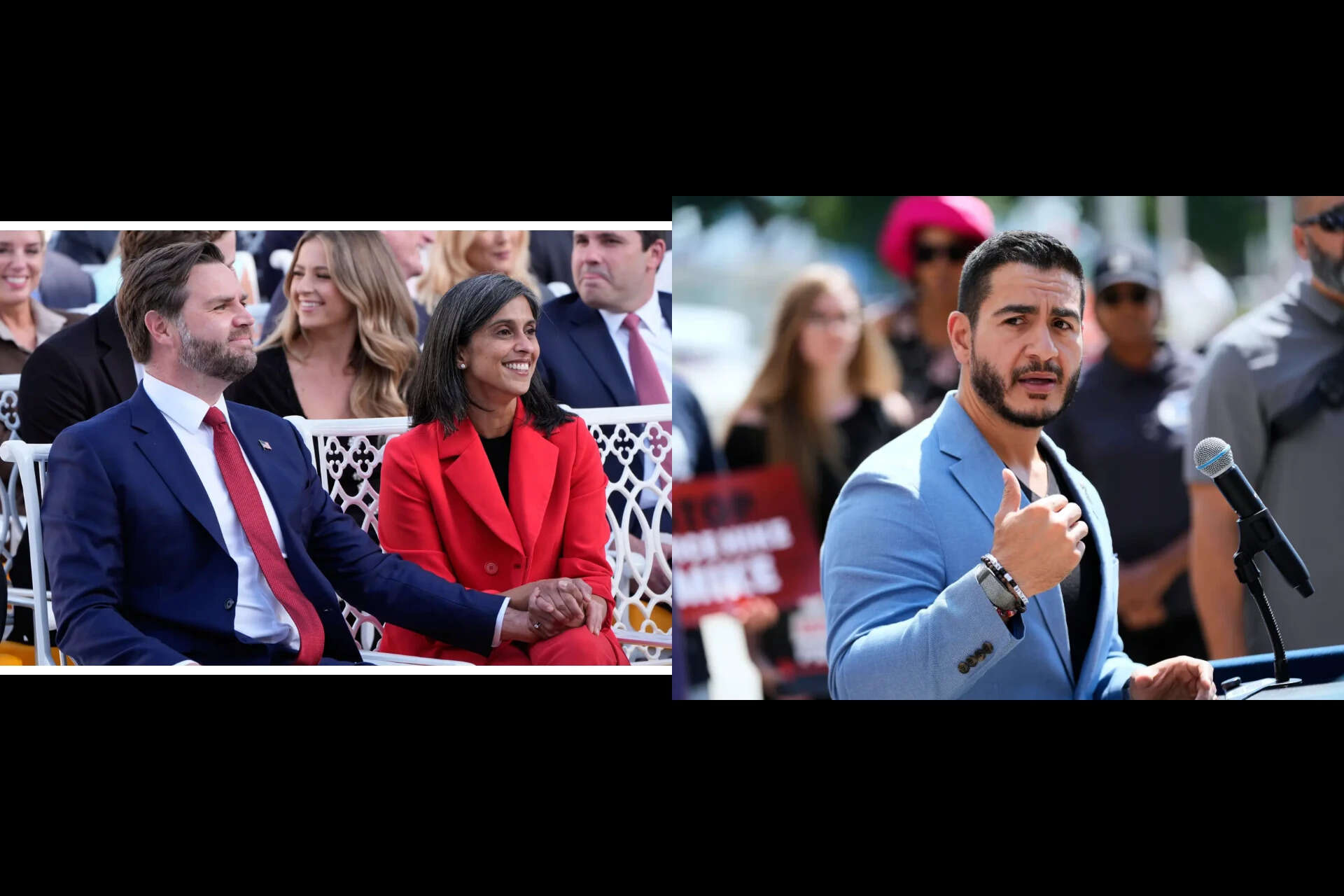
Modern political discourse has officially regressed to the intellectual depth of a junior high school cafeteria. When Vice President JD Vance fired back at Michigan Senate candidate Abdul El-Sayed with a recycled Hollywood line demanding that he keep his wife's name out of his mouth, the media treated it like a heavyweight boxing match. Pundits rushed to microphones to dissect the machismo, the territorial posturing, and the theater of offense.
Everyone missed the actual story. You might also find this connected story useful: The Clash at the Top That Just Redefined America's Army.
The lazy consensus across the political spectrum assumes that dragging a candidate's spouse into the mud is either a brilliant populist counter-punch or an unforgivable crossing of ethical boundaries. Both sides are wrong. This routine is not a sign of high-stakes political combat. It is a predictable, scripted distraction designed to shield both camps from discussing actual policy failures. When politicians turn family into a firewall, voters lose every single time.
Let us look at how this manufactured feud actually started. Vance took a swing at El-Sayed over past comments regarding Sharia law and working-class representation, weaponizing his late grandfather, Papaw, as a moral benchmark for authentic Americanness. El-Sayed responded by questioning whether Vance planned to take his wife, Usha Vance, back in time to meet that same grandfather, poking at the historical and cultural tensions of an interracial marriage in the mid-century Midwest. Then came the viral soundbite from Vance declaring that Usha is way out of El-Sayed's league. As discussed in detailed reports by Al Jazeera, the effects are worth noting.
The entire exchange relies on a flawed premise that political figures own their families' identities as strategic assets, deploying them like medieval shields whenever an opponent gets too close.
Stop treating this as a cultural war victory and start looking at the mechanics of deflection.
When a candidate pivots from inflation, housing crises, or legislative records to defend their spouse's honor on a national stage, it is usually because their economic platform cannot withstand five minutes of honest scrutiny. Vance does not want to debate the trajectory of manufacturing jobs or the reality of rising living costs in the Midwest. El-Sayed does not want to spend an entire news cycle answering for every radical endorsement or fringe association in his primary coalition.
So what do they do? They retreat to the safest terrain in American politics: identity grievance.
By centering Usha Vance in a proxy war over ancestral approval, both men successfully diverted public attention away from the substantive metrics that affect voters' daily lives. This is the oldest trick in the political playbook. Create a spectacle personal enough to generate algorithmic outrage, secure maximum media fragmentation, and starve the electorate of any meaningful policy debate.
The defenders of these public dustups argue that politicians have a natural human right to defend their families. That sounds noble until you examine how the trap is baited. Candidates invite public scrutiny the moment they monetize their personal narratives for campaign memoirs, stump speeches, and media profiles. Vance built a massive political brand around his Appalachian family tree, his upbringing, and his domestic life. You cannot package your personal lineage as a core political credential and then scream foul when an opponent questions how that lineage interacts with the modern world.
Conversely, El-Sayed's decision to target a candidate's spouse to score a rhetorical point reveals a profound tactical bankruptcy. If your critique of an opponent's economic or social platform requires you to speculate about their domestic arrangements or marital dynamics, your argument has already collapsed under its own weight. It is cheap, undisciplined, and fundamentally lazy.
Imagine a scenario where a debate moderator cuts off a candidate mid-sentence for mentioning an opponent's spouse and forces them to state a concrete plan for regional infrastructure instead. The entire house of cards would collapse in seconds.
Vance and El-Sayed are playing roles in a managed WWE-style theater that keeps the donor class happy and the voters thoroughly distracted. Every headline about who said what about someone's wife is a direct subsidy for institutional stagnation. It rewards performative outrage while punishing anyone trying to talk about structural reform, tax policy, or regulatory overreach.
The solution is not asking politicians to be polite. Civility is a dead language in contemporary campaigns. The solution is starving them of the one thing they crave more than adulation: attention given to non-answers.
The next time a candidate turns a policy disagreement into a soap opera about their household, do not pick a side. Recognize it for what it is. It is a confession of emptiness. It is a sign that the substance has run out, leaving nothing behind but noise.
Stop buying the marital melodrama. Demand the ledger.