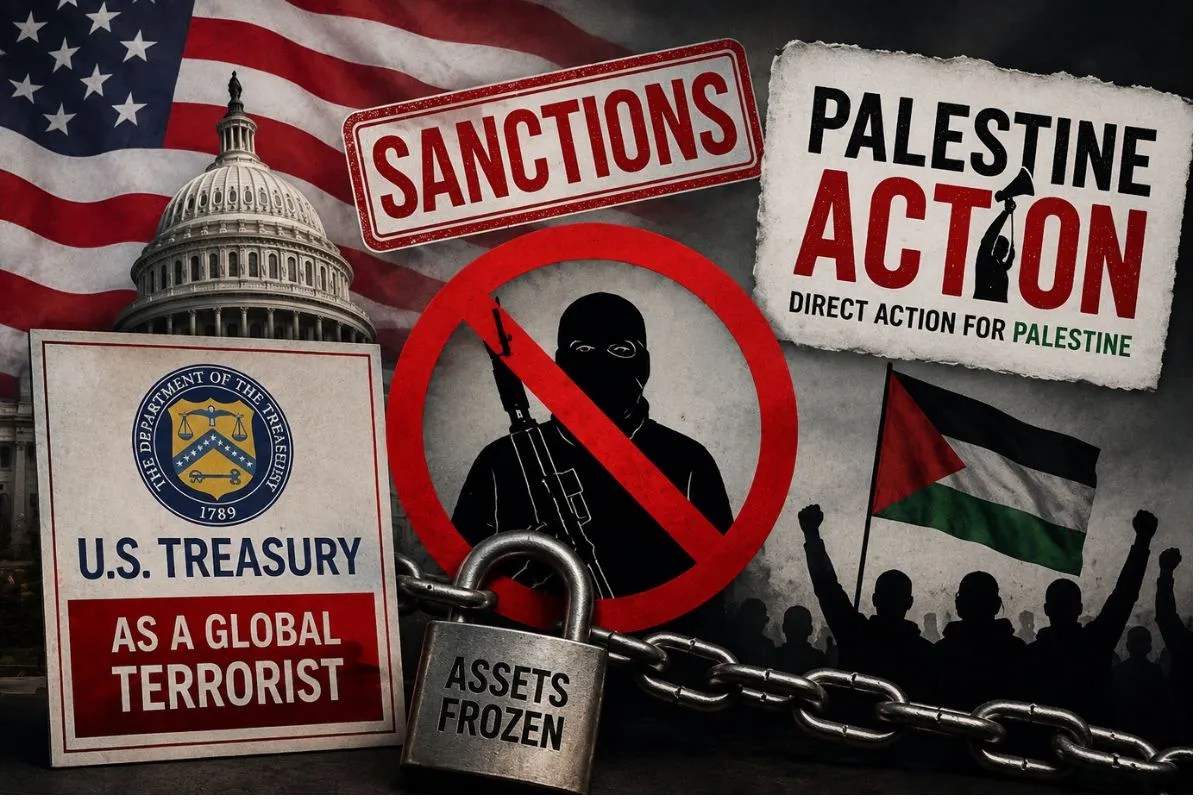
The United States Treasury Department has officially designated Palestine Action as a global terrorist organization, mirroring a controversial British legal precedent and expanding the White House enforcement apparatus into the architecture of international civil disobedience. Treasury Secretary Scott Bessent announced the sweeping financial sanctions, targeting the network for what Washington terms material support for political violence and infrastructure sabotage. This move elevates a localized property destruction dispute into an international counterterrorism campaign, weaponizing state financial systems against radical activist cells operating across borders.
For years, the British direct-action network focused its operations on disrupting supply chains linked to defense contractors, most notably Israeli weapons manufacturer Elbit Systems. Activists smashed facility windows, occupied rooftops, and deployed red paint to symbolize bloodshed. When a cell breached the perimeter of the Royal Air Force base at Brize Norton and damaged military transport aircraft, the threshold for state reaction shifted permanently. London proscribed the group under terrorism legislation, triggering mass arrests of demonstrators holding supportive placards. Now, Washington has imported that doctrine, utilizing the Office of Foreign Assets Control to freeze assets and choke off transactional lifelines.
The Mechanics of Transnational Proscription
Stigmatizing a domestic or foreign protest movement with the label of terrorism requires a specific administrative bridge. The United States government achieved this by classifying direct-action property destruction not as criminal mischief or civil disobedience, but as a coercive attack on commercial and governmental infrastructure designed to influence foreign policy.
By applying secondary sanctions, the Treasury warning extends far beyond direct members. Banks, digital service providers, and crowdfunding platforms anywhere in the Western financial ecosystem now face severe penalties if money flows toward designated accounts or associated fronts.
- Assets held within the United States jurisdiction are frozen immediately.
- Transactions involving American citizens or entities are banned under threat of federal prosecution.
- International financial institutions risk exclusion from the dollar-dominated clearing system if they service linked entities.
This financial strangulation targets the operational oxygen of modern decentralized movements. Without anonymous donation processors, encrypted communication toolkits, and cross-border solidarity networks, militant cells struggle to coordinate physical occupations. Yet, history suggests that decentralization breeds adaptation. When formal accounts close, movements migrate toward untraceable peer-to-peer exchanges and autonomous local cells that require virtually zero centralized funding to execute low-tech sabotage.
The Shrinking Margin for Civil Disobedience
Legal scholars and human rights monitors are tracking the fallout with acute alarm. When standard criminal statutes punishing trespass and vandalism are replaced with counterterrorism designations, the foundational definitions of public dissent undergo a structural fracture.
Consider a hypothetical scenario where an environmental coalition blocks heavy machinery at an open-pit mine. Under traditional frameworks, participants face misdemeanor charges or minor civil injunctions. Under a national security paradigm where economic disruption equates to political intimidation, the same act risks classification as material support for unlawful coercion.
The expansion of these powers reflects a broader Western anxiety regarding civil unrest tied to foreign conflicts. Governments facing intense internal polarization are increasingly willing to use emergency national security instruments to police ideological friction.
The Repercussions on Global Activism
The integration of American and British counter-extremism strategies creates a unified front against militant direct action. State Department officials have made it clear that domestic law enforcement agencies view radical left-wing networks as a transnational threat vector rather than isolated domestic nuisances.
Co-founders of Palestine Action have condemned the measure as an authoritarian blueprint designed to criminalize political dissent, pointing out the deep hypocrisy of states prosecuting protesters while arming foreign military campaigns. Litigation continues to wind through European appellate courts, testing whether democratic constitutions can withstand the erosion of free speech protections under the banner of national security.
The financial barriers are absolute, and the legal penalties are severe. The underground networks, however, continue to mutate in response to state pressure, ensuring that the friction between radical disruption and state sovereignty remains a defining conflict of the decade.


