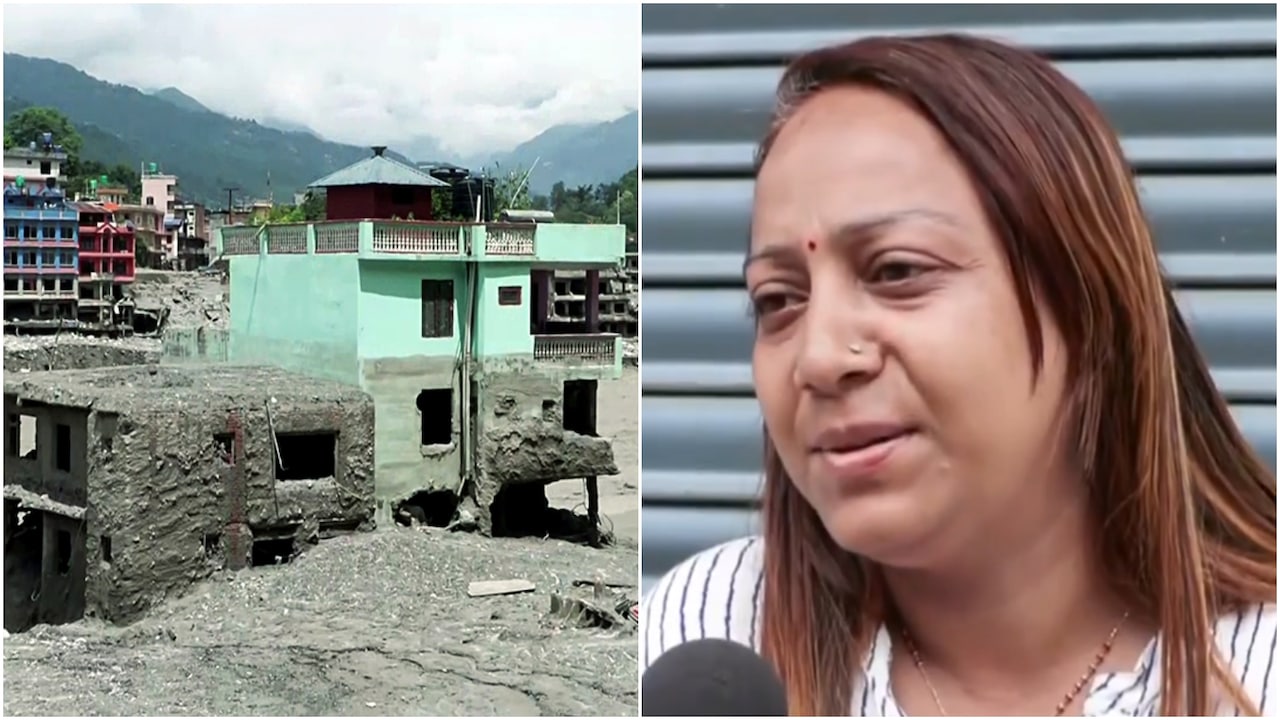
A wall of mud, car-sized boulders, and freezing water tore down the Trishuli River valley at highway speeds. It flattened buildings, swallowed vehicles, and left total devastation in its wake. Yet right in the middle of that apocalyptic churn, a single mint-green, three-storey house refused to budge.
Footage of the structure went viral almost instantly. People online called it a miracle. But for Prakash and Laxmi Pandey, who were trapped inside with four other family members, it was pure terror. They didn't care about viral videos. They just wanted to stay alive.
The Moments Before the Surge
The disaster struck on August 26, catching communities off guard after an ice-and-rock collapse near the border sent an immense volume of water crashing downstream. Prakash and Laxmi were at their small shop roughly five minutes away when the first frantic warnings started circulating.
Realizing their daughter and mother-in-law were still at home, the couple sprinted back. Laxmi rushed inside and begged her mother-in-law to evacuate immediately.
The older woman hesitated. She couldn't fathom the danger, telling them that a disaster of this scale had never hit their pocket of Nuwakot's Dunge Bazaar before. Seconds later, an old bridge upstream collapsed. The water crested the banks instantly, cutting off any possibility of escaping on foot.
Trapped Inside a Shaking Fortress
With escape routes gone, six people retreated higher into the structure. As the muddy torrent smashed against the exterior, the building began to vibrate violently.
Laxmi later described the horror, noting that the motion felt identical to the catastrophic 2015 Nepal earthquake. Outside their windows, neighboring houses disintegrated under the pressure. The family crowded onto upper floors, watching their ground-floor shop inventory, scooters, and cars get swallowed by the brown tide.
They spent over an hour stranded, waiting for the ceiling to give way. They figured their time was up.
Rescue came only when the water level dipped slightly and local neighbors took massive risks. Throwing a makeshift bridge of pipes and ropes across the gap, residents from nearby areas pulled all six family members to safety. They walked away with their lives, but little else.
Engineering Meets Pure Resilience
Everyone wanted to know why this specific building stood firm while everything around it vanished. Experts and structural analysts quickly weighed in on the architecture of the green house.
Prakash pointed to decisions made decades ago. Built roughly 40 years back, the house relied on construction standards and cement qualities that many modern, hastily built structures skip. More importantly, because of its proximity to the river, the family invested heavily in the base. They packed two to three distinct layers of road material directly beneath the foundation to anchor it against erosion.
Structural observers noted additional protective factors. Unlike unreinforced stone masonry common in the region, the building featured a rigid reinforced concrete frame with continuous steel rebar tying the columns, beams, and foundation together. Its position relative to the main current also helped split the debris flow, allowing heavy mud to bank against it and create a temporary deflecting ramp rather than a direct battering ram.
Living After the Waters Recede
The viral attention will eventually fade, but the reality for survivors across Nepal remains grim. The death toll from the floods climbed past 900, with thousands remaining missing.
For the Pandeys, looking at the standing walls of their home brings a complex mix of gratitude and heartbreak. They lost their vehicles, their stored goods, and their sense of local security. Yet, standing on a balcony overlooking a completely transformed landscape, they call it a second birth.
Disasters expose the fragility of human infrastructure in minutes. Sometimes, good engineering and brave neighbors are all that stand between a community and total erasure.