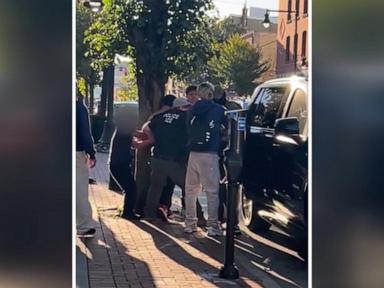
Forty-one seconds of shaky smartphone footage does not explain immigration enforcement in New Jersey. It triggers outrage. It drives clicks. And it leaves almost everyone arguing about the wrong thing.
When video surfaces of federal agents detaining a man in Harrison or confronting angry crowds inside a New Jersey grocery store, the standard media reflex is predictable. One side treats the clip as proof of runaway federal overreach or cruelty in front of children. The other side treats any pushback as lawlessness or obstruction. Both sides stare at the same forty-one seconds and walk away convinced their pre-existing script just won.
They are both dodging the harder reality. A viral street arrest is not an anomaly in modern immigration enforcement; it is what happens when civil administrative authority collides with local policing expectations, state-level friction, and split-second crowd dynamics.
The Lazy Consensus Around Viral Street Clips
Watch enough coverage of an ICE arrest in New Jersey and you will hear the same lazy consensus repeated until it sounds like law. Either federal agents are acting like a rogue street army with zero rules, or local critics are inventing crises out of routine law enforcement.
Both claims are intellectually lazy.
Federal immigration enforcement operates under a distinct legal framework that confuses everyday observers. Immigration violations are generally civil rather than criminal offenses, even though arrest scenes look indistinguishable from criminal felony takedowns. When plainclothes or tactical officers pull someone from a vehicle or walk out of a commercial storefront, bystanders see a street arrest and judge it by familiar criminal-procedure instincts. Meanwhile, agents are executing federal authority in dense municipalities where every sidewalk has a camera and every crowd has a history of distrust.
I have spent years analyzing operational breakdowns, public-safety communications, and high-friction institutional conflicts where public perception lags far behind legal mechanics. When agencies and local officials fight over optics instead of explaining jurisdiction, warrants, and operational rules, trust evaporates on both sides. Worse, people start treating emotional clips as complete legal audits. A camera captures force, noise, and panic. A camera rarely captures the underlying administrative file, the type of warrant involved, or the exact chain of command behind the operation.
Civil Warrants Versus Criminal Instincts
Most people assume an arrest means a judge signed off on probable cause after reviewing evidence. With immigration enforcement, that assumption breaks down fast.
An administrative immigration warrant—such as a Form I-200 or Form I-205—is issued by an authorized immigration official, not a neutral magistrate or judge. That distinction matters enormously when operations happen in public spaces, driveways, or businesses. A judicial warrant carries specific constitutional weight regarding entry and search; an administrative warrant does not grant the same authority to enter private spaces without consent.
Imagine a scenario where federal officers approach a parked car on a residential or commercial street in Hudson County, move to detain a target, and a crowd gathers within ninety seconds. From the sidewalk, bystanders see masked or unbadged personnel, hear children crying, and see a physical struggle. Officers see a volatile perimeter, potential flight or intervention, and a mandate to complete a custody transfer quickly before the scene spirals. Both sides are reacting to real pressure in real time, yet neither shares a common baseline of what legal authority applies on that exact patch of asphalt.
Even state-level rules add fuel to the fire. Reporting around New Jersey operations has highlighted friction over officer face coverings, local school district counseling responses, and clashes between federal agents and local residents or business owners. When federal agents operate in a densely populated state with strong immigrant communities and vocal municipal leaders, every tactical choice—wearing a mask, drawing a crowd in a market, detaining someone outside a vehicle—becomes an instant political flashpoint.
What "People Also Ask" Gets Backward
Search feeds around these incidents fill up with predictable questions. Most of them start from a flawed premise.
Can ICE arrest someone in New Jersey without a local police officer present?
Yes, federal immigration officers do not need a municipal cop holding their hand to enforce federal immigration law. Asking whether local police "allowed" the arrest misses how federalism works. Federal agents enforce federal statutes; local departments set their own policies on cooperation and participation. Expecting local police to act either as federal deputies or as street referees between federal agents and angry residents misunderstands both roles.
Why do bystanders step in during street arrests?
Because human beings react to visible distress faster than they read the U.S. Code. When children are crying or shouting outside a car or a storefront, instinct takes over. That does not make physical interference smart or lawful—stepping into an active law enforcement detention can escalate force and put bystanders or minors in physical danger—but pretending crowds act like neutral courtroom observers is pure fantasy.
Do viral videos change how enforcement actually works?
Sometimes they force rapid public-relations damage control, municipal statements, or legal scrutiny. Rarely do they rewrite federal statutory authority overnight. Heavy hitters in administrative and immigration law—from scholars like Hiroshi Motomura and Stephen Legomsky to policy researchers at the Migration Policy Institute—have spent decades documenting how enforcement priorities, detention capacity, and executive discretion shape outcomes far more than any single clip. A viral video shifts political heat; statutory rules and resource bottlenecks shift actual enforcement volume.
The Blind Spot in My Own Contrarian Take
Focusing on legal mechanics and crowd dynamics carries its own risk: sounding clinical when real families are shaken. A sharp analytical breakdown can easily look detached if it treats human fear and children's distress as mere "variables" in an enforcement equation.
That is a real cost of taking a cold-eyed view. When a town asks schools to offer counseling after a street detention or residents compare a neighborhood scene to a nightmare, dismissing that emotion as "noise" makes the analysis worse, not sharper. Law explains authority; it does not erase trauma or community tension. The trick is holding both truths at once without letting sentimentality replace facts or cold logic excuse sloppy execution.
What Actually Works Instead of Performative Outrage
If you care about outcomes rather than shouting into a comment section, stop treating every new clip as a brand-new revelation. Start building real situational awareness.
- Separate the clip from the claim. When a video drops, list what is visually verifiable—location, number of personnel, crowd reaction—and separate it from unproven claims about legal authority, criminal history, or exact sequence of events.
- Know the difference between public spaces, businesses, and private dwellings. Legal boundaries shift sharply depending on where an encounter occurs and whether consent or a judicial warrant is present. Vague outrage is useless; precise knowledge protects people and clarifies disputes.
- Watch municipal policy and local cooperation rules, not just viral feeds. Real day-to-day friction in New Jersey and the broader metro region is shaped by local ordinances, sanctuary or non-cooperation policies, court appearances, and federal enforcement surges.
- Demand clear identification and accountability standards. Pushing for transparent identification, clear de-escalation rules around minors, and accurate official reporting does not require inventing legal myths—it targets the exact points where public trust breaks hardest.
Stop letting forty-one seconds of rage do your thinking for you; read the law, watch the policy, and judge the system by how it operates when the cameras turn off.