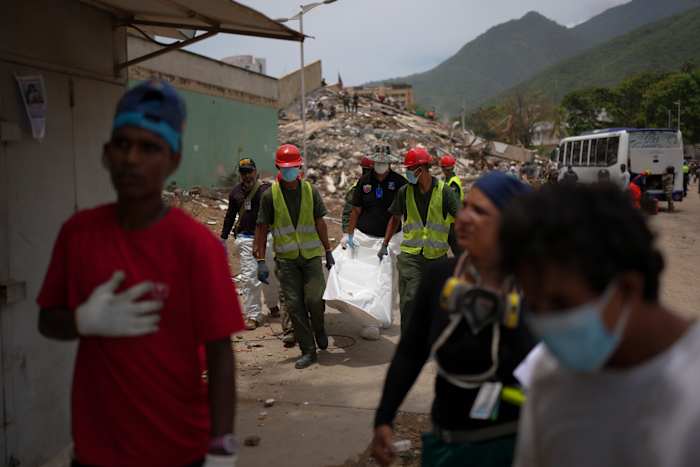
The international press has a predictable script for natural disasters in Latin America. When a major earthquake rattles Venezuela, the cameras rush to the rubble. The headlines scream about the rising body counts, the frantic lines outside morgues, and the immediate, visceral tragedy of families identifying their dead. It is a narrative designed to evoke pity, trigger a brief wave of international aid, and then vanish from the news cycle.
It is also entirely missing the point.
Focusing on the immediate seismic event is a lazy intellectual cop-out. Earthquakes do not kill people in the numbers we see today; systemic infrastructure collapse, institutional rot, and decades of weaponized economic mismanagement kill people. By treating a predictable geological event as an isolated, tragic act of God, the global media operates as an accidental shield for the very bureaucratic forces that guaranteed the body count would be this high.
We need to stop looking at the rubble and start looking at the blueprints.
The Illusion of the Natural Disaster
Let us get one thing straight: seismology is a known variable. Venezuela sits right above the boundary between the Caribbean and South American plates. The Boconó fault system is not a secret. It has been mapping out potential destruction for centuries. Caracas, El Tocuyo, and Cumaná have been leveled before. Engineers have known for fifty years exactly how to build structure-stable housing in these zones.
The media paints a picture of a sudden, unpredictable catastrophe. This is a lie. The tragedy in Venezuela is not an unpredictable disaster; it is a structural certainty.
When you see reports of families rushing to identify bodies, you are looking at the final, unavoidable symptom of a disease that started decades ago. The real killer is the normalization of substandard building codes, the black market for substandard concrete, and the complete evaporation of municipal oversight.
- The Concrete Lie: High-grade, earthquake-resistant concrete requires precise chemical ratios and reinforcing steel rebar. In a hyperinflationary, heavily sanctioned economy, those materials are diverted to luxury state projects or smuggled across borders. The housing citizens rely on is built with brittle, unreinforced masonry.
- The Topography Trap: Desperate populations do not build on stable bedrock. They build on the sheer, unstable hillsides of the barrios. When the ground shakes, these hillsides do not just shift; they liquefy.
To look at the resulting death toll and blame the tectonic plates is equivalent to watching someone get pushed out of an airplane without a parachute and blaming gravity for the impact.
Why International Aid is Poisoning the Recovery
The standard response to these headlines is a global call for humanitarian aid. Celebrities tweet, non-governmental organizations (NGOs) set up donation links, and cargo planes full of bottled water and emergency medical kits line up on tarmacks.
I have watched this play out across multiple disaster zones. Millions of dollars are dumped into a crisis theater that accomplishes nothing but self-absorption for the donors. In a highly centralized, politically fractured state, massive influxes of foreign emergency aid do not reach the vulnerable. They are hijacked.
Imagine a scenario where thousands of tons of medical supplies arrive at an airport controlled by military factions. The supplies do not go to the field hospitals in the worst-hit zones. They are rationed out based on political loyalty, or worse, ends up on the black market where citizens have to buy back the charity meant for them.
"When raw cash and goods flood a broken logistical network, it functions as a subsidy for corruption."
By focusing entirely on the emotional weight of the casualties, the international community justifies a knee-bucket reaction that strengthens the status quo. If you want to actually reduce the body count of the next inevitable tremor, you do not send more body bags or field tents. You cut off the regular avenues of corruption and demand structural accountability before the ground ever moves.
Dismantling the Victim Narrative
The Western media loves a helpless victim. It fits a comfortable paternalistic framework. The articles detailing the chaos outside Venezuelan morgues paint a picture of a population entirely paralyzed by grief and chaos.
This is a profound misunderstanding of the ground reality. The people rushing to these sites are not helpless; they are operating within a highly rational, brutal calculation forced upon them by a failed state. In a system where official records are a mess, identity theft is rampant, and the state frequently buries unidentified bodies in mass graves to keep official statistics artificially low, identifying a body immediately is an act of resistance. It is the only way to protect a family's legal rights, property inheritance, and basic human dignity.
By framing this as merely a sad, chaotic scramble, journalists miss the sheer defiance involved. The citizens are doing the work that a functional government is supposed to handle.
The Real Cost of Disaster Reporting
When we look at the data surrounding disaster recovery, the correlation is grim. The more sensationalized the coverage of the immediate aftermath, the faster the international community forgets about the long-term reconstruction.
| Metric | Immediate Media Focus | Actual Systemic Need |
|---|---|---|
| Primary Target | Body counts, emotional grief, temporary shelters. | Retrofitting existing buildings, clearing corrupt zoning boards. |
| Funding Allocation | 85% goes to short-term relief (food, water, tents). | Less than 15% goes to long-term engineering and infrastructure. |
| Long-term Outcome | Vulnerable populations return to the exact same unsafe hillsides. | Permanent relocation to geologically stable ground. |
The Hard Truth About Reconstruction
If we want to stop writing these articles every ten years, the strategy has to shift from emotional triage to cold, hard engineering and political disruption. The current approach is a loop: build poorly, suffer an earthquake, cry on international television, accept aid, build poorly again.
Breaking this loop requires an uncomfortable, unpalatable strategy.
First, stop funding the immediate aftermath through centralized state channels. If an international entity cannot control the distribution down to the last brick, the money should stay in the bank.
Second, recognize that urban planning in these regions is an active battleground. The illegal expansion of unsafe housing on the peripheries of major cities is not a housing solution; it is a human rights violation waiting to happen. Forcing populations off dangerous slopes and into properly engineered, decentralized sectors is a logistics nightmare that will cause immediate political outrage. But it is the only path that saves lives.
The downside to this approach is obvious. It looks cold. It sounds heartless to withhold funds or demand massive structural overhauls while people are searching through concrete dust for their children. It requires telling grieving communities that their homes cannot be rebuilt where they stood, that their neighborhoods are fundamentally unviable.
But continuing to endorse the emotional alternative—sending band-aids to a patient with terminal cancer—is the true cynicism.
Stop weeping over the inevitable results of broken systems. Demand the dismantling of the systems themselves, or admit that you prefer the theater of tragedy to the boring, difficult work of prevention.


