Saltwater does not forgive. You learn that quickly when you watch iron groan against an unseen current four miles down.
On the surface, the ocean looks like a sheet of hammered silver or a flat, indifferent blue. It invites poetry. But ask anyone who has stood on the deck of a heavy drilling vessel when the swells roll in at twenty feet; the ocean is not a view. It is an engine of immense, crushing pressure. It is a place where human breath is entirely dependent on the integrity of a six-inch steel pipe and the quiet calculations of engineers who have not seen the sun in three weeks.
For years, the story of maritime superpower competition has been told in the sharp angles of gray destroyers and the low hum of nuclear submarines playing cat-and-mouse in the straits of Southeast Asia. We watch the surface. We count the hulls. We listen for the ping of sonar.
We are looking the wrong way.
The real race is happening straight down. It is happening in the pitch-black abyss where the water pressure could flatten a tank like a discarded soda can. And recently, that race yielded a trophy that has quietly shifted the geopolitical gravity of the South China Sea.
The Machine That Ate the Mud
Meet the Mengxiang.
Translate the name from Mandarin, and you get "Dream." It sounds poetic, almost gentle, until you look at the specifications. This is not a floating barge with a sputtering diesel engine. It is a forty-thousand-ton monster, a floating industrial city engineered to pierce the earth’s crust thousands of meters below the waterline.
Imagine standing on a drilling floor the size of a football field while a drill bit, tipped with industrial diamonds, begins a descent that will take it deeper than the tallest mountains on earth can reach. Above you, the sky changes mood every hour—typhoons churn the surface into a white-water blender. Below you, through miles of brine, the drill bit touches the ocean floor. It bites. It twists. It drinks the sediment.
This is what a deep-ocean drilling ship actually does. It is an archaeological dig into deep time, pulling up basalt, mud, and ancient minerals that have sat undisturbed since dinosaurs walked the earth.
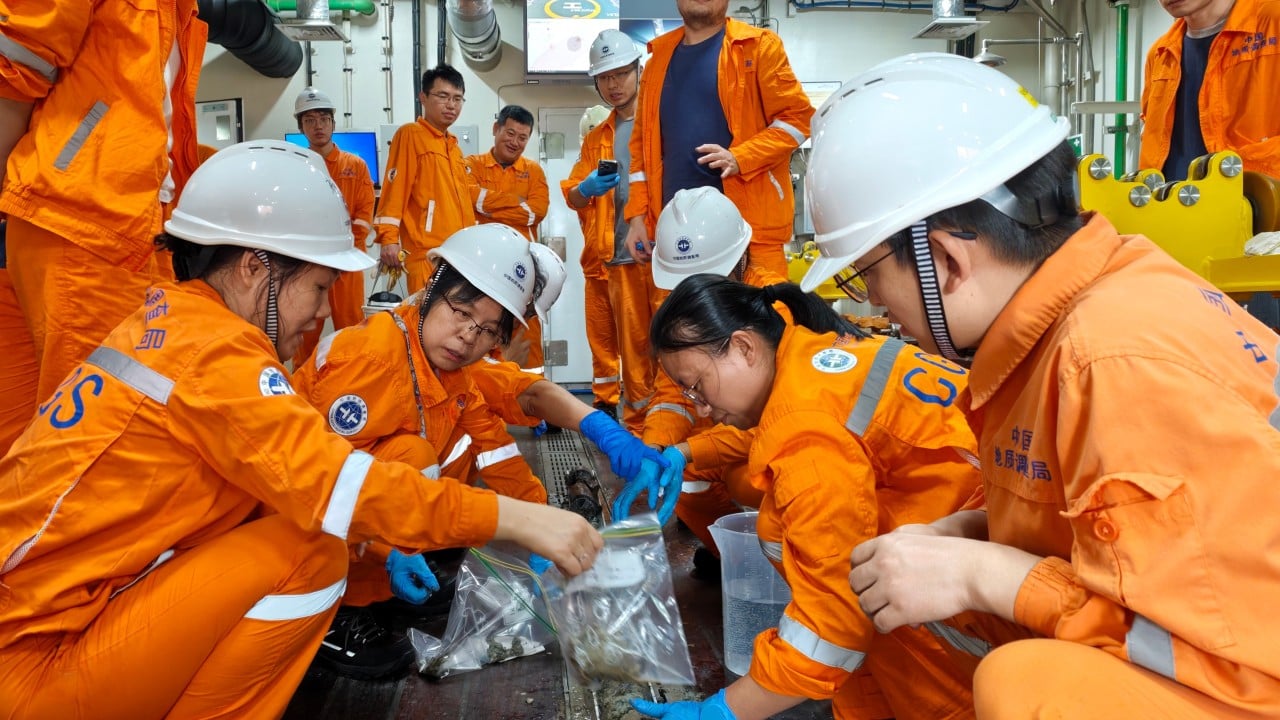
And recently, the Mengxiang brought home something that has sent quiet shockwaves through international research halls: pristine, high-grade core samples from the floor of the South China Sea.
To the untrained eye, a core sample looks like a long, cylindrical tube of gray-brown mud stuck inside a plastic sleeve. It looks like dirt you might scrape off your boot after a rainy hike. But to a geochemist, that cylinder is a time machine. It holds the chemical signature of ancient climates, the exact composition of the earth's upper mantle, and, crucially, the hidden mineral wealth locked beneath the seabed.
We are talking about polymetallic nodules, rare earth elements, and immense reservoirs of methane hydrates—the frozen gas that nations are eyeing as the fuel of the next century.
The Weight of the Invisible
To understand why a box of mud matters more than an aircraft carrier, you have to understand scarcity.
Modern technology runs on elements that are frustratingly, terrifyingly rare. The magnet inside your phone's vibration motor, the guidance system of an electric vehicle, the laser optics in fiber-optic cables—they all demand rare earth elements. For decades, the global supply chain has operated like a delicate, hyper-extended rubber band, anchored heavily in terrestrial mines where environmental costs are high and geopolitical leverage is absolute.
Now, look at the map.
The South China Sea is one of the most contested maritime zones on the planet. Six different governments claim overlapping boundaries of water, coral atolls, and fishing grounds. Every diplomatic cable, every naval patrol, every squabble over a reef has been viewed through the lens of sovereignty and shipping lanes.
We thought the prize was the water. We thought the prize was the fish.
We were wrong. The prize is the crust.
When a vessel like the Mengxiang successfully drills eleven thousand meters into the earth’s crust—a depth capability that breaks previous global records—it stops being just an engineering marvel. It becomes a geological key. It unlocks the ability to map and claim the seabed wealth that lies far beyond the reach of traditional divers or smaller, less sophisticated research vessels.
Consider what happens next. If you can map the deep floor, you can claim the resources. If you can claim the resources, you rewrite the economic dependencies of entire continents.
The Human Cost of the Abyss
Let us step away from the maps for a moment. Let us step onto the rig.
I spoke once with a marine geologist who had spent forty days straight aboard a seismic research vessel in the Western Pacific. He didn’t talk about geopolitics. He talked about the sound.
"You never escape the thrum," he told me, rubbing his eyes against the memory of fluorescent lights. "The ship never sleeps. The engines rumble through the steel bunks, vibrating right up through your spine. And when you’re pulling up a core sample from four thousand meters down, there is this collective silence in the control room. Fifty grown men and women, staring at a plastic tube, holding their breath. Because that mud is talking to us. It’s telling us secrets the planet kept locked away for fifty million years."
There is a profound vulnerability in that scene. Out there, storms don't care about diplomatic recognition. Corrosion doesn't read treaties. When a dynamic positioning system has to keep a forty-thousand-ton ship locked precisely in place over a single spot while four miles of steel pipe dangle beneath it in a 50-knot gale, the margin for error is zero.
The engineers on the Mengxiang are not abstract actors in a grand strategy game. They are people standing in grease-stained coveralls, clutching hot paper cups of instant noodles at three in the morning, watching digital readouts flicker green. They are sweating over hydraulic pressures and drill-string harmonics.
They are doing the heavy lifting of the twenty-first century while the rest of us argue about headlines on the surface.
The Shift Beneath Our Feet
For centuries, nations grew wealthy by conquering what was on top of the earth. They fought over fertile river valleys, timber forests, and oil fields that bubbled right up through the topsoil.
Then we went vertical. We built skyscrapers. We reached for the stratosphere and launched satellites into orbit to look down at ourselves.
We thought we had mastered the globe.
Yet the deepest parts of our own planet remain more alien to us than the surface of the moon. We have better maps of Mars than we do of the abyssal plains of the South China Sea.
When a nation masters ultra-deepwater drilling, it crosses a threshold. It proves it can operate in the most hostile environment on Earth, extracting not just data, but physical control over the subterranean commons.
The samples resting in the laboratories of Guangzhou right now are small. They fit in trays. They can be held in the palm of a hand.
Yet they carry the weight of a changing world order. They tell us that the next great resource scramble will not be fought with flags planted on dirt islands, but with steel teeth biting into the silent, freezing dark, miles below the waves.