For the first time since the Korean War, the United States Army is actively training soldiers to excavate, map, and manage mass battlefield graves. This grim return to Cold War-era mortuary affairs doctrine is driven by a sobering shift in Pentagon planning—moving away from two decades of counterinsurgency in the Middle East and preparing for high-intensity, large-scale combat operations against near-peer adversaries like Russia or China, where daily casualty rates could overwhelm standard evacuation pipelines.
To understand why excavators and trench-digging drills are suddenly back on the training schedule at installations like Fort Gregg-Adams, you have to look at the math of modern warfare. It is brutal. For twenty years, American military logistics operated under the "Golden Hour" standard. If a soldier was wounded in Iraq or Afghanistan, air superiority ensured a medevac helicopter could reach them within sixty minutes, flying them to a trauma center while fallen service members were swiftly flown home to Dover Air Force Base in aluminum transfer cases.
That system collapses the moment the enemy has anti-access/area denial (A2/AD) capabilities, hypersonic missiles, and relentless drone surveillance.
The Collapse of the Golden Hour
In a peer-on-peer conflict, the sky is no longer a safe highway for American transport planes. Airfields become primary targets for ballistic missile strikes, and cargo aircraft like the C-17 Globemaster become massive, slow-moving liabilities in contested airspace. When logistics chains snap, everything backs up.
Military planners use a specific, clinical term for what happens when the dead cannot be evacuated from the front lines: temporary interment. Under Army doctrine—specifically Army Techniques Publication (ATP) 4-46, Mortuary Affairs Operations—burying troops in the field is strictly an emergency measure of last resort. It is authorized only when tactical conditions prevent evacuation, when decomposition threatens the health of surviving troops, or when the sheer volume of casualties paralyzes combat units.
We have seen this exact scenario play out in real time on the plains of eastern Ukraine. Over the past several years, drone feeds and satellite imagery from the Russo-Ukrainian war have offered the Pentagon an unfiltered preview of twenty-first-century industrial attrition. Artillery barrages, loitering munitions, and dense minefields have created dead zones where neither side can safely retrieve bodies for weeks at a time.
The Logistics of Mass Fatality
When the Army practices digging mass graves, they are not simply handing out shovels and telling soldiers to dig a hole. It is an exacting, bureaucratic, and deeply psychological operation designed to preserve human dignity and forensic identity under catastrophic conditions.
Consider a hypothetical scenario involving a brigade combat team engaged in a major defensive battle in Eastern Europe. Within forty-eight hours, sustained long-range rocket fire and armored assaults could generate hundreds of fatalities. If road networks are cratered and airlift is grounded by enemy air defenses, those remains cannot simply be left on the terrain, nor can they be piled into the back of tactical vehicles needed for ammunition resupply.
To manage this, Army Mortuary Affairs specialists—known by the Military Occupational Specialty code 92M—must execute precise field protocols:
- Site Selection: Engineers and mortuary specialists must identify high, dry ground well away from water tables, local civilian populations, and active tactical maneuvers to prevent contamination and ensure future recovery.
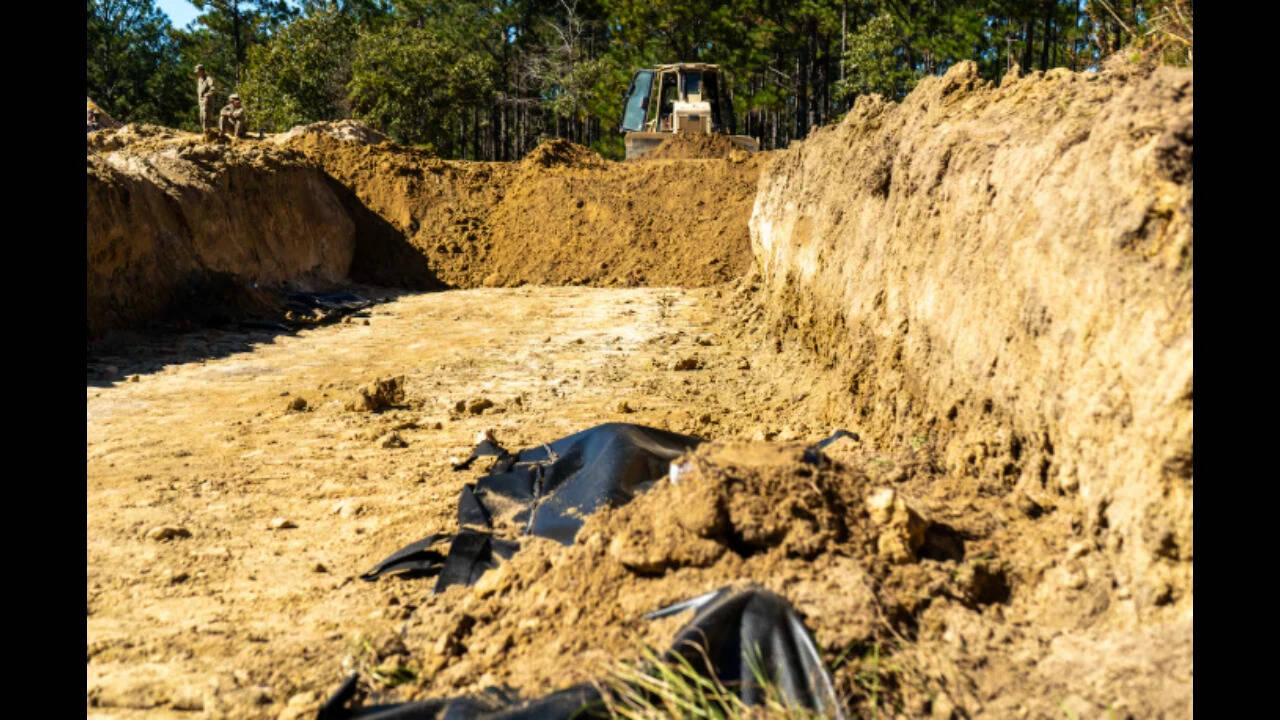
- Trench Dimensions and Mapping: Trenches are dug to exact depths and widths, typically accommodating rows of remains separated by earth, never stacked. Every single position is surveyed using GPS coordinates and hand-drawn grid maps.
- Forensic Preservation: Before burial, soldiers must inventory personal effects, secure identification tags, record biometric data if equipment is available, and place remains in heavy-duty human remains pouches alongside waterproof documentation.
Why the Korean War Is the Benchmark
The historical parallel to the 1950s is not accidental. During the opening months of the Korean War, American and United Nations forces were pushed down the peninsula to the Pusan Perimeter in a chaotic, bloody retreat. The Army lacked the graves registration personnel and refrigeration infrastructure to handle thousands of sudden deaths in the blistering summer heat.
Bodies were buried hastily in temporary cemeteries, rice paddies, and roadside trenches, often with incomplete records. When the front lines shifted back and forth across the 38th Parallel, entire burial sites were lost, bombed, or plowed over. Decades later, the Defense POW/MIA Accounting Agency (DPAA) is still spending millions of dollars and using advanced DNA sequencing to untangle the forensic mess left behind by those emergency burials.
After Korea, the military vowed never to bury its dead in foreign soil again if it could possibly be avoided. By the Vietnam War, helicopter evacuation became standard. By the Gulf War and the Post-9/11 conflicts, the expectation among the American public—and within the ranks—became absolute: every fallen service member comes home immediately, intact, and escorted by a uniform-clad honor guard.
Reintroducing emergency burial training forces the institution to confront a cultural taboo. Admitting that the U.S. military might have to bury its own dead in mass trenches abroad is an implicit admission that the next war will look nothing like the skirmishes of the past generation.
The Psychological Toll on the Force
There is a massive gap between digging a trench on a training range in Virginia and executing that task under incoming artillery fire while smelling decomposing flesh. Veteran 92M soldiers frequently suffer some of the highest rates of post-traumatic stress disorder in the military, despite rarely firing a weapon in direct combat.
Training conventional combat engineers and infantry units to assist in these operations adds another layer of friction. Infantrymen are trained to fight, maneuver, and protect their squad mates; asking them to dig mass graves for those same squad mates pushes human psychology to its absolute breaking point.
The Counter-Argument From Logistics Reformers
Not everyone inside the defense establishment agrees that digging mass graves is an inevitable reality we should simply accept and practice for. A vocal contingent of military logisticians and medical planners argues that preparing for temporary interment risks creating a self-fulfilling prophecy—a defeatist mindset that papers over solvable supply-chain failures.
Their counter-argument centers on contested logistics innovation. Instead of resigning commanders to burying troops in the mud, critics contend the Pentagon should aggressively fund:
- Autonomous Heavy-Lift Drones: Unmanned aerial systems capable of flying low beneath radar coverage to extract casualties and remains without risking human pilots.
- Mobile Refrigeration and Chemical Preservation: Decentralized, rapidly deployable cold-storage units and advanced bio-containment pouches that allow forward units to hold remains safely for weeks until extraction corridors open.
- Subterranean and Hardened Hubs: Pre-positioned underground medical and mortuary bunkers in allied territories like Poland, the Baltics, and the Indo-Pacific.
These critics point out a glaring flaw in current doctrine. In an era of persistent commercial satellite surveillance and thermal drones, excavating a massive trench with heavy engineering equipment creates an unmistakable signature on the battlefield. To an enemy drone operator, a freshly dug mass grave looks identical to a command bunker or an artillery emplacement, inviting immediate, devastating follow-up strikes on the very soldiers performing the burial.
The Reality of Attrition Warfare
Despite the validity of those technological critiques, senior Army leaders operate on a simple, unforgiving rule: hope is not a course of action. You cannot build a war plan assuming your autonomous drones will work flawlessly against sophisticated electronic warfare, nor can you assume the enemy will respect the Geneva Conventions regarding mortuary recovery teams.
During recent exercises at the Joint Readiness Training Center (JRTC) in Louisiana and the National Training Center (NTC) in California, observers have watched units struggle when artificial "Golden Hour" rules are stripped away. When exercise controllers simulate denied airspace and mass casualty events, logistics networks routinely buckle under the weight of simulated dead and wounded. Commanders who fail to plan for disposition of remains quickly find their combat power degraded, their medical tents clogged, and unit morale plummeting.
The quiet return of mass grave training is ultimately a cold dose of institutional honesty. For decades, American military dominance allowed the nation to sanitize the visual and logistical realities of war, insulating the public from the industrial scale of sacrifice required to fight a major global power.
If a high-intensity conflict erupts tomorrow, the glossy recruiting commercials and precision-strike videos will vanish within hours, replaced by the brutal arithmetic of attrition, broken supply lines, and soldiers with entrenching tools measuring out trenches in the dirt.