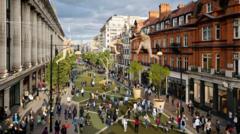
Urban municipal interventions are frequently driven by aesthetic ambition rather than logistical mechanics. When local authorities initiate high street pedestrianisation projects, they treat the removal of vehicular traffic as an isolated optimization variable. This approach mistakes a symptom for a system. Restricting cars does not inherently generate commercial vitality; it merely alters the routing matrix of a localized economic ecosystem. To evaluate the viability of pedestrianisation, policymakers must analyze three core structural variables: network displacement, accessibility friction, and spatial carrying capacity.
The primary mechanism that fails in standard municipal planning is network displacement. Banning vehicles from a primary artery does not eliminate the vehicular demand; it redirects it onto adjacent secondary and tertiary residential or commercial corridors. Without an integrated spatial strategy that models traffic flow redistribution prior to implementation, a local authority creates localized bottlenecks elsewhere in the urban grid. This displacement often introduces severe friction for logistics, servicing, and emergency access, turning adjacent neighborhoods into unintended traffic dumps.
Furthermore, commercial survival on high streets relies heavily on accessibility elasticity. Retailers depend on a dual-stream consumer base: foot traffic and vehicular or transit accessibility for broader catchment areas. When pedestrianisation schemes are implemented without concurrent upgrades to mass transit or peripheral parking infrastructure, the catchment radius shrinks. Consumers substitute the friction of accessing a pedestrian-only zone with frictionless online retail or out-of-town retail parks equipped with ample parking. The economic penalty falls disproportionately on businesses that rely on quick-stop visits or the transport of bulky goods.
A second critical vulnerability is the erosion of spatial management and maintenance standards. Pedestrianised zones generate dense concentrations of foot traffic, which exponentially increases the demand for municipal upkeep, waste management, and security infrastructure. If a local council allocates capital expenditure entirely to hard landscaping and surface treatments while neglecting ongoing operational expenditure, the public realm degrades rapidly. Poorly maintained pedestrian zones quickly attract anti-social behavior and public safety liabilities, transforming a civic amenity into a derelict corridor.
Successful high street transformation requires shifting away from ideological traffic bans toward comprehensive multi-modal spatial strategies. Municipalities must model demand shifts across the entire transport network, guarantee servicing access during off-peak hours, and secure long-term operational funding before altering the physical streetscape.
Institute a mandatory traffic redistribution impact assessment for every adjacent corridor before approving any permanent street closure, tying project approval directly to the absorption capacity of surrounding networks.


