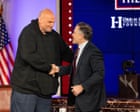
Pennsylvania Senators John Fetterman and Dave McCormick have filed paperwork with the Federal Election Commission to create a bipartisan joint fundraising committee called Common Ground PA. This alliance marks a stark departure from standard Senate behavior, merging the financial operations of a Democrat who rose to fame as a progressive icon and a Republican who recently entered the chamber with corporate backing. The arrangement allows the two politicians to pool donor pools and share contributions, a mechanism typically reserved for allies within the same party.
The transaction is not merely a gesture of local cooperation. It is a calculated response to a severe financial crisis confronting Fetterman, whose base of small-dollar progressive donors has evaporated after his repetitive breaks from Democratic party orthodoxy.
The Arithmetic of Bipartisan Finance
Joint fundraising committees are traditional vehicles in federal elections. They allow multiple campaigns or political action committees to collect single, large checks from wealthy contributors, dividing the proceeds according to an agreed ratio. What makes Common Ground PA historically anomalous is its cross-party structure. According to the July 6 FEC filings, the entity encompasses four participating groups: Fetterman for PA, Friends of Dave McCormick, and the respective leadership PACs of both men, Every Vote PAC and Pennsylvania Honor.
+----------------------------------------------------+
|                  Common Ground PA                  |
|           (Joint Fundraising Committee)            |
+-------------------------+--------------------------+
                          |
            +-------------+-------------+
            |                           |
            v                           v
+-----------------------+   +-----------------------+
|  Fetterman Campaigns  |   |  McCormick Campaigns  |
|  - Fetterman for PA   |   | - Friends of McCormick|
|  - Every Vote PAC     |   | - Pennsylvania Honor  |
+-----------------------+   +-----------------------+
The underlying mechanics serve two different purposes for each senator. McCormick, who won his seat in 2024 and does not face reelection until 2030, enjoys comfortable backing from traditional conservative donors and institutional networks. Fetterman, facing a looming reelection cycle in 2028, is watching his campaign accounts dwindle.
During his high-profile 2022 campaign, Fetterman brought in a staggering $76 million, powered by a national network of left-leaning small donors who viewed him as the future of the populist left. That network no longer exists for him. From 2023 through 2024, his intake dropped to $7.4 million. Since 2025, his campaign has pulled in less than $2 million, leaving him with an identical cash-on-hand balance at the end of the spring reporting period. His leadership PAC brought in just $424,000 since 2023. By contrast, McCormick has raised $4.4 million since the start of 2025 alone, supplemented by $1.1 million for his leadership PAC.
By anchoring his operation to McCormick's donor network, Fetterman gains immediate access to deep-pocketed donors who would otherwise never fund a registered Democrat. McCormick's campaign openly acknowledged this reality, noting that the arrangement was driven by high-net-worth contributors who wanted to support both lawmakers simultaneously.
The Ideological Pivot
Fetterman's current political stance contradicts his 2016 campaign identity. A decade ago, he was a chief surrogate for Senator Bernie Sanders, running on single-payer healthcare, wealth taxes, and progressive criminal justice reform. Today, Fetterman is the most frequent Democratic defector in the Senate, voting in alignment with the second Trump administration 28 percent of the time over the past year.
He stood alone among Senate Democrats in voting to confirm several controversial cabinet nominees. He has supported aggressive border enforcement measures and endorsed expansive military posturing overseas. This ideological migration has completely reversed his public approval metrics in Pennsylvania.
A recent Quinnipiac University poll illustrated this polarization. Among registered Democrats in Pennsylvania, Fetterman has a 62 percent disapproval rating. Conversely, 73 percent of state Republicans approve of his performance. A separate Philadelphia Inquirer-Suffolk University poll showed his favorability among Philadelphia Democrats sitting at just 17 percent, while 60 percent of Republicans viewed him favorably.
These numbers explain the financial collapse. The working-class progressives who gave $25 increments in 2022 are actively abandoning him. Former staff members and local party officials have publicly called for donors to demand refunds of previous contributions. Former Representative Conor Lamb, who lost the 2022 primary to Fetterman, publicly labeled the joint committee a betrayal, signaling a clear path toward a contentious Democratic primary challenge in 2028.
The Mechanics of the Party Switch Speculation
The alliance has naturally ignited intense discussion within Washington regarding a formal party defection. National Republican strategists have spent months courting Fetterman, hoping to solidify their legislative margins. Prominent political consultants have taken to public forums to predict that Fetterman will formally caucus with the Republicans by 2027, setting up a 2028 reelection run under a different banner.
Democratic consultants are already advising clients to treat Fetterman as an opponent. The logic is straightforward: a legislator who relies on Republican donors to maintain their campaign apparatus cannot be counted on for critical judicial confirmations or party-line procedural votes.
Fetterman has pushed back against these assertions. In an essay published earlier this year, he claimed he has no intention of leaving the Democratic party, arguing that he would make an ineffective Republican because he still votes with his party on core domestic issues. He insisted his independence is intended to serve Pennsylvania interests ahead of national party loyalty.
Yet, historical precedent suggests that financial dependence frequently dictates legislative behavior. When a politician's survival depends on the financial infrastructure of the opposing party, their voting record tends to drift permanently in that direction.
Local Alliances Over National Friction
While national observers view this through a hyper-partisan lens, the relationship between Fetterman and McCormick has been building through state-level collaboration. The two men have established a genuine personal rapport that transcends their public policy disagreements.
Earlier this year, the pair openly challenged Democratic Governor Josh Shapiro over the state's participation in the Great American State Fair. When Shapiro withdrew state sponsorship due to a lack of corporate enthusiasm, Fetterman and McCormick stepped in personally. Within 48 hours, the two senators secured over 50 private corporate sponsors to fully fund Pennsylvania's exhibition booth, saving taxpayers money while ensuring the commonwealth was featured during America's semiquincentennial celebrations.
The exhibition featured historic flags, coal mining machinery, and local snack brands, drawing praise from the state Republican Party, which thanked both men for protecting Pennsylvania's image on the national stage. This joint effort offered a blueprint for their current financial arrangement, showing that both senators see tangible benefits in bucking their respective party leadership to build an independent brand.
For McCormick, the arrangement lowers the political cost of his own corporate-friendly legislative agenda by shielding him behind a bipartisan veneer. For Fetterman, it offers a lifeline to replace the small-dollar base he chose to abandon. Whether this financial marriage can survive the pressure of an upcoming election cycle remains an open question, but the financial architecture filed at the FEC ensures that Pennsylvania's Senate representation is now inextricably linked.