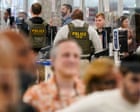
The cabin smells of stale coffee, jet fuel, and the distinct anxiety of a delayed red-eye. Outside, the tarmac glows under amber floodlights. Inside, a flight attendant named Sarah stands by the galley counter, running her thumb over the seam of her coffee cup. She is tired. Everyone is tired. But tonight, a different kind of exhaustion hums through the aluminum tube.
It is the tension of an uninvited choice.
Down the jetbridge, federal authorities are waiting. They are not checking boarding passes or handing out extra pretzels. They are looking for names on a manifest, scanning faces for compliance, and preparing for the logistics of removal. They expect a seamless partnership. They expect the crew—the people who hand out ginger ale and demonstrate seatbelt buckles—to slide easily into the machinery of an accelerated deportation sweep.
Instead, a quiet resistance settles over the crew quarters.
Cabin doors close. Briefcases drop onto seats. Workers look away.
To understand why airline crews are quietly stepping back as United States immigration enforcement ramps up its operational tempo, you have to look past the political headlines and into the daily reality of commercial aviation. This is a story about the collision between federal mandates and the human contract written in the sky.
The Architecture of the Cabin
Commercial aviation runs on predictability. Every checklist, every safety demonstration, every hurried transition from gate to gate is engineered to minimize variables. Passengers step into a metal cylinder, surrender a degree of autonomy, and trust the crew to deliver them safely across borders.
That trust is sacred. Or at least, it used to be.
Consider what happens when federal agents board a commercial flight or station themselves at arrival gates with specific administrative targets. Suddenly, the neutral ground of the airplane transforms. The aisle becomes a checkpoint. The exit row becomes a threshold.
Airline workers operate under a distinct code of hospitality and safety. Their primary directive is clear: get everyone from point A to point B alive and relatively sane. When state power enters that cabin, demanding cooperation, verification, or logistical assistance for immigration enforcement, it fractures the foundational ethos of the job.
Sarah remembers a flight last autumn. Two plainclothes agents boarded during deplaning, moving with the quiet, practiced authority of law enforcement. They asked the lead flight attendant for specific seat allocations, manifest data, and passenger movement records beyond what standard customs declarations require.
"We are just here to help with the transition," one agent had said, smiling a thin, professional smile.
Sarah did not smile back. She felt the heavy knot in her stomach that comes when a boundary is blurred. Flight attendants are safety professionals, not auxiliary border patrol officers. When they are asked to facilitate detentions or point out specific passengers, the emotional cost is immediate. It turns a service profession into an instrument of surveillance.
The Acceleration
The current friction is not happening in a vacuum. It is the direct result of a policy engine shifted into overdrive. As federal immigration authorities accelerate enforcement operations under renewed administrative pushes, the pressure trickles down to unexpected places.
Airports are high-security choke points. They are federally regulated spaces where jurisdiction overlaps like overlapping tectonic plates. Customs and Border Protection holds supreme authority at international arrivals, but domestic cabins are a gray zone of corporate employment and federal oversight.
When immigration crackdowns intensify, agencies look for force multipliers. Commercial airlines—carrying millions of passengers daily across domestic and international networks—represent an enormous logistical web. If federal agents can leverage airline personnel to spot, track, or smoothly transition targeted individuals upon landing, the machinery runs faster.
But the workers are dragging their feet.
Union representatives and frontline employees across major carriers have noted a sharp cooling of voluntary cooperation. Flight attendants, gate agents, and baggage handlers are discovering the power of silence. They are sticking strictly to their job descriptions. If a request falls outside the narrow scope of FAA safety regulations or contractual obligations, the answer is increasingly a polite, impenetrable shrug.
This is not necessarily an act of radical political defiance. More often, it is self-preservation wrapped in exhaustion.
The Cost of Complicity
Imagine standing in a narrow aisle where passengers are clutching passports and sleeping toddlers. Imagine knowing that a casual word, a cooperative nod, or an extra piece of administrative assistance could upend a family's existence.
For many aviation workers, the math simply does not add up.
Aviation is a notoriously demanding industry. Long hours, chronic understaffing, delayed flights, unruly passengers, and turbulent schedules already push workers to their psychological limits. Adding the moral weight of immigration enforcement to that daily burden is a bridge too far.
When workers decline to assist, they are protecting the psychological safety of the cabin. Trust is the invisible currency of commercial flight. If passengers begin to view flight attendants as potential informants or extensions of immigration enforcement, the atmosphere changes. Suspicion replaces hospitality. Fear replaces routine.
No one wants to fly in an atmosphere of quiet dread.
Furthermore, airline unions are increasingly stepping in to clarify boundaries. Legal teams are reminding workers that while they must comply with lawful, mandatory warrants, they are under no obligation to act as voluntary extensions of immigration enforcement agencies during routine operations.
The line between cooperation and coercion is razor-thin. Frontline workers are learning to find it, stand on it, and refuse to budge.
The Horizon
The plane touches down with a heavy thud, spoilers deploying with a roar that rattles the overhead bins. The seatbelt sign pings. Passengers begin the familiar, restless dance of unbuckling, grabbing coats, and jockeying for position in the aisle.
Up front, Sarah packs her manual into her bag. She avoids eye contact with the men in windbreakers lingering near the jetbridge.
Outside, the political machinery of the state grinds forward, relentless and vast. Inside, a quieter, more stubborn force pushes back—not with megaphones or protests, but with the quiet closing of a galley door, the strict adherence to a job description, and the silent, heavy solidarity of workers who decided that the sky belongs to everyone, or it belongs to no one at all.