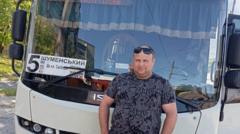
You don't think about public transit as a military target. On a normal morning, a city bus is just a loud, rattling box carrying people to grocery stores, offices, or shifts at a local factory. But along the Dnipro River and deep into the eastern oblasts of Ukraine, these yellow and white buses are moving bullseyes.
Getting behind the wheel here isn't a career choice anymore. It's a daily negotiation with mortality.
While drone footage of tanks dominates international headlines, a quiet, bloody war of attrition targets the mundane infrastructure of daily life. Russian drone operators actively hunt local public buses. Despite the terrifying odds, a small group of civilian drivers keeps turning the ignition keys every single morning. They aren't soldiers, but they are holding a crumbling lifeline together.
The Lethal Shift From Artillery to FPV Drones
The nature of the danger facing these drivers has shifted dramatically over the past couple of years. In the early stages of the full-scale war, the primary threats were unguided artillery and sudden rocket attacks. You could listen for the whistle, check the local Telegram warning channels, and try to time your routes between barrages.
Now, the sky belongs to First-Person View (FPV) drones and loitering munitions like the Russian Lancet.
According to data verified by the UN Human Rights Monitoring Mission in Ukraine (HRMMU), short-range drones have become a leading cause of civilian casualties in frontline areas. In early 2025, these weapons caused more civilian deaths in close-proximity zones than traditional artillery. By March 2026, the trend had only intensified. A striking example occurred in Kharkiv Oblast, when a Lancet drone slammed directly into a civilian bus near Nova Oleksandrivka, killing the 53-year-old driver instantly.
The onboard cameras on these drones give operators a clear view of their targets. They see the lack of military markings. They see the civilian passengers through the glass. Yet, the attacks continue. Human Rights Watch documented that Russian military-affiliated social media channels even designated specific civilian-populated districts in Kherson as red zones, explicitly warning that any moving vehicle would be treated as a legitimate target.
What It Feels Like Inside the Kill Zone
Imagine driving an unarmored, slow-moving vehicle down a road completely stripped of tree cover by shellfire. You can't speed up because the asphalt is cratered by years of mortar impacts. You can't see the drone until it's right above you, and by then, the high-pitched whine is the last thing you'll ever hear.
Drivers like Maxim Dyak, who operates routes through the heavily targeted Kherson region, face this reality every time they shift into drive. For residents who refuse to leave or simply have nowhere else to go, his bus is the only way to get food, collect pensions, or reach medical care.
The structural vulnerability of these buses makes the survival rates shockingly low. Standard regional transit vehicles—like the older, Ukrainian-manufactured Bohdan models or converted Mercedes Sprinter vans—possess zero armor plating. When an explosive drone hits, the thin metal shell does nothing to stop shrapnel. Windows shatter inward, transforming glass fragments into secondary missiles.
A mass-casualty event in February 2026 highlighted this stark reality when a drone targeted a shuttle bus carrying energy workers in the Pavlograd district, roughly 40 miles from the active frontline. The strike killed 12 people and wounded seven others, leaving the vehicle completely hollowed out.
The Psychological Burden of the Empty Seat
The occupational hazards of driving a bus in Ukraine used to involve navigating bad roads, engine failures, and long hours. Today, the primary hazard is severe emotional trauma. Research published by the Dnipro University of Technology before the escalation highlighted that Ukrainian transit workers already faced high levels of nervous tension due to difficult sanitary and mechanical conditions. Layering a relentless aerial threat on top of that baseline has pushed drivers to absolute exhaustion.
Drivers frequently talk about the internal calculus of risk. You aren't just responsible for your own life; you are carrying fifteen or twenty neighbors who trusted you to get them through the corridor alive. If a drone appears, do you slam on the brakes and tell everyone to scatter into the ditches, or do you floor the accelerator and hope the operator misses? There is no correct answer. There is no training manual for this.
Many drivers admit they keep going simply because the alternative is watching their communities wither away. If the buses stop running, the isolated villages along the frontline become completely dark. Old people freeze or starve in silence. The drivers know this, so they keep showing up to work, taping over cracked windshields, and listening to the sky.
Keeping Transit Alive Amid Constant Threat
To mitigate the relentless drone hunting, logistics managers and regional authorities have had to change how transit operates near the frontlines.
- Decentralizing Schedules: Fixed timetables are a death sentence. Bus departures are now staggered randomly, communicated through private messaging groups or word of mouth right before the vehicle leaves.
- Visual Camouflage: Drivers avoid using large, brightly colored buses whenever possible, opting for muted, dusty colors that blend into the gray winter and brown summer landscapes of the southern steppes.
- Electronic Warfare (EW) Scramblers: Some local volunteer organizations have raised funds to install small, vehicle-mounted EW jammers on essential transit routes. These devices attempt to break the signal between the drone and its operator, though their effectiveness varies wildly against newer drone models.
If you want to support these efforts or better understand the reality on the ground, follow updates from verified human rights organizations like the UN HRMMU or Human Rights Watch, which continuously document frontline transport infrastructure attacks. You can also look into grassroots Ukrainian volunteer groups that supply local transit networks with specialized trauma kits and vehicle-mounted jammer components. Staying informed and directing resources toward localized infrastructure support keeps these critical lifelines moving.