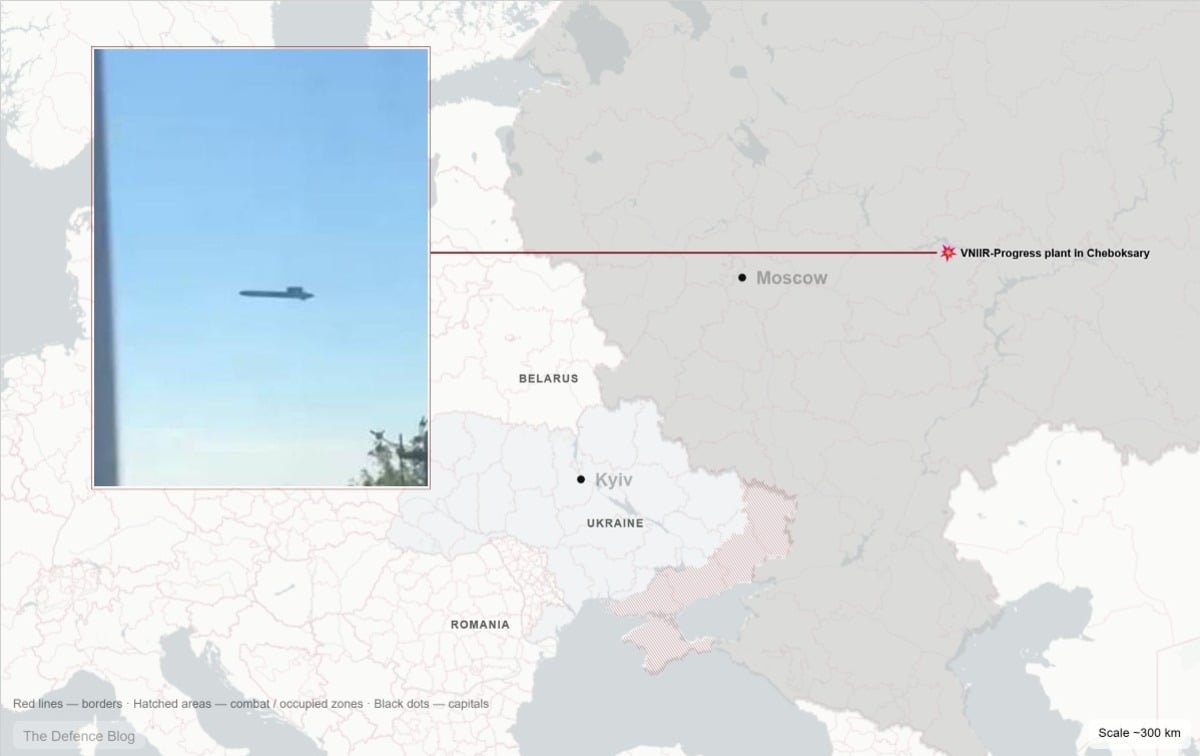
Air defense sirens don't usually wail in the Chuvash Republic. Located roughly 1,000 kilometers from the Ukrainian border, Cheboksary has spent most of the current war feeling safely out of reach. That illusion evaporated on June 10, 2026.
Residents filmed a low-slung, jet-powered silhouette screaming over the Volga River before a massive explosion ripped through the VNIIR-Progress defense electronics plant. Plumes of black smoke rose above the facility. It wasn't a slow-moving kamikaze drone. It was an FP-5 Flamingo cruise missile, manufactured entirely within Ukraine by private defense firm FirePoint.
Ukrainian President Volodymyr Zelensky quickly confirmed the precision strike, noting it part of a wider overnight operation that also hammered the Kuibyshev oil refinery in Samara and energy infrastructure in Vladimir. But the Cheboksary hit is the one that should make Russian military planners sweat. This wasn't a lucky fluke. It's the second time Ukraine has pierced a thousand kilometers of heavily defended airspace to hit the exact same factory facade, following an initial strike on May 5.
If you want to understand where this war is heading in 2026, don't look at the trenches in the Donbas. Look at why Ukraine is risking its prized, homegrown cruise missiles on a single electronics facility deep in the Russian interior.
The Factory Producing Russia's Electronic Shield
You can build a thousand drone hulls, but they're just expensive lawnmowers without guidance systems. That's why VNIIR-Progress is on Ukraine's high-priority target list.
The Cheboksary facility is the lifeblood for Russia's precision electronics. Specifically, it manufactures the Kometa-series jam-resistant satellite navigation antennas. If you've tracked the brutal effectiveness of Russian Shahed-type loitering munitions, Iskander-M tactical ballistic systems, or Kalibr cruise missiles, you've seen Kometa technology at work.
Standard GPS and GLONASS signals are incredibly easy to jam. Ukraine has deployed massive electronic warfare networks along the front lines to confuse incoming threats. The Kometa antenna array is Russia's antidote. It isolates and filters out electronic jamming, allowing weapons to find their targets despite intense electronic noise.
By striking VNIIR-Progress, Ukraine isn't just trying to blow up a building. They're trying to blind the Russian long-range strike complex at the source. Following the May 5 attack, open-source intelligence analysts noted the Russians desperately tried covering the entire facility with camouflage netting. It didn't work. The Flamingo's guidance system found the target anyway, bypassing the visual deception and hitting the administrative and production wings.
Why Drones Weren't Enough for This Mission
Ukraine flies long-range propeller drones into Russia every single week. They're cheap, they're plentiful, and they mess with Russian logistics. But when the target is a reinforced Soviet-era industrial complex, a 20-kilogram drone warhead usually just shatters windows and scorches the paint.
That's where the FP-5 Flamingo changes the equation.
Developed by FirePoint under the leadership of founder Denis Shtilerman, the Flamingo is a beast of a cruise missile. It packs a massive 1,150-kilogram warhead and boasts a staggering 3,000-kilometer operational range.
When you need to punch through concrete industrial roofing, collapse structural pillars, and destroy heavy manufacturing machinery, you need kinetic weight. Drones are for harassment and starting fires at oil depots. Cruise missiles are for structural deletion.
The decision to use multiple Flamingos against Cheboksary shows the Ukrainian General Staff knew they needed catastrophic, structural damage to halt Kometa production. They didn't want a fire that could be put out with extinguishers. They wanted to bend the steel frame of the factory.
The Myth of Layered Russian Air Defenses
Let's look at the map. To get from Ukrainian-controlled territory to Cheboksary, a missile has to fly across hundreds of miles of Russian territory. It has to clear radars, S-400 mobile batteries, and Pantsir-S1 close-in weapon systems.
The fact that a cruise missile got through on May 5 was a embarrassment for Moscow. The fact that another one did it on June 10 proves Russia has a structural air defense deficit.
The math simply doesn't work for the Kremlin anymore. Russia is the largest country on earth by landmass. They have thousands of critical infrastructure points—refineries, power grids, drone factories, military bases. They do not have enough air defense batteries to protect all of them simultaneously.
To defend Moscow, St. Petersburg, and the immediate front lines, Russia has been forced to strip the interior bare. Military analysts at Defense Express highlighted this exact gap after the latest strike. Ukraine knows exactly where the radar blind spots are. By flying low along river valleys and exploiting gaps in local radar coverage, the Flamingo can slide past the defensive grid undetected until it's too late. Local authorities in Chuvashia didn't even issue air raid warnings until after the missile was already over the city.
What Happens Next
Don't expect Ukraine to let up on these deep-strike operations. As domestic production of the Flamingo and other long-range systems scales up, the geographic safety zone inside Russia will continue to shrink.
If you are tracking this conflict, keep your eyes on how Russia redistributes its air defense assets over the coming weeks. They face a brutal choice. They can leave their deep-interior weapons factories vulnerable to devastating cruise missile strikes, or they can pull S-400 systems away from the front lines, leaving their occupying troops exposed to Ukrainian tactical aviation.
For the technicians at VNIIR-Progress, camouflage netting isn't going to cut it anymore. Ukraine has found the range, they have the hardware, and they've shown they aren't afraid to hit the exact same spot twice.