The lobby once smelled of jasmine and expensive salt air. It was a scent that clung to the silk scarves of travelers who had crossed oceans just to stand on this tiny, man-made triangle of land. For twenty-four years, the Mandarin Oriental was more than a building; it was a silent witness to the evolution of Miami from a neon playground into a global financial titan.
Then came the silence. Then came the dust.
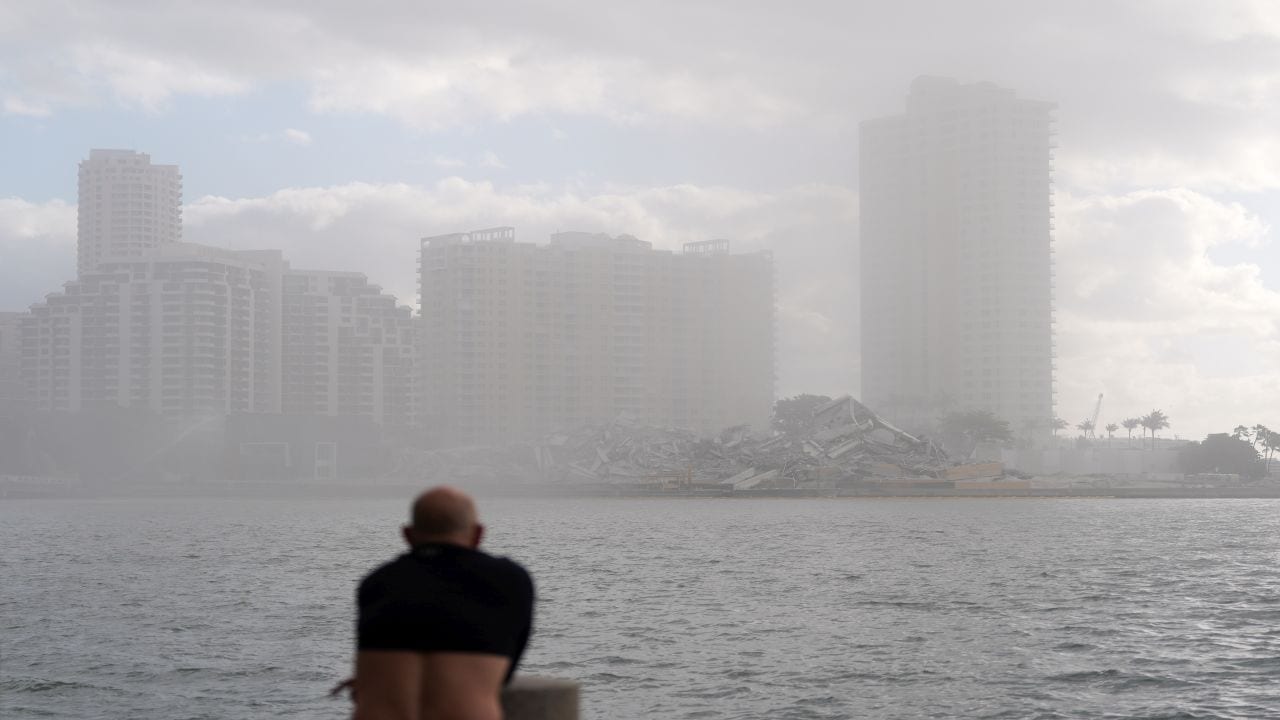
In exactly twenty seconds, decades of memories—anniversaries toasted with vintage Cristal, high-stakes mergers signed over sea bass, and the quiet footfalls of world leaders—were reduced to a grey, billowing cloud. The implosion was surgical. It was efficient. It was a masterclass in controlled destruction that left the Brickell skyline momentarily toothless.
We often talk about urban development in terms of "progress" or "inventory," but those are sterile words used by people who didn't spend their lives within those walls. To watch a landmark disappear is to realize that in the world of high-end real estate, even the most solid marble is temporary.
The Weight of a Falling Giant
When the demolition team triggered the charges, the sound wasn't just a boom. It was a physical pressure that pushed against the chests of those watching from the mainland. Gravity took hold of the fourteen-story structure, and it folded into itself like a tired giant finally allowed to sleep.
The physics of an implosion are a brutal dance of timing and math. Engineers spent months mapping the skeletal structure of the hotel, identifying the load-bearing columns that would need to fail in a precise sequence. If one charge fired a millisecond too late, the building might lean. If it leaned, the neighboring luxury condos—homes to people who pay millions for their privacy—would be in the path of a catastrophic domino effect.
But the math held. The building dropped straight down.
As the cloud settled over the waters of Biscayne Bay, the reality of the void became clear. The Mandarin Oriental wasn't failing; it wasn't a "distressed property." It was simply in the way of something even bigger. In Miami, being good is no longer enough to guarantee your survival. You have to be the absolute maximum expression of the land you sit on.
The Invisible Stakes of the One Island Drive
What replaces the ghost of the Mandarin isn't just another hotel. It is a vertical city called One Island Drive.
Swire Properties, the developer behind the transformation, is betting $1 billion—and likely much more—that the world’s elite want to live in a way that makes the old luxury look like a quaint relic. The plan involves two towers. One will rise 800 feet, housing the new Mandarin Oriental Residences. The other will stand at 400 feet, serving as the "new" Mandarin Oriental hotel.
This is the hidden logic of the modern skyline. The "hotel" is no longer the primary product; it is the amenity for the residences.
Think about the psychology of that shift. A hotel guest is a transient. They are there for a weekend, a conference, or a secret. But a resident? A resident is an owner. They demand a different kind of permanence. By demolishing a perfectly functional, world-class hotel to build residences, Miami is signaling its final transformation. It is no longer a place you visit to escape your life. It is the place where you bring your life, your capital, and your legacy to stay.
The Human Cost of the View
Consider a hypothetical resident of the old Brickell Key. Let’s call her Elena.
Elena bought her condo in the late nineties, back when the Mandarin was the new kid on the block. She watched the palm trees grow. She knew the names of the doormen who had been there since the grand opening in 2000. For her, the hotel was a lighthouse. It anchored the island. It provided a sense of continuity in a city that changes its identity every decade.
Now, Elena looks out her window and sees a construction site. She sees the heavy machinery and the barges hauling away the remains of the marble floors she once walked on.
For Elena, and hundreds like her, the next several years will be a symphony of jackhammers and cranes. This is the tax of living in a boomtown. The "invisible stakes" are the quiet nerves of neighbors who wonder if the new 800-foot tower will steal their sunset, or if the character of their secluded island will survive the influx of even more Ferraris and delivery trucks.
Growth is a violent process. We see the polished renderings of glass towers with infinity pools reflecting the moon, but we rarely talk about the years of grit, noise, and displacement required to get there.
The Ghost in the Machine
There is a specific kind of melancholy in seeing a room you once slept in turned into a pile of rubble.
In the weeks leading up to the implosion, the hotel was stripped. The furniture was sold, the linens were cleared, and the art was moved. It became a shell. In those final days, the building looked like a skeleton, its windows like empty eye sockets staring out at the bay.
The people who worked there—the concierges who could find a tailor at 3:00 AM or the chefs who knew exactly how a regular liked their coffee—have moved on to other properties. Some followed the Mandarin brand; others were absorbed into the vast maw of Miami’s hospitality industry.
Their expertise is the software of luxury. The building was just the hardware. But hardware matters. The way a hallway curves or the way the light hits the bar at 5:00 PM creates a specific emotional frequency. You can build a taller tower, you can use more expensive stone, and you can install faster elevators, but you cannot instantly manufacture the soul of a place that has been broken in by twenty years of human life.
The Billion-Dollar Gamble
Why do this now?
Miami is currently experiencing a "flight to quality" that borders on the fanatical. Wealthy individuals from New York, California, and abroad aren't just moving here; they are trying to recreate the ultra-dense, ultra-luxury environments of Singapore or Hong Kong.
The developers know that the "old" Mandarin, while beautiful, was built for a different Miami. It was built for a city that was still a bit sleepy, a bit more affordable, and a lot less crowded. The new project, designed by the architects at Kohn Pedersen Fox (KPF), is designed for the Miami of 2026 and beyond.
It is a bet on the future of the American South.
If you look at the renderings, the towers look like sails caught in the wind. They are sleek, aerodynamic, and unapologetically tall. They represent the "Manhattanization" of the coast. For the developers, the 20-second implosion was a necessary clearing of the throat before a very long and very loud speech about power and prestige.
The Dust Settles
As the dust from the implosion finally dissipated into the humid Miami air, the barges began their work. Tons of concrete, steel, and glass are being hauled away to be recycled or buried.
What remains is a hole in the sky.
For a brief moment, there is a gap in the skyline where you can see the horizon. It’s a reminder that every building we admire is just a temporary occupant of the space it fills. We think of cities as permanent, but they are more like forests—old trees must fall for the new canopy to reach the sun.
The residents of Brickell Key will eventually get used to the new silhouette. The noise will stop, the cranes will be dismantled, and a new lobby will once again smell of jasmine and salt air. New memories will be made. New mergers will be signed.
But for those who stood on the shoreline and watched twenty years disappear in twenty seconds, there will always be a lingering thought. They will remember the way the old building caught the orange glow of the sunset, and they will know that under the foundation of the billion-dollar "One Island Drive" lies the dust of a landmark that thought it had more time.
The skyline is a scoreboard, and in Miami, the game never ends.