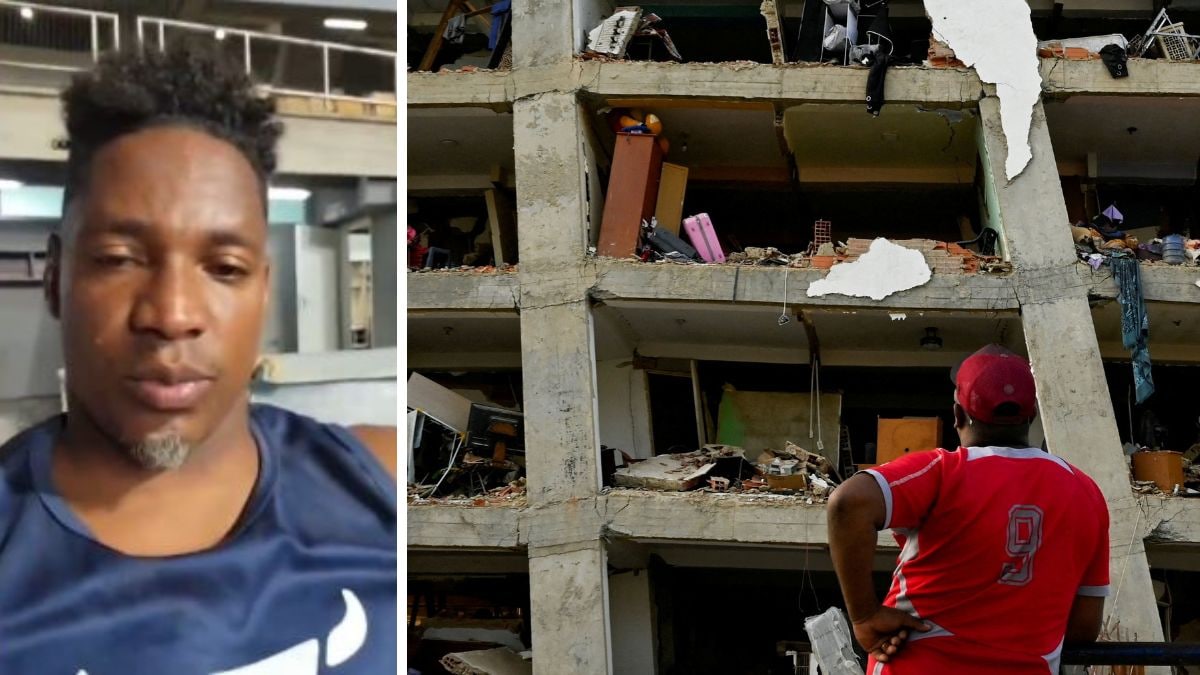
The metal cables of an elevator in Caracas do not care about a baseball player’s ERA. They do not know about the lifetime ban, the desperate winter league comebacks, or the heavy, humid pressure of a Venezuelan afternoon. To the steel and grease of a standard high-rise elevator, a human body is just weight. Roughly two hundred pounds of muscle, bone, and regret, suspended in a vertical shaft while the earth prepares to tear itself apart.
Jenrry Mejia stepped into that metal box because he wanted to get away from the heat.
We often view professional athletes as permanent residents of a higher plane. We see them under stadium lights, engineered from birth to react faster, jump higher, and defy the physical limitations that keep the rest of us bound to the couch. But a stadium is an illusion. Strip away the thousands of screaming fans, the clean white lines of the diamond, and the protective armor of a team uniform, and a ballplayer becomes devastatingly fragile. They become just another person caught in the wrong place when the tectonic plates decide to shift.
On August 21, 2018, the northern coast of Venezuela shook with a magnitude 7.3 earthquake. It was one of the largest seismic events in the country’s history.
To understand the scale of a 7.3 magnitude quake, you have to look past the decimal points on a seismograph. Think of it as the energy of several Hiroshima-sized atomic bombs detonating simultaneously deep within the earth's crust. It is a force that liquefies concrete, turns glass into a storm of shrapnel, and makes the foundational pillars of twenty-story buildings bend like reeds in a swamp.
When the earth began to roll, Mejia was inside a hotel elevator, descending.
The Anatomy of an Unseen Trap
In a disaster, we are trained to look out the window. We look for smoke, for falling bricks, for the cracks spreading across the asphalt like black lightning. But the most terrifying place to be during a major seismic shift is completely enclosed, blind to the world, hanging by a thread.
Consider what happens to an elevator during a severe earthquake. The guide rails, which keep the cab aligned in its vertical track, twist out of shape as the building sways. The counterweights—massive blocks of iron weighing thousands of pounds—can break free from their tracks, turning into unguided pendulums swinging violently inside the shaft. If a counterweight strikes the cab, it delivers a crushing blow that no safety brake can withstand.
Mejia did not know the engineering specifics. He only knew the sudden, sickening drop in his stomach.
The lights flickered once. Then out.
The mechanical groan that followed was not the sound of a normal stop. It was the screech of metal structural elements grinding against each other as the entire hotel tilted several degrees off its axis. The elevator jammed between floors, trapped in total darkness.
Silence followed. Not a peaceful quiet, but the heavy, pressurized silence of an underground tomb, punctuated by the distant, muffled roars of a city screaming.
Every athlete relies on a hyper-attuned sense of proprioception. It is the subconscious understanding of where your limbs are in space, the internal gyroscope that allows a pitcher to release a baseball at exactly ninety-six miles per hour and hit a target the size of a tea saucer. Inside that stalled elevator, Mejia’s gyroscope spun out of control. Up became down. Left became right.
The human mind, when deprived of light and subjected to violent motion, fills the void with terror. He was trapped in a concrete throat, waiting for the cables to snap.
A Career of Hard Breaks and Broken Ground
To understand why a stalled elevator in Caracas felt like a cosmic reckoning for Jenrry Mejia, you have to look at the trajectory of his life before the ground opened up.
Years earlier, he was the crown jewel of the New York Mets organization. A young Dominican pitcher with a live arm, a devastating cutter, and a fierce, stomping celebration on the mound that infuriated opponents and enchanted Queens. He was the chosen closer.
Then came the positive tests. One. Two. Three.
Major League Baseball’s joint drug prevention and treatment program is unyielding. A third strike means a lifetime ban. In an instant, Mejia went from the bright lights of Citi Field to the historical dustbin, becoming the first player in history to receive the ultimate punishment for performance-enhancing drugs. The exile was absolute. He was a ghost in the baseball world, banned from entering Major League clubhouses, his name turned into a cautionary tale told to rookies in spring training.
By 2018, he was playing in the Venezuelan Winter League, trying to scrape together a living in a country undergoing its own profound economic and social upheaval. He was pitching for the Cardenales de Lara. It was a long way from the majors. The stadiums were older, the security was tight, and the daily realities of life in Venezuela required a constant, exhausting vigilance.
He was fighting for a second chance that nobody believed he would get. He was trying to prove to the world, and perhaps to himself, that he was more than his worst mistakes.
And then the hotel began to shake.
The Twenty-Second Eternity
Psychologists talk about a phenomenon known as subjective time expansion. During a life-threatening event, the brain’s amygdala goes into overdrive, recording memories with far greater density than normal. The result is that a few seconds can feel like hours.
For Mejia, the ride lasted less than half a minute before the mechanism failed, but inside that dark box, time stretched into an infinity of self-reflection.
When you are facing the literal end of your existence, the things that seemed monumental an hour prior suddenly lose their gravity. The lifetime ban did not matter. The blown saves did not matter. The lost millions, the sports talk radio vitriol, the contract negotiations—all of it evaporated, leaving behind only the primal, desperate desire to breathe another breath of fresh air.
He prayed.
It was not the performative prayer of a player stepping onto the field before a big game, arms raised to the sky for the television cameras. It was the raw, unfiltered bargaining of a man who realized he was completely powerless.
"I think it was God," Mejia would later recount to reporters, his voice stripped of the usual athletic bravado.
The elevator did not plummet. The safety brakes, designed to lock onto the guide rails when tension drops, bit into the steel. They held. It was a mechanical miracle, but to the man shivering in the dark, it felt entirely divine.
When the emergency doors were finally pried open by hotel staff hours later, the light that hit Mejia’s eyes did not just signal his rescue. It signaled a resurrection. He crawled out of the shaft and into a city covered in dust, but he was alive.
The Physics of the Aftershock
The earthquake eventually subsided, leaving behind a trail of cracked facades and rattled nerves across Venezuela and Trinidad. But for the people who experienced it, the ground never quite stops shaking.
We look for signs in the chaos. It is a fundamental human trait to seek narrative symmetry in accidents. If a piece of falling concrete had drifted six inches to the left, a life would be over. Because it drifted to the right, we call it a miracle.
For Mejia, the escape from the elevator shaft acted as a bizarre, beautiful turning point. Within months of surviving the Caracas earthquake, Major League Baseball Commissioner Rob Manfred did something unprecedented. He reinstated Jenrry Mejia.
The lifetime ban was lifted. The ghost was allowed back into the machine.
Mejia's Career Trajectory:
[Mets Closer] ---> [Lifetime Ban (2016)] ---> [Caracas Earthquake (2018)] ---> [MLB Reinstatement (2019)]
He did not return to the major leagues as a superstar. There was no Hollywood ending where he threw a strikeout to win the World Series. He bounced around the minor leagues, pitched in Mexico, and took the mound in independent leagues where the crowds are small and the paychecks are modest.
But the victory was never about the box score anyway.
The real triumph was the simple act of standing on a patch of dirt, under the open sky, feeling the solid, unyielding earth beneath his cleats. Every pitch thrown after that August afternoon was a bonus. Every line drive, every walk, every run allowed was a luxury available only to a man who had looked at the ceiling of a broken elevator and prepared himself for the drop.
We spend our lives building walls, signing contracts, and planning for a future we assume is guaranteed. We think we are the authors of our own stories. Then the earth shivers, the lights go out, and we are reminded that we are all just passengers in a fragile vessel, suspended over the dark, waiting for the cables to hold.