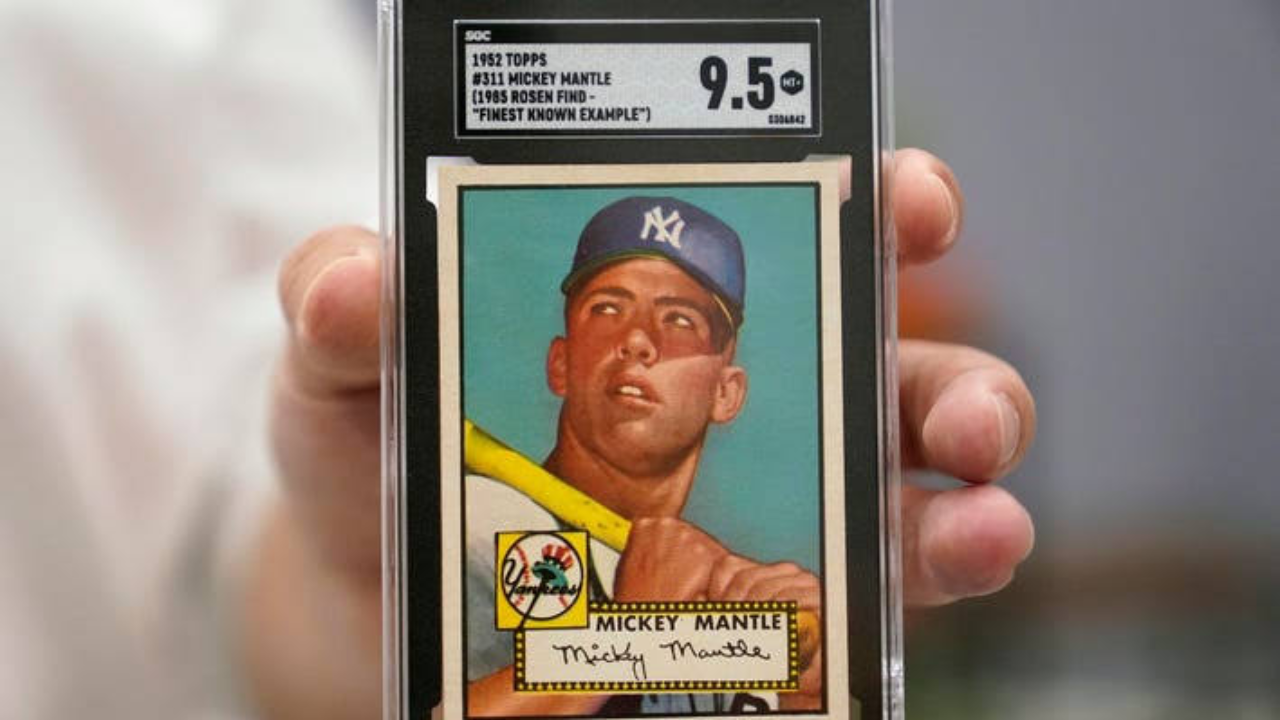
Everybody loves a good lottery ticket story. The media drools over it. The public eats it up. A greasy piece of cardboard printed on a 1952 factory floor goes from costing pennies to commanding twelve point six million dollars at auction.
The narrative writes itself. Pure American dream. Find the right piece of garbage in your attic, keep it clean, and punch your ticket to generational wealth.
It is a complete fairy tale.
I have spent decades watching speculators throw fortunes at cardboard while missing the actual mechanics of value creation. When a single 1952 Topps Mickey Mantle in mint condition shatters auction records, the mainstream financial press treats it as a triumph of smart asset allocation. It is not. It is a symptom of liquidity seeking a place to hide while basic economic logic gets thrown out the window.
The lazy consensus says that rare sports memorabilia functions as a brilliant alternative asset class. The historical returns look incredible if you cherry-pick the absolute outliers. But nobody talks about the thousands of vintage cards rotting in safety deposit boxes that lost value adjusted for inflation, or the immense transaction costs, grading fees, and insurance premiums required to keep a piece of paper from disintegrating.
Let us look at how the hobby actually operates behind the closed doors of high-end auction houses and private syndicates.
The Grading Industrial Complex Is a Confidence Game
If you want to understand why a piece of cardboard commands the price of a commercial real estate property, you have to look at the gatekeepers.
For decades, the hobby was driven by raw condition and personal inspection. Then came third-party authentication and grading companies like PSA and Beckett. They turned subjective physical inspection into an institutionalized number scale from one to ten.
Suddenly, a card is no longer just a piece of ink on cardstock. It is a plastic slab housing a grade.
This created a massive structural distortion. The difference between an eight and a nine on a vintage card is often invisible to the naked eye. Yet, that single numerical tick swings the value by millions of dollars. You are not paying for the cardboard or the ink or even the nostalgia. You are paying for the plastic encapsulation and the arbitrary opinion of a designated grader working inside a private corporation.
When millions hang on the whim of a grader's loupe, the system stops being an open market and starts looking like an unregulated futures pit. If the grading entity makes a mistake or shifts its standards over time, entire fortunes built on vintage cardboard can evaporate.
Insiders know this. They exploit the variance. They buy raw, grade aggressively, cross-submit until they get the desired number, and dump the asset onto retail buyers who think they are buying a piece of baseball history rather than a financial derivative based on subjective plastic slabs.
Survivorship Bias Masquerading as Investment Strategy
The twelve million dollar headline relies entirely on survivorship bias.
Thousands of boxes of 1952 Topps cards were printed. Millions of cards were chewed up by kids riding bikes with clothespins holding them against spokes, thrown away in spring cleaning, or destroyed by basement humidity. The fact that one survived in pristine condition does not mean the category is a stellar store of value. It means a single statistical anomaly beat astronomical odds.
Compare this to actual productive capital.
If you put twelve million dollars into a cash-flowing business, a portfolio of dividend-paying equities, or real estate with a reliable tenant base, money moves. It produces goods. It employs people. It generates cash flow that can be reinvested.
A mint-condition baseball card produces nothing. It sits in a vault. It does not pay a dividend. It does not generate interest. Its entire financial return relies entirely on the Greater Fool Theory. You need to find someone tomorrow who is willing to pay more than you did today, purely because they believe someone else will pay even more tomorrow.
That is not investing. That is a game of musical chairs played with historical artifacts.
The Liquidity Trap Nobody Warns You About
People love to quote the peak auction price of a marquee asset as if it represents liquid net worth. It does not.
Try taking a twelve-million-dollar piece of cardboard to a local bank to secure a business loan. See what the loan officer says. Try selling that card instantly during a broader market liquidity crunch. You cannot. High-end collectibles are notoriously illiquid. When economic conditions tighten, alternative luxury assets are the first things to freeze up because buyers pull back to safety.
The transaction friction is brutal. Major auction houses take hefty buyer and seller premiums. Insurance costs scale exponentially with valuation. Storage in secure climate-controlled vaults eats into any theoretical yield. By the time you factor in all the hidden friction, the net annualized return of high-end sports cards often underperforms basic fixed-income instruments over long horizons.
Yet, promoters keep pushing the narrative that cardboard beats the S&P 500. They use manipulated indices that track only the top tier of graded cards, ignoring the massive denominator of worthless paper that sank into obscurity.
Stop Treating Nostalgia as an Asset Class
If you collect sports memorabilia because you love the history, the players, and the aesthetic of mid-century design, buy whatever you want. Enjoy the hobby. Frame a card and put it on your desk.
Just stop calling it an investment strategy.
When you confuse sentimentality with asset allocation, you open yourself up to severe financial damage. The market for ultra-luxury collectibles is driven by cheap capital, speculative frenzy, and a handful of ultra-wealthy buyers treating trophies like modern art. The moment macroeconomic conditions shift or the cultural relevance of baseball fades further into the background for younger generations, the bottom drops out of valuations that were never anchored to fundamental economics in the first place.
True wealth is built on utility, production, and solving real-world problems.
A piece of cardboard from 1952 is worth what someone's ego is willing to pay on a single afternoon at an auction house. Nothing more. Nothing less.