The Shadow Over the Seafloor
Old Chen remembers when the water turned dead.
For forty years, his calloused hands hauled nets from the gray-green shallows of the Liaoning coast. He knew every ripple, every shift in the autumn tide, and every silent tragedy unfolding on the silt below. Sea cucumbers are not creatures that demand your pity. They do not dart or flash like mackerel. They crawl. They graze. They endure. Or, at least, they used to.
Lately, summer had become a season of stone.
When the July sun beat down with a wet, suffocating heat, the shallow waters warmed beyond endurance. The cucumbers—valuable, ancient, and frustratingly delicate—did what they always did when the world turned hostile. They stopped. They buried themselves in the muck, retreating into a state of profound, exhausting metabolic arrest. Estivation. A biological shutdown. For nearly four months out of the year, millions of dollars worth of marine life simply froze in time, waiting for an autumn chill that arrived too late and stayed too briefly.
Chen watched his livelihood evaporate into the sediment. He thought he knew the limits of the sea. He thought human industry and marine survival were sworn enemies, locked in an eternal zero-sum game where every kilowatt generated on land meant another degree of warmth suffocating the life beneath the waves.
He was wrong.
An Accidental Sanctuary
A few miles off Chen’s usual route, a strange new horizon rose above the coastline. Acres of dark, shimmering panels tilted toward the heavens, drinking the blinding yellow light of the northern sky.
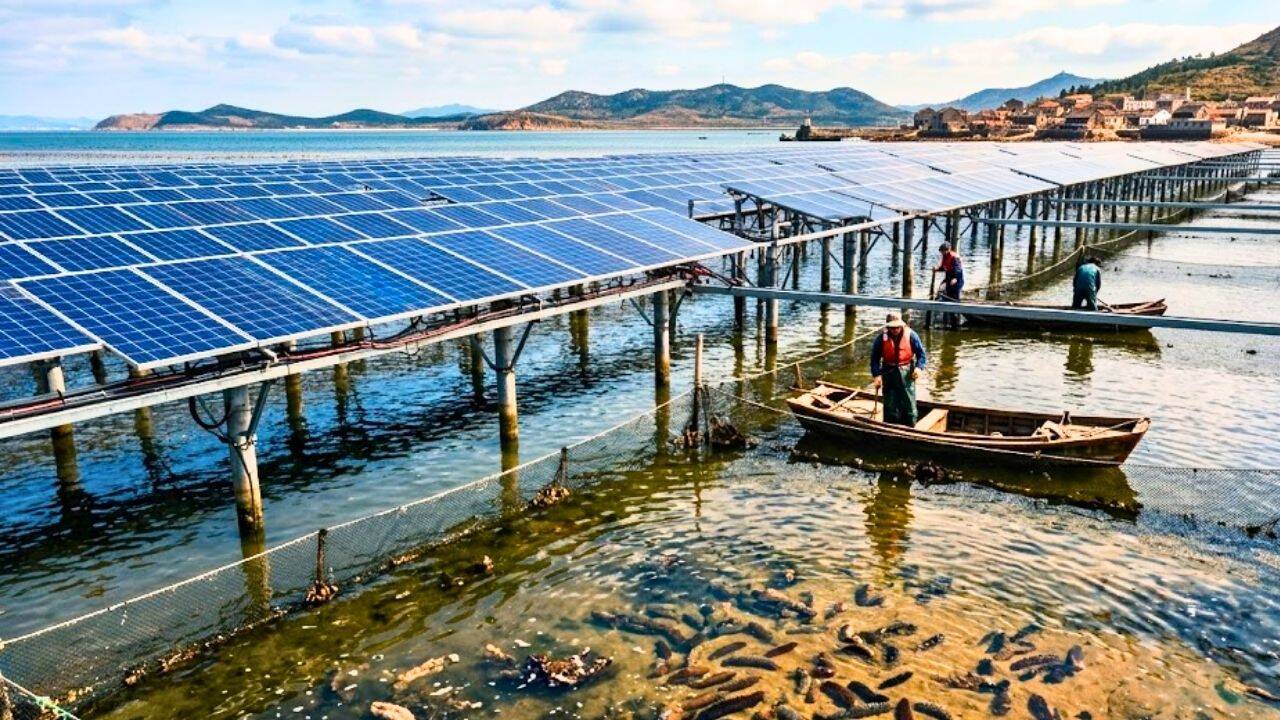
Photovoltaic farms. They marched across barren hills and reclaimed salt flats, casting massive, geometric shadows that stretched across the earth. But the engineers had pushed further. They took the glass over the water. Thousands of floating solar arrays were anchored above the aquaculture zones, designed to harvest clean energy while keeping the machinery dry.
Nobody built the installation for the cucumbers. The goal was simple kilowatts, grid stability, and carbon reduction.
Yet, the moment the dark glass slid into place above the water, the physics of the shallows fractured.
To understand what happened next, you have to understand the terrible geometry of a summer heatwave in an artificial fish farm. Unshielded water acts like a magnifying glass. The sun beats down relentlessly, driving temperatures past thirty degrees Celsius. Oxygen plummets. The sediment turns sour. For a juvenile sea cucumber, this is the equivalent of living inside a slowly heating oven with the oxygen steadily being sucked out of the air.
(Note: When I describe the cucumbers as feeling an oven, I am using a biological metaphor for severe thermal stress and metabolic deceleration.)
Then came the shade.
The sprawling canopies of solar panels cut the direct, brutal glare of the midday sun. They shaved crucial fractions off the water temperature. They altered the evaporation rates, creating a microclimate right at the water's edge that defied the baking mainland.
The Mathematics of Motion
Biologists monitoring the site noticed something bizarre on their spreadsheets.
Normally, juvenile sea cucumbers entered their prolonged summer dormancy—that stubborn, profit-killing inactivity—by early July, dragging their sluggish bodies through a twelve-week haze of nothingness. Under the glass, the timeline buckled.
They woke up earlier.
Twelve days earlier, to be exact.
Twelve days might sound like a footnote to an accountant, but in the frantic biological clockwork of aquaculture, it is an eternity. It represents nearly two weeks of extra feeding time, additional growth, and uninterrupted foraging before the winter freeze settles in. Twelve days is the difference between a stunted harvest and a thriving ecosystem.
Consider what happens next: the shading effect alters the phytoplankton blooms beneath the panels. Without the scorching UV radiation burning off vital nutrients, the micro-algae flourish in a balanced, steady pulse. The cucumbers graze on this rich, cooled carpet of organic matter. Their metabolism revs back up. The chemical signals that trigger emergency estivation simply fail to fire because the acute thermal trigger has been neutralized.
It is an invisible synergy of modern infrastructure and ancient biology. We built the panels to power our electric cars, our air conditioners, our bustling coastal cities. We forgot that the earth is a closed loop. Every shadow cast has a destination. Every watt harvested ripples outward through the ecosystem in ways no computer model can fully anticipate.
The Human Cost of Silence
Chen stood on the bow of his wooden skiff last July, pulling up a sampling cage.
He expected the usual heartbreaking lethargy—limp, unresponsive cylinders of flesh that felt like wet leather. Instead, the small creatures in his palm wriggled. They gripped his rough skin with hundreds of tiny, frantic tube feet. They were hungry.
He laughed, a dry, incredulous sound that carried over the gentle slap of the waves against the hull.
"They're moving," he muttered, shaking his head. "In July, they're supposed to be dead to the world."
For years, coastal communities like Chen's have lived under a cloud of ecological dread. We are told that every step forward technologically is a step backward for the wild world. We brace ourselves for the trade-offs. We accept the pollution, the habitat loss, and the warming seas as the inevitable price of human progress.
This story does not erase that grief. The climate is still changing. The oceans are still acidifying. A few acres of floating glass will not save the coral reefs of the tropics or reverse the melting ice caps.
Yet, inside this narrow, sun-dappled bay in China, something profound occurred. Human ingenuity accidentally intersected with biological resilience. By blocking the sun to generate clean power, we inadvertently built an umbrella for the most fragile creatures at the bottom of the food chain.
The panels do not fix the ocean. But they buy time. And in the high-stakes arithmetic of marine conservation, time is the only currency that matters.
Chen lowered the cage back into the water, watching the dark, rhythmic silhouettes of the solar arrays ripple against the surface of the sea. The water was cool against his fingers. Below, in the dim, protective shade of human ambition, thousands of tiny lives were eating, growing, and moving against the tide.