Donald Trump isn't one for subtlety, and his latest shot at Australia proves he's still running the White House like a boardroom where loyalty is measured in military hardware. Standing on the South Lawn this Thursday, the President didn't hold back. "I'm not happy with Australia," he told reporters. The reason? According to him, Australia went missing in action when it came to the Strait of Hormuz and the broader conflict with Iran.
This isn't just a tiff between leaders. It's a fundamental breakdown in how the 2026 version of the US-Australia alliance actually functions. While Trump claims he "asked them to be there" and they said no, the view from Canberra is completely different. Prime Minister Anthony Albanese and Defence Minister Richard Marles are essentially looking at their phones wondering if they missed a call.
The phantom request and the Hormuz headache
The core of this drama is a massive "he-said, she-said" over military deployments. Trump is convinced he put out the call for allies to help police the Strait of Hormuz—the world's most sensitive oil chokepoint—and that Australia ignored him.
But talk to anyone in the Australian government and you'll get a very different story. Richard Marles has been firm: there was no "specific request" for Australia to join offensive operations or a blockade in the Strait. Australia did send a Wedgetail surveillance aircraft to the Gulf, but they've been extremely careful about what that plane actually does. They aren't sharing intelligence for offensive strikes. They're there to "protect and defend" civilians, not to help Trump bomb Iranian power plants.
Honestly, it looks like Trump is operating on a transactional "you owe me" basis. He mentioned that the US always says yes to Australia, so he was "surprised" when Canberra didn't jump into the fray. This is the new reality of the alliance in 2026. It's no longer about shared values or long-term strategy; it's about what you've done for Washington lately.
Albanese plays the long game of dodging bullets
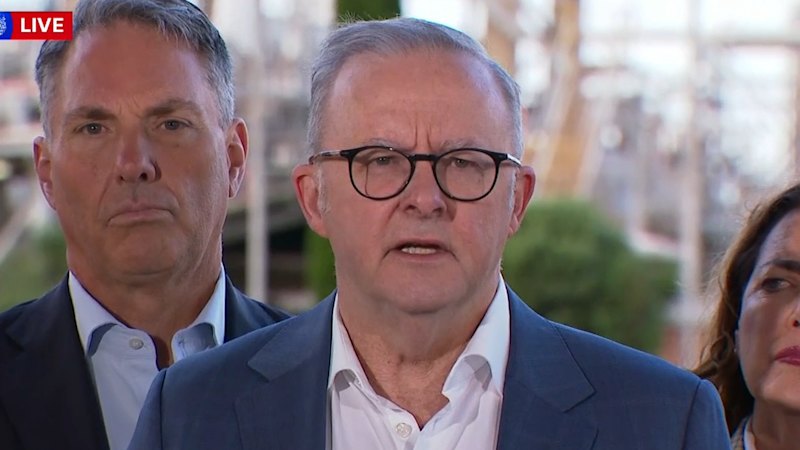
If Trump is a flamethrower, Anthony Albanese is a fire blanket. The Prime Minister’s strategy has been to duck, weave, and refuse to engage with the President’s more "extraordinary" rhetoric. When asked on Friday morning what Trump meant by his "not happy" comments, Albanese basically shrugged. He told reporters in Geelong it was a question for the President, not him.
But don't let the calm exterior fool you. Albanese has started to push back in ways we haven't seen before. Just last week, he called Trump's threats to destroy Iranian civilian infrastructure "inappropriate." That’s a massive word in the world of diplomacy. It’s basically the polite Australian way of saying, "You’re out of line."
Why Australia is hesitating
- International Law: Canberra is terrified of being dragged into a conflict that legal experts say could involve war crimes if civilian infrastructure is targeted.
- The Wedgetail Limitation: Our spy planes are in the region, but they have a "no-sharing" policy for offensive data.
- The Ceasefire: There’s currently a fragile two-week ceasefire in place. Albanese wants to protect it; Trump’s rhetoric threatens to blow it up.
The 2026 alliance is looking shaky
The problem for Australia is that "self-reliance" is much harder in practice than it is in a policy paper. The 2026 National Defence Strategy talks a big game about Australia standing on its own two feet, but we still rely on the US for almost everything that matters—from nuclear sub tech to high-end missiles.
Trump knows this. His frustration stems from the fact that he views the AUKUS deal and US protection as something Australia should be paying for with boots on the ground in the Middle East. When Australia says "we’ll help with surveillance" instead of "we’ll help with the bombing," Trump sees a partner that's taking more than it gives.
The Iranian regime has already shown it's willing to strike close to home, with drone strikes hitting near Australian airbases in the UAE earlier this year. The stakes aren't theoretical. For Albanese, the risk of a full-scale war is a global economic meltdown and a human cost that Australia simply isn't willing to bankroll.
What happens next
Expect the silence from Canberra to continue. Albanese isn't going to win a shouting match with Trump, and he knows it. Instead, the Australian government will likely keep pointing to the Wedgetail deployment as proof of their "contribution" while quietly praying the ceasefire holds.
If you're watching this play out, keep an eye on the Strait of Hormuz. If that shipping lane stays open, the pressure on Australia might ease. But if the ceasefire collapses and Trump decides to follow through on his threats to "destroy a civilization," the "not happy" comments will be the least of Australia's problems. Canberra will have to choose between its legal soul and its most important ally.
Australians should prepare for more of this friction. As long as the US administration views alliances as a subscription service rather than a partnership, these public lashings from the White House are the new normal. If you're in the Australian defence or policy space, the move now is to double down on regional partnerships with Japan and South Korea—who, notably, also got a serve from Trump this week. Diversifying our "friend group" has never been more urgent.