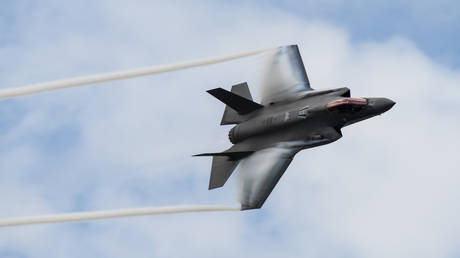
The formal notification transmitted by the United States Department of State to Congress for forty-eight Lockheed Martin F-35 Lightning II aircraft carries an estimated price tag of twenty-four billion three hundred million dollars. This official filing marks a fundamental break from decades of diplomatic hesitation. For fifteen years, Riyadh’s pursuit of Western stealth technology met administrative roadblocks, regional deterrence calculations, and strict technology transfer barriers. The September clearance transforms a persistent diplomatic ambition into a concrete procurement framework. Yet, signing a Foreign Military Sales notification is an administrative milestone, not an operational reality. Securing membership in the fifth-generation air combat club demands an exhaustive sacrifice of fiscal capital, strategic autonomy, and technological sovereignty. Deconstructing the mechanics of this potential acquisition reveals a multi-layered cost function that extends far beyond the headline financial figures.
The Arithmetic of the Procurement Package
A superficial reading of the twenty-four billion three hundred million dollar valuation obscures the actual composition of the military hardware. The notification specifies forty-eight aircraft accompanied by forty-nine Pratt and Whitney engines. This numerical ratio offers an immediate structural insight into the nature of the procurement. Because the F-35 relies on a single-engine architecture, forty-nine engines for forty-four to forty-eight airframes indicates a remarkably lean spare parts inventory, translating to precisely one spare engine across the initial tranche. This signals that the proposed buy functions as an initial operational capability baseline rather than an immediate wholesale replacement of the Royal Saudi Air Force legacy fleet.
Beyond the airframes and propulsion units, the financial envelope covers mission planning systems, electronic warfare protection suites, cryptography devices, maintenance trainers, and specialized support infrastructure. Historical benchmarks from international procurement programs indicate that the acquisition cost of fifth-generation stealth aircraft represents only a fraction of the total cost of ownership. Over a projected operational lifecycle spanning three to four decades, sustainment, software upgrades, spare parts replenishment, and depot-level maintenance typically consume twice the initial procurement expenditure.
The financial burden is compounded by the structural reality of defense inflation and specialized supply chain constraints. Riyadh possesses immense sovereign wealth, but absorbing the recurring maintenance costs of low-observable aircraft requires a permanent restructuring of military expenditure priorities. Unlike legacy fourth-generation platforms such as the Boeing F-15SA or the Eurofighter Typhoon—platforms where domestic maintenance pipelines and regional depot arrangements offer cost efficiencies—the F-35 operates under strict proprietary maintenance frameworks. Every structural repair involving radar-absorbent material requires certified technicians, specialized climate-controlled hangars, and direct authorization from original equipment manufacturers supervised by United States government oversight personnel.
The Technological Security Paradox and Intelligence Compartmentalization
The most formidable barrier to Saudi operational integration is not financial; it is informational security. Fifth-generation fighters are flying supercomputers embedded within a global diagnostic network. The operational efficacy of the F-35 relies on continuous data integration, threat library updates, and telemetry synchronization through advanced logistics architectures.
Washington maintains rigorous export control regimes, specifically structured around the security of sensitive software source codes, sensor fusion algorithms, and low-observable signatures. The United States defense establishment faces an acute internal dilemma regarding Riyadh's historical and contemporary defense diversification policies. For years, Saudi Arabia has pursued military and technological acquisitions outside the Western ecosystem, cultivating commercial and defense ties with non-allied industrial powers.
The presence of advanced telecommunications infrastructure supplied by non-Western firms within the kingdom creates friction points for American counterintelligence protocols. Washington requires absolute physical and digital compartmentalization to prevent unauthorized technical exploitation of stealth coatings, radar frequencies, and electronic countermeasure profiles. To satisfy American security mandates, Saudi military installations hosting the aircraft must implement sterile zones, restrictive personnel vetting procedures, and independent communications networks entirely isolated from dual-use commercial infrastructure.
These security requirements impose operational constraints. If Washington suspects that sensitive tactical data or diagnostic signatures could be accessed or monitored by foreign intelligence services from non-allied states operating within regional infrastructure corridors, software updates can be withheld, and maintenance support can be frozen. The cost of membership thus includes surrendering a degree of operational sovereignty over the national fleet's software architecture. Riyadh must accept that American overseers retain a permanent diagnostic window into the operational readiness and deployment parameters of its premier air wing.
The Regional Equilibrium and Qualitative Military Edge
Any analysis of the procurement mechanics must account for regional military power balances. United States statutory obligations mandate the preservation of Israel's Qualitative Military Edge across the Middle East. For over a decade, the Israeli Air Force maintained a regional monopoly on fifth-generation stealth capabilities through its customized F-35I Adir fleet, integrating unique domestic electronic warfare systems and specialized maintenance frameworks.
Introducing a rival Middle Eastern state into the same technological tier disrupts historical deterrence models. Washington manages this friction by staggering delivery timelines, restricting specific weapon integration packages, and negotiating diplomatic alignments. The proposed Saudi acquisition moves forward within a complex web of regional diplomacy, where defense sales serve as instruments of broader geopolitical reordering.
The strategic trade-off for Riyadh involves accepting structural caps on its operational independence during coalition operations. The kingdom's military planners must design air tasking orders under the assumption that certain software-dependent munitions, offensive profiles, or electronic warfare frequencies will be regulated or restricted based on shifting diplomatic alignments with neighboring states. The cost is measured in tactical flexibility; the Royal Saudi Air Force gains unmatched sensor fusion and situational awareness, but binds its operational envelope to Washington's regional risk calculus.
Infrastructure Transformation and Human Capital Bottlenecks
Transitioning from fourth-generation analog and digital platforms to a fully integrated fifth-generation ecosystem requires an overhaul of military infrastructure. Operating a stealth aircraft demands pristine facility standards. Runways must be kept entirely free of debris to prevent foreign object damage to engine intakes and radar-absorbent surfaces. Hangar facilities require strict environmental controls to preserve material tolerances on skin panels.
Human capital represents an even scarcer resource than physical infrastructure. Piloting an F-35 requires a cognitive shift from traditional dogfighting and visual interception metrics to managing a complex sensor fusion node. Pilots do not simply fly an aircraft; they manage a tactical network, parsing data streams from airborne radar, ground stations, and allied assets.
Training this cadre requires years of simulator hours, specialized academic instruction, and extensive joint exercises with experienced operators. Saudi Arabia's pipeline for technical maintenance personnel must also be radically upgraded. Technicians cannot rely on traditional heuristic troubleshooting; they must interface with automated diagnostic networks that transmit encrypted health and status data directly to manufacturer facilities. Building a self-sustaining domestic maintenance corps capable of satisfying strict United States security audits will take years, meaning the kingdom will remain reliant on contractor logistics support during the initial operational phase.
Strategic Forecast
The clearance of forty-eight F-35 airframes represents a calculated gamble for both Washington and Riyadh. For the United States, the proposed sale serves as an anchor to secure long-term defense alignment, preempting strategic drift toward alternative suppliers. For Saudi Arabia, acquiring the platform fulfills a long-standing prestige and defense modernization objective, anchoring its air defense architecture in premier Western technology.
Yet, the true cost of this membership will be paid in institutional adaptation and operational friction. As the 30-day congressional review window concludes and formal contract negotiations proceed, the actual delivery schedule will stretch well into the next decade. Riyadh will find that possessing the hardware is the simplest part of the equation. The enduring expenditure lies in managing the relentless administrative audits, maintaining absolute digital firewall integrity against non-allied intelligence infiltration, and absorbing the lifetime sustainment outlays of the most complex tactical aircraft ever built. The ultimate test of the acquisition will not be measured by ceremonial flypasts, but by whether the Royal Saudi Air Force can operate the platform under the rigorous, unyielding constraints imposed by its manufacturer and regional security architects.