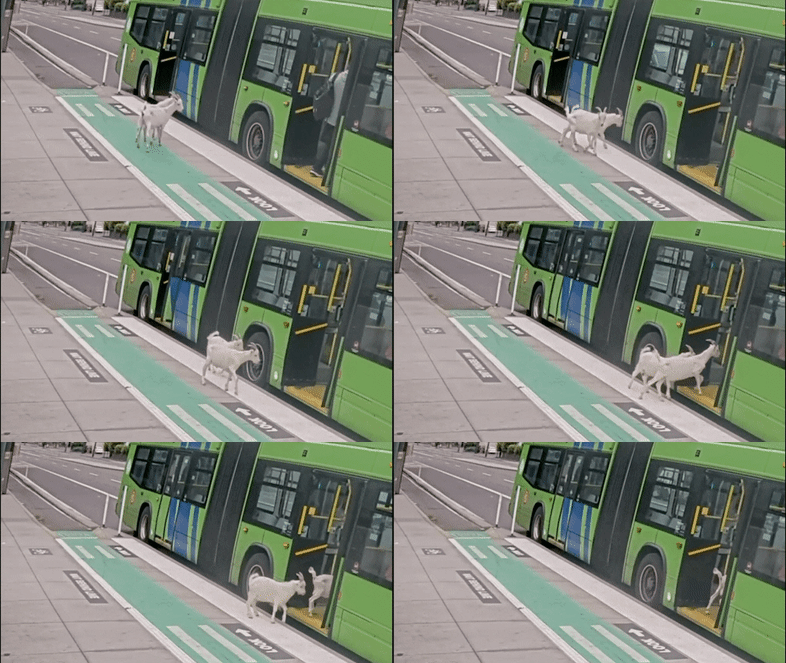
Urban public transit infrastructure relies on deterministic access controls to maintain revenue integrity and passenger throughput. When unconstrained variables enter these closed environments, such as un-ticketed livestock boarding municipal buses, the underlying assumptions of the transit model fail. This event exposes systemic vulnerabilities in automated fare collection, operator discretion protocols, and incident management frameworks. Evaluating this anomaly through operational risk management and transit economics reveals structural flaws in how metropolitan systems handle edge-case disruptions.
The Economic Mechanics of Fare Evasion and System Friction
Public transit operations operate on tight margins where marginal revenue recovery directly dictates capital expenditure allowances. Fare collection systems are designed around predictable human actors who possess standard payment tokens, whether physical passes, contactless smart cards, or digital tickets.
When non-human entities or unusual biological units bypass standard transaction gateways, the financial impact is negligible on a micro scale, but the institutional impact on system friction is substantial. Transit authorities measure efficiency through metrics such as passengers per revenue hour and boarding times per stop. An anomalous entry event introduces a multi-variable delay vector.
Bus operators face a critical operational dilemma when confronted with non-standard boarding scenarios. The operator must choose between two suboptimal paths:
- Enforce strict access control, which halts vehicle movement, disrupts route schedules downstream, and consumes operator attention bandwidth.
- Accommodate the anomaly to maintain schedule velocity, which creates a legal liability precedent and signals enforcement leniency to human riders.
Schedule adherence metrics often incentivize operators to minimize dwell time at all costs. Consequently, standard enforcement protocols break down when an event falls outside the predefined operating parameter matrix of the automatic fare collection software.
Operational Risk Management and Policy Deficits
Metropolitan transit agencies build rule sets for common operational hazards, including passenger medical emergencies, fare disputes, and mechanical failures. They rarely account for un-tethered large mammals entering a confined passenger compartment. This absence of policy creates operational paralysis.
Risk exposure in urban mass transit is categorized into three distinct tiers:
- Financial exposure via lost revenue and potential asset damage.
- Physical exposure through passenger injury or animal-induced panic.
- Reputational exposure amplified by digital media documentation of institutional bewilderment.
When an un-ticketed animal boards a transit vehicle, the immediate response mechanism depends entirely on the individual operator's situational judgment rather than an algorithmic decision tree. This reliance on discretionary execution introduces high variance in system safety and compliance outcomes.
Agencies mitigate this variance through explicit protocol documentation. Without an established playbook for mammalian ingress, the system defaults to ad-hoc improvisation. This lack of standardization increases passenger anxiety and exposes the municipality to regulatory scrutiny regarding public safety compliance inside enclosed transit spaces.
Systematic Failures in Access Control Architecture
Public transit design prioritizes openness and rapid ingress to compete with private vehicular transport. Turnstiles on rapid rail systems and front-door boarding requirements on surface buses represent the primary defense lines against unauthorized access. These architectures assume a cognitive agent capable of transactional exchange.
The presence of livestock on a public bus highlights the boundary limitations of physical barrier systems. Surface transit lacks the physical containment gates found in heavy rail systems, making buses vulnerable to opportunistic or erratic boarding events.
To quantify the vulnerability, transit planners evaluate the cost of hardening infrastructure against the frequency of rare anomalies. Implementing physical animal barriers at every bus entrance is economically unfeasible and would drastically increase boarding times for standard commuters. Therefore, transit systems deliberately accept the risk of rare, unpreventable boundary breaches, absorbing the operational friction when they occur.
Strategic Realignment of Transit Enforcement
Mitigating the systemic vulnerabilities exposed by unconventional boarding events requires a shift from reactive operator discretion to pre-computed escalation protocols. Transit authorities must codify operational responses for non-human ingress to eliminate decision fatigue for vehicle operators.
Integrating telemetry systems with automated dispatch centers allows operators to instantly flag anomalous boarding events and route the vehicle to designated intervention points without compromising schedule integrity across the wider network. Establishing clear communication channels between frontline operators and municipal animal control or specialized transit security units minimizes dwell time disruption.
The long-term resilience of urban transit networks depends on acknowledging that municipal spaces intersect with unpredictable environmental variables. By treating unconventional operational disruptions as quantifiable inputs rather than statistical outliers, transit agencies can engineer more robust contingency frameworks that protect both revenue models and passenger throughput.


:max_bytes(150000):strip_icc():focal(599x0:601x2)/jake-romy-reiner-dodgers-080326-14058af2500249a2afdfd69ef3af9f09.jpg)
