The travel industry is currently suffering from a collective delusion regarding Egyptology.
Every major publication is churning out the same tired narrative. They paint the old Egyptian Museum in Tahrir Square as a dusty, romantic relic—a charming "treasure chest" that somehow retains its magic despite being completely mismanaged for a century. Then, in the same breath, they worship the newly opened Grand Egyptian Museum (GEM) near the Giza pyramids as the ultimate savior of cultural tourism.
They are wrong on both counts.
The romanticization of Tahrir Square’s museum is a coping mechanism for people who tolerate terrible curation. Meanwhile, the $1 billion hyper-modern GEM is not a triumph of preservation. It is a sterile, hyper-commercialized warehouse designed for mass-market tour groups, not the actual appreciation of antiquity.
I have spent nearly two decades navigating global cultural heritage sites, consulting on exhibition logistics, and watching ministries of tourism prioritize gift-shop foot traffic over historical depth. The reality of Cairo’s museum shift is not a glorious evolution. It is a cautionary tale of how modern tourism infrastructure kills the soul of the artifacts it claims to protect.
The Tahrir Square Nostalgia is a Lie
Let us dismantle the "romantic charm" of the old Tahrir Square museum immediately.
For decades, Western travel writers have walked through those red walls and waxed poetic about the "Indiana Jones atmosphere." They describe the lack of labels, the broken display cases, and the suffocating heat as if these elements add to the mystique.
That is not charm. That is institutional neglect.
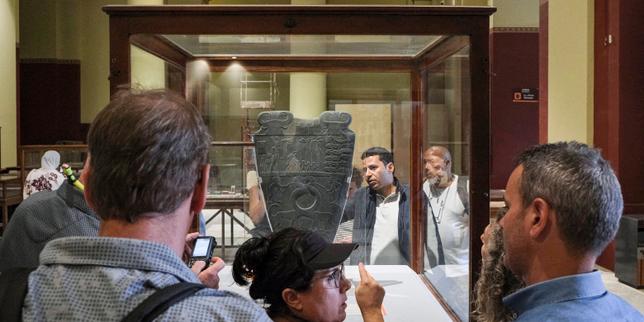
Before the mass migration of artifacts to the GEM, Tahrir was a logistical disaster. Priceless block statues from the New Kingdom were used as literal doorstops. Dust layers were so thick they obscured the inscriptions on sarcophagi. The lighting was so poorly designed that natural glare from the windows actively degraded sensitive pigments over decades.
To call this an "unchanging jewel" is insulting to the conservators who fought for budgets to fix it. The old museum did not thrive because of its atmosphere; it survived in spite of it. The romanticism is merely a projection of orientalist fantasy, where Western tourists prefer their African and Middle Eastern museums to look like chaotic 19th-century curiosity cabinets rather than functional, modern scientific institutions.
The Grand Egyptian Museum is a Sterile Warehouse
Now look at the counter-weight: The Grand Egyptian Museum.
The architectural community has spent years celebrating its sweeping concrete lines, its massive glass facade looking out toward Giza, and its soaring atrium dominated by an 82-ton statue of Ramesses II.
But step past the atrium. Look at the actual gallery design.
The GEM has made the classic mistake of substituting scale for intimacy. When you place thousands of delicate, deeply personal funerary objects into a space that feels like an international airport terminal, you lose the scale of human history. The King Tutankhamun collection—the crown jewel of the entire project—has been subjected to a corporate aesthetic that strips away the gravity of the tomb.
In the old Tahrir museum, packed into a dark, poorly air-conditioned room, the solid gold death mask of Tutankhamun possessed an undeniable, terrifying weight. It felt dangerous. It felt sacred.
In the GEM, under perfectly calibrated, cold LED strips, surrounded by acoustic paneling designed to muffle the chatter of three hundred cruise-ship passengers arriving via tour bus, the mask looks like a high-end luxury good in a boutique window. The museum has successfully turned archaeology into retail.
The Architecture of Crowd Control
Museum directors rarely admit this openly, but the GEM was not built for the artifacts. It was built for throughput.
The entire layout is a exercise in crowd control. The vast spaces are designed to prevent the exact bottlenecks that made Tahrir a nightmare when three tour buses arrived at the same time. The wide corridors, the massive escalators, and the strategic placement of experiential dining options are there to keep people moving toward the exit.
Consider the economic reality. Egypt’s tourism sector represents roughly 12% of the nation's GDP. The GEM is a massive state investment that requires a staggering volume of daily ticket sales just to cover its operational overhead. To achieve this, the curation must appeal to the lowest common denominator.
This means:
- Fewer detailed hieroglyphic translations and more interactive touchscreens that provide superficial overviews.
- The isolation of famous artifacts to create distinct "selfie spots," disrupting the chronological and religious context of the burial assemblages.
- The prioritization of visual spectacle over academic rigor.
When you design a museum to handle 15,000 visitors a day, you cannot afford nuance. You cannot afford spaces that invite quiet contemplation. You build an assembly line for history.
The Myth of the "Complete" Collection
The biggest piece of marketing deception surrounding the GEM is the promise of seeing the entire Tutankhamun collection together for the first time.
Yes, over 5,000 objects have been moved from Tahrir and various storage facilities across Luxor and Alexandria to this single location. But more does not equal better.
Howard Carter took ten years to clear KV62 because many of the objects were mundane, repetitive, or strictly utilitarian. Shoving every single pair of the boy-king’s sandals, every fractional piece of linen, and dozens of identical ritual oars into public display cases does not enhance the visitor's understanding of the Amarna period. It creates cognitive fatigue.
After walking past fifty cases of gold-gilded furniture, the human brain ceases to process the historical significance. The individual genius of the ancient artisans is swallowed by sheer volume. The old curation at Tahrir, imperfect as it was, accidentally curbed this fatigue by keeping the majority of the repetitive material locked away in the basement, forcing visitors to focus on the definitive masterpieces.
Museum Comparison Profile
-----------------------------------------------------------------
Feature             Tahrir Square Museum     Grand Egyptian Museum
-----------------------------------------------------------------
Curation Style      19th-Century Chaos       21st-Century Corporate
Visitor Intent      Discovery / Academic     Spectacle / Tourism
Artifact Context    Sacred / Dense           Isolated / Commodified
Logistics           Terrible                 Excellent (Assembly Line)
Dismantling the "People Also Ask" Flaws
If you look at what prospective travelers are asking, the flawed premise of modern travel curation becomes even more obvious.
"Is the old museum in Tahrir Square still worth visiting?"
People ask this assuming the old museum is now empty. It isn't. But the reason it is worth visiting is exactly why the Egyptian Ministry of Tourism is terrified it will lose relevance: it has become a graveyard of masterpieces that do not fit the GEM’s shiny narrative.
With the royal mummies moved to the National Museum of Egyptian Civilization (NMEC) and Tutankhamun moved to the GEM, Tahrir is left with massive, heavy stone sarcophagi, Old Kingdom masterpieces like the statues of Rahotep and Nofret, and thousands of items that are too heavy or too niche to fit into the GEM's streamlined storyline.
Go to Tahrir precisely because the crowds are gone. Go there because the lack of corporate funding means you can actually stand alone with a masterpiece from the Fourth Dynasty without a security guard hurrying you along to keep the tour group line moving.
"Which museum gives you the best view of Egyptian history?"
Neither. This is the wrong question entirely.
A museum located in Cairo, separated by hundreds of miles from the actual tombs and temples of Luxor and Aswan, can only ever provide an abstracted, fragmented view of Egyptian history. The modern obsession with seeing the objects inside a concrete box in the capital city ignores the fact that these items were never meant to be seen by human eyes at all. They were designed for the darkness of the tomb.
If you want to understand ancient Egypt, skip the $1 billion museum entirely. Spend your money on a flight to Sohag or Abydos. Stand inside the Temple of Seti I, where the reliefs still retain their original 3,000-year-old paint, untouched by the sterile LED lights of a Cairo mega-project. The best museum in Egypt is the country itself, not a air-conditioned warehouse next to a highway.
The Cost of the Upgrade
There is a dark side to this transition that nobody wants to discuss. The centralization of Egypt's heritage into these massive, centralized complexes in Cairo starves the regional museums of resources and attention.
Museums in Minya, Asyut, and even the Luxor Museum—which is arguably the finest curated small museum in the world—are consistently overlooked because the state must recoup its investment in Giza. The artifacts that belong to local communities, found in regional digs, are routinely stripped from their geographic context and shipped north to fill the endless display cases of the GEM.
This is cultural extraction disguised as modernization.
We are trading a authentic, localized, albeit flawed relationship with history for a sanitized, corporate experience designed to optimize the spending per visitor. The GEM may be a triumph of civil engineering, but it represents the death of intimacy in archaeology.
Stop waiting for the grand opening. Stop buying into the PR campaigns that tell you history needs a billion-dollar glass frame to be understood. The old world was messy, dark, and complicated. It belongs in spaces that reflect that complexity, not in an architectural monument to the tourist dollar.
Stop looking at the glass cases. Go to the desert. Get the dust on your shoes. That is where the history actually lives.