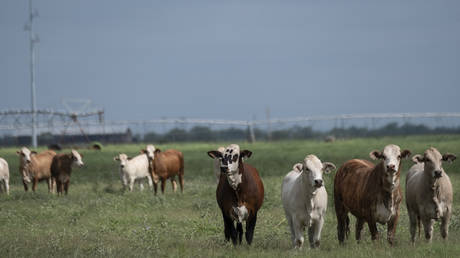
The headlines want you to panic about a Texas parasite invasion. They want you to envision swarms of flesh-eating screwworms marching across the border, decimating herds, and crippling the North American meat supply. Mainstream media outlets are dutifully copying and pasting press releases about Canada’s sudden embargo on Texas livestock, framing it as a heroic, swift act of biosecurity.
It is a comforting narrative. It is also entirely wrong. In related updates, we also covered: Why the IAEA Demand for Iran to Disclose Bombed Uranium Stocks is Diplomatic Theater.
Having spent two decades analyzing agricultural supply chains and trade policy, I can tell you that this ban has very little to do with biological containment and everything to do with economic protectionism and bureaucratic inertia. When you look at the actual vectors of transmission, the biology of Cochliomyia hominivorax, and the existing compliance protocols, the Canadian Food Inspection Agency’s (CFIA) blanket ban looks less like science and more like a political theater production.
The media is asking how this parasite will destroy our food supply. The real question we should be asking is why we are letting a hyper-cautious bureaucracy disrupt a multi-billion-dollar trading relationship over a risk that is already managed to near-zero. The Washington Post has analyzed this critical issue in great detail.
The Screwworm Scaremongering vs. Biological Reality
To understand why this ban is an overreaction, you have to understand the pest itself. The New World screwworm is undeniably nasty. The larvae feed on the living tissue of warm-blooded animals, and left unchecked, an infestation can be fatal.
But here is what the alarmist reports conveniently omit: the United States eradicated the New World screwworm in 1966.
For sixty years, the United States Department of Agriculture (USDA), in collaboration with international partners, has maintained a permanent biological barrier at the Darien Gap in Panama. They release millions of sterile male flies every single week. This technique, the Sterile Insect Technique (SIT), is one of the most successful entomological achievements in human history.
When isolated detections occur in the US, they are almost exclusively linked to imported pets or human travelers returning from endemic zones in South America—not commercial livestock herds roaming the Texas plains.
Furthermore, the biological limitations of the parasite make a sudden, self-sustaining outbreak in Canada highly improbable.
- Temperature Constraints: Screwworms thrive in tropical and subtropical climates. They cannot survive sustained freezing temperatures.
- Pupation Limits: The pupal stage requires warm soil to emerge. A Texas fly does not simply hitchhike its way to Alberta and establish a colony in the Canadian climate.
- Existing Checks: Every single head of cattle moving through commercial channels undergoes rigorous veterinary inspection before it ever reaches a border checkpoint.
To suggest that a blanket ban on an entire state's livestock industry is the only way to prevent an outbreak is biologically illiterate. It ignores sixty years of proven containment infrastructure.
Follow the Money: The Protectionist Playbook
If the biological risk is minimal, why the sudden drastic measures? Look at the timing and the market dynamics.
North American cattle cycles are at historic lows, driving prices per hundredweight to unprecedented highs. Canadian packers are competing fiercely with American processors for a dwindling supply of feeder cattle. By slamming the door on Texas livestock, the Canadian market creates an artificial supply barrier that temporarily insulates domestic producers from southern competition while giving regulatory agencies a chance to flex their muscles.
I have watched agricultural ministries pull this lever for decades. When a government wants to appease a domestic farming lobby without violating free trade agreements like the USMCA, they do not impose tariffs. They invent a biosecurity crisis.
"Sanitary and phytosanitary measures are the oldest trick in the protectionist handbook. You cannot legally tax the import, so you declare the import biologically hazardous."
The downside to my contrarian view is obvious: if I am wrong, and a loophole allows an infestation to take root during a peak northern summer, the eradication costs are astronomical. But the downside of the current approach is certain, immediate economic damage. We are sacrificing real economic certainty today to appease a hypothetical threat tomorrow.
Dismantling the "People Also Ask" Delusions
The public discourse surrounding this ban is filled with fundamentally flawed assumptions. Let us dismantle the most common questions circulating right now.
Will this ban lower beef prices for consumers?
No. It will do the exact opposite. The North American beef market is deeply integrated. Calves born in Canada are often shipped to the US for feeding and slaughter, and vice versa. Disrupting this flow restricts supply and forces packers to source alternative, more expensive inputs. If you think blocking Texas cattle keeps Canadian beef cheap, you do not understand how meat packing margins work.
Is Canada just following international biosecurity standards?
The World Organisation for Animal Health (WOAH) advocates for regionalization and risk-proportionate responses. A blanket ban on an entire state—especially one with the robust veterinary infrastructure of Texas—is a blunt-force instrument that violates the spirit of regionalized trade policy. It is an escalation, not a standard protocol.
Can’t we just source livestock from other states?
Logistically, it is a nightmare. Supply lines, transport routes, and long-standing corporate contracts cannot be rewritten overnight without massive financial friction. Eliminating a primary supplier like Texas shocks the system, creating a bottleneck that affects transport logistics across the entire continent.
The Actionable Alternative: Precision Biosecurity
We do not need to shut down borders to keep herds safe. The solution is already in our hands, but it requires regulatory agility rather than bureaucratic panic.
- Ditch the Blanket Ban for County-Level Regionalization: If an isolated detection occurs, quarantine the specific county or a 50-mile radius. Do not penalize an entire state that is larger than most European nations.
- Implement Mandatory Pre-Shipment Ivermectin Treatments: Rather than relying solely on visual inspections, require a certified antiparasitic treatment for all livestock departing from high-risk zones during peak season. This kills any potential larvae before the animal even boards a trailer.
- Deploy Digital Traceability Systems: Stop relying on paper health certificates that get smudged at border crossings. Utilize real-time RFID tracking data coupled with immutable veterinary logs to verify the exact movement history of every animal.
The current Canadian strategy is lazy. It is the regulatory equivalent of using a sledgehammer to kill a fly on a glass window. It breaks the window, disrupts billions in commerce, and leaves the fundamental vulnerabilities untouched.
Stop cheering for the ban. Demand a smarter border, not a closed one. This is not a victory for public health; it is a monument to bureaucratic cowardice.