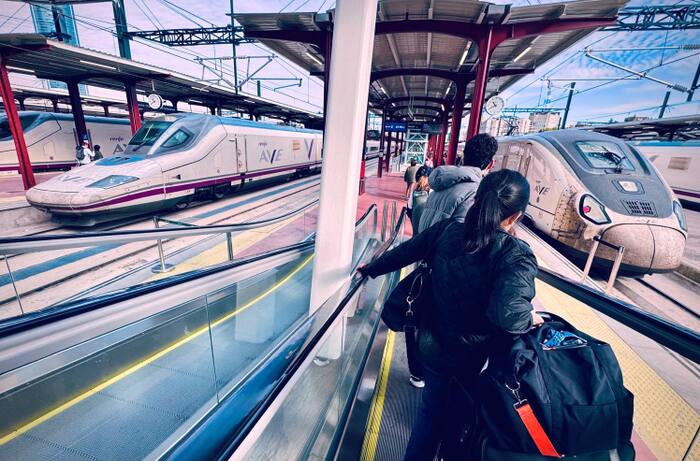
High-speed rail networks depend on absolute synchronization between rolling stock, signaling infrastructure, and real-time traffic control. When an operational catastrophe strikes Spain's Alta Velocidad Española (AVE) network—whether triggered by extreme weather events, rolling stock defects, track sabotage, or signaling collapses—the immediate consequence is a cascading failure across the entire corridor. A single point of failure in a hub-and-spoke topology centered on Madrid does not merely delay one train; it induces a network-wide deadlock that exposes the fragility of high-utilization rail corridors.
Understanding the reality inside a high-speed carriage during the aftermath of a major disruption requires stripping away anecdotal travelogue and examining the mechanics of crisis operations. When a train halts or crawls through a degraded network, passengers experience the downstream effects of four distinct operational failures: track capacity saturation, human-factor bottlenecks in traffic dispatch, rolling stock rotation deficits, and asymmetric information flow. Learn more on a similar subject: this related article.
The Topology of Vulnerability in Spanish High-Speed Rail
Spain operates the longest high-speed rail network in Europe and the second longest globally. The physical architecture of this system dictates how it fails. Unlike decentralized mesh networks where trains can be rerouted across redundant parallel corridors, the Spanish network is heavily radial. Nearly every primary trunk line—connecting Barcelona, Seville, Valencia, Malaga, and Galicia—converges on Madrid's Atocha and Chamartín stations.
This radial geometry maximizes point-to-point speed under normal conditions but creates severe systemic vulnerability during disruptions. Additional analysis by The Guardian explores similar perspectives on this issue.
- Zero-Buffer Scheduling: To maximize return on capital-intensive infrastructure, operators schedule trains at tight headways. In peak windows, the buffer time between arrivals and departures leaves no slack for recovery.
- Gauge Break Constraints: While Spain has deployed dual-gauge variable axles (ancho variable) on specific trainsets, a large portion of the fleet is restricted to standard European gauge (1,435 mm). When a standard-gauge high-speed line is blocked, operators cannot simply divert those trains onto conventional Iberian-gauge (1,668 mm) tracks.
- Single-Track Bottlenecks: Several critical junctions, particularly around the Madrid tunnel connections and regional approaches, rely on constrained track geometry where a single stalled train blocks bidirectional traffic.
When an incident occurs—such as an overhead catenary collapse, a signaling software crash, or a collision—the physical track becomes an impassable barrier. Trains already in transit cannot turn around easily; high-speed trainsets require specialized signaling clearances to reverse direction, a process that demands manual authorization from central command and reduces line capacity by over 70 percent.
The Anatomy of a Cascading Delay
A catastrophe on a high-speed line triggers a predictable chain of operational degradation. What begins as a localized infrastructure failure rapidly mutates into a multi-day logistical crisis due to the interdependence of physical assets and crew schedules.
1. Infrastructure Lockout and Degraded Mode Operations
The first phase of any major rail incident is the immediate enforcement of safety interlocks. Modern European Rail Traffic Management System (ERTMS) and ASFA (Anuncio de Señales y Frenado Automático) signaling systems are designed to fail safe. If a sensor loses track circuit continuity or power drops in a substation, the system automatically commands all trains in the affected block to execute an emergency or service brake application.
Once the immediate danger passes, traffic control shifts to degraded mode (marcha a la vista). Under degraded mode, drivers must operate strictly by visual line-of-sight at speeds capped around 30 to 40 kilometers per hour, regardless of the train's 300 km/h design capability. A journey segment that normally requires 20 minutes suddenly consumes two hours. Because high-speed lines lack frequent sidings, trains queue up behind the bottleneck like cars on a closed highway, trapping thousands of passengers inside sealed aluminum tubes.
2. Rolling Stock Rotation Collapse
High-speed trainsets do not sit idle at terminals; they operate on tight, continuous rotation cycles. A single Talgo Avril or Siemens Velaro set might run from Madrid to Barcelona in the morning, turn around in 45 minutes, return to Madrid, and continue to Seville by evening.
When a disruption traps ten trainsets on the southern corridor, those specific physical units fail to arrive in Madrid for their scheduled departures to the north or east. Even if the northern tracks are completely clear and fully operational, trains are canceled because the rolling stock is physically marooned hundreds of kilometers away. Operators rarely maintain a large reserve fleet of idle high-speed trains due to the prohibitive capital cost of acquisition and maintenance—often exceeding 30 million euros per trainset.
3. Crew Hours-of-Service Expiration
Rail safety regulations strictly enforce maximum continuous driving hours for train drivers (maquinistas) and onboard safety personnel. During a prolonged standstill, the clock continues to run. A driver stuck outside a station for four hours may hit their statutory duty limit before the track clears.
At that exact minute, the train cannot legally move, even if the green signal illuminates. Dispatchers must then locate a relief crew, transport them via road vehicles to the stranded train's remote location, and execute a formal handover. This human-factor constraint frequently extends disruptions long after the physical infrastructure has been repaired.
The Economics of Liberalization and Operational Friction
To understand why passenger management inside the train often feels chaotic during a crisis, one must examine the structural changes in the Spanish rail market. Following the European Union's Fourth Railway Package, Spain liberalized its high-speed passenger market, introducing competition between the state-owned incumbent (Renfe) and private entrants (Iryo and Ouigo), while keeping infrastructure management centralized under Adif (Administrador de Infraestructuras Ferroviarias).
This vertical separation creates distinct operational friction during emergencies:
- Split Command Chains: Adif controls the tracks, signals, power, and station platforms. The operators (Renfe, Iryo, Ouigo) own or lease the trains and employ the onboard staff. During a catastrophe, Adif prioritizes network safety and infrastructure triage, while operators scramble to manage passenger welfare and fleet recovery.
- Information Asymmetry: Onboard train managers rely on updates filtered through their respective operator's control center, which in turn awaits diagnostic data from Adif's centralized traffic control (CTC). Because infrastructure engineers cannot provide an accurate repair estimate until they physically inspect the damage, control centers withhold timelines to avoid issuing false promises. To the passenger sitting in a dark or stationary carriage, this institutional caution manifests as total silence and incompetence.
- Platform Congestion at Termini: Liberalization dramatically increased train frequencies on major routes, particularly Madrid–Barcelona and Madrid–Valencia. Stations built for a monopoly operator now handle peak passenger volumes that exceed original concourse capacities. When delayed trains finally limp into Atocha or Sants, disembarking passengers collide with crowds waiting for delayed departures, creating severe crowd-control hazards.
Inside the Carriage: Life-Support and Passenger Dynamics
A modern high-speed train is an enclosed environment entirely dependent on continuous external electrical power—typically 25 kV AC supplied via the overhead catenary. When an incident involves a power loss or forces a pantograph drop, the train transitions to onboard battery reserves.
Battery capacity is finite and strictly rationed by the train's central computer to preserve safety-critical systems: emergency lighting, braking pressure monitoring, public address systems, and radio communications. High-draw comfort systems are the first to shed load.
- HVAC Shutdown: Heating, ventilation, and air conditioning units consume massive power. Within 20 to 30 minutes of a main power loss in extreme summer heat or winter cold, cabin temperatures diverge sharply from comfortable baselines. Because high-speed windows are permanently sealed to maintain pressurization against tunnel boom waves, natural ventilation is impossible without opening exterior doors.
- Sanitation Lockouts: Vacuum toilet systems require both electrical power and compressed air. Prolonged power outages render onboard lavatories inoperable, turning a two-hour delay into an acute hygiene crisis.
- Telecommunications Saturation: High-speed rail corridors often traverse sparsely populated rural zones (la España vaciada) where cellular tower density is low. Under normal speeds, a train passes through a cell sector in seconds. When a train carrying 400 to 600 passengers stops stationary in a rural sector, all devices simultaneously attempt to stream video, check news, and make calls, immediately saturating the local cell tower's bandwidth and severing passenger connectivity.
Opening exterior doors to relieve cabin heat or claustrophobia is strictly prohibited unless an evacuation is formally ordered by Adif. Stepping onto active ballast alongside adjacent tracks carrying 300 km/h traffic presents an immediate fatality risk. Consequently, onboard staff must enforce containment while lacking the operational authority or real-time data to explain when the containment will end.
Strategic Failures in Crisis Communication
The recurring pattern in the aftermath of Spanish rail catastrophes is not merely the technical failure itself, but the collapse of institutional credibility during recovery. Operators routinely default to reactive damage control rather than proactive operational transparency.
Passengers tolerate mechanical failures when given clear, probabilistic expectations; they revolt against uncertainty. When onboard announcements repeat generic scripts without acknowledging the specific nature of the bottleneck, passengers assume the worst. Furthermore, the rigid separation between ticketing systems across competing operators prevents seamless cross-honoring of tickets during emergencies. A passenger holding an Ouigo ticket cannot easily board an adjacent Renfe train with empty seats during a disruption, even though both operators utilize the exact same state-owned track infrastructure.
Tactical Recommendations for Network Resilience
Resolving these systemic vulnerabilities requires structural intervention across infrastructure engineering, regulatory policy, and operator protocols rather than superficial customer service training.
- Mandate Cross-Operator Emergency Clearing: Adif and the Ministry of Transport must establish a binding legal protocol that suspends commercial ticketing boundaries during Level 2 and Level 3 network disruptions. When track capacity drops below 50 percent, all available rolling stock must function as a unified shuttle pool, honoring any valid ticket for that corridor to clear stranded passengers at maximum throughput.
- Deploy Autonomous Auxiliary Power Units: Future rolling stock procurement specifications must require dedicated, diesel-electric or high-density lithium-titanate auxiliary power modules capable of sustaining full cabin HVAC and sanitation systems for a minimum of six hours independent of overhead catenary power.
- Establish Automated Telemetry Feeds to Onboard Staff: Operators must eliminate the human bottleneck in crisis communication by linking Adif's real-time track occupation maps and diagnostic fault codes directly to the tablets carried by onboard train managers. Equipping frontline staff with raw operational data enables them to brief passengers accurately on the exact distance to the bottleneck and the number of trains ahead in the queue.
- Reintroduce Dynamic Schedule Slack: Regulators must audit peak-hour slot allocations on the Madrid–Barcelona and Madrid–Andalusia corridors, enforcing mandatory 15-minute recovery windows every two hours. Sacrificing marginal peak capacity is the only mathematically viable mechanism to absorb minor delays before they metastasize into multi-day network collapses.