The espresso machine at Café Comercial in Madrid doesn't hiss; it sighs. Behind the counter, Alejandro wipes down the zinc surface for the thousandth time today. He is thirty-two, holds a master’s degree in macroeconomics, and earns eleven hundred euros a month making café con leche for tourists.
Outside, the midday sun bathes the capital in a brilliant, deceptive warmth. If you glance at the front page of the financial dailies left on the wooden tables, the numbers paint a picture of a nation triumphant. Spain is leading the Eurozone. Growth is clipping along at nearly three percent, outpacing Germany, leaving France in the dust. Inflation has cooled. The Brussels technocrats are smiling.
They call it the Spanish economic miracle.
But Alejandro doesn't feel miraculous. He feels tired. His reality is a quiet, grinding friction shared by millions across the Iberian peninsula—a disconnect between the glittering macroeconomic data celebrated in boardroom meetings and the stubborn, fragile reality on the cobblestone streets. Spain is booming, yes. But it is a house built on shifting sand.
The Mirage of the Moving Crowd
To understand how a country can be simultaneously rich on paper and precarious in practice, you have to look at where the money actually lands.
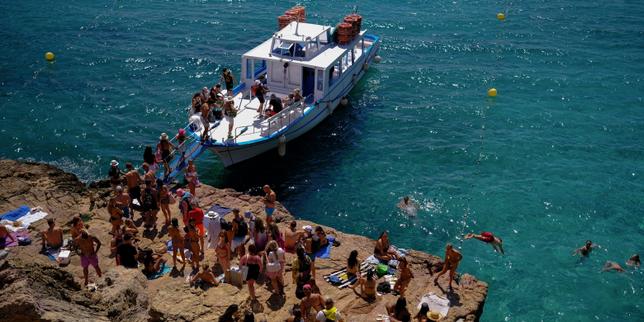
Step out of Alejandro’s café and walk toward the Gran Vía. The streets are packed. Restaurants are humming, and hotel lobbies gleam with marble and digital check-in screens. Tourism has not just recovered; it has mutated into a colossal engine driving the entire economy forward. Last year, a record-breaking eighty-five million international visitors poured into Spain, spending their euros on tapas, beach rentals, and rental cars.
On paper, this looks like a triumph. It counts heavily toward Gross Domestic Product. It creates jobs.
But consider what happens next.
Tourism jobs are, by their very nature, fleeting. They are the seasonal ghosts of the labor market. A contract is signed in May and torn up in October. When a nation relies so heavily on the hospitality sector to drive its growth engine, it isn't building a deep, resilient foundation of innovation. It is throwing dry wood onto a fire that burns bright but fast.
This is the productivity trap. When an economy grows primarily by adding low-wage, low-skill service jobs, its overall productivity per hour worked stagnates. It takes just as many hours to pour a glass of Rioja today as it did in 1995. True, long-term wealth comes from doing things smarter, faster, and more efficiently through technology and high-value industry. Spain’s current boom relies heavily on simply doing more of the same basic tasks for more people.
It is growth by volume, not by value.
The Locked Doors of Malasaña
The consequence of this service-heavy boom walks hand-in-hand with a housing crisis that is suffocating the younger generation.
Let us invent a colleague for Alejandro. Call her Sofia. She is twenty-eight, works in digital marketing for an agency near Plaza de España, and still lives with her parents in a concrete suburb forty minutes outside the city center. Sofia wants to move out. She dreams of a small apartment in Malasaña, a vibrant neighborhood known for its vintage shops and street art.
She cannot afford it. Not even close.
The massive influx of foreign capital and the explosion of short-term tourist rentals have turned Spain’s urban housing markets into speculative playgrounds. While Sofia's salary has crawled upward by perhaps two or three percent over the last three years, rent in Madrid and Barcelona has skyrocketed by double digits. The math simply does not work.
The statistics bear this out with brutal clarity. Spain has one of the highest ages of emancipation in Europe; the average young adult doesn't leave the family home until they are thirty. This isn't a cultural preference for extended family living. It is economic imprisonment.
When a generation cannot afford to rent a flat, they do not buy furniture. They do not start small businesses. They do not have children. The demographic time bomb tickers louder every year, fueled by a property market that rewards wealthy outside investors while locking out the very people needed to build the country's future.
The numbers on the government spreadsheets look phenomenal because real estate transactions and tourism spending push the GDP higher. But the human cost is a generation frozen in place, watching life happen through the windows of their childhood bedrooms.
The Weight of the Invisible Ledger
Then there is the structural debt, a quiet monster lurking beneath the surface of the celebration.
During the pandemic, governments across the globe spent heavily to keep their societies afloat. Spain was no exception. But while the immediate crisis has passed and tax revenues have surged due to high inflation and increased employment, the country's public debt remains stubbornly high, hovering around one hundred and five percent of GDP.
Think of it like a household that has taken out a massive mortgage during a time of record-low interest rates. As long as the sun shines and wages come in, the payments are manageable. But the global landscape is shifting. Interest rates have risen, and the era of free money from the European Central Bank is over.
Every euro spent servicing the interest on that national debt is a euro that cannot be invested in public schools, research labs, or cutting-edge green infrastructure. It leaves the country incredibly vulnerable to the next global shock. If a recession hits tourism again, or if energy prices spike unexpectedly, the buffer is gone. The safety net has been stretched thin.
The Fragmented Kingdom
Look closer at the map, and the concept of a singular "Spanish miracle" fractures entirely.
There are, in reality, two Spains. There is the thriving, hyper-connected axis of Madrid and the Mediterranean coast, where capital flows freely and cranes dot the skyline. Then there is España vaciada—emptied Spain. In the vast interiors of Castile and León, Extremadura, and Aragon, villages are quietly dying.
In these regions, young people are the primary export. They flee to Madrid or abroad because the local economies offer little beyond traditional agriculture. The growth numbers celebrated in the ministries of the capital mean absolutely nothing in a town where the last pharmacy closed two years ago and the school has three pupils left.
Even within the booming cities, the labor market remains deeply divided. The government recently introduced labor reforms designed to curb the rampant use of temporary contracts, forcing companies to hire workers on permanent terms. On paper, temporary employment numbers dropped significantly.
But employers adapted. They turned to the fijo-discontinuo contract—a legal definition meaning "permanent seasonal worker." You are technically on a permanent contract, but you only work, and get paid, when the business needs you. If you are a waiter, you work the summer and sit at home in January, earning nothing, yet the official government statistics do not count you as unemployed.
It is a statistical sleight of hand that masks a deep, systemic insecurity.
The Last Accord
Back in Café Comercial, the afternoon rush begins to fade. The sunlight shifts, casting long, dramatic shadows across the plaza outside.
Alejandro collects the empty cups, counting the tips left on the tables. A few shiny coins. He smiles politely at a departing couple from London who praise the beauty of the city and the cheap price of the wine. They tell him how lucky he is to live in a country experiencing such an incredible economic renaissance.
He nods, thanks them, and wishes them a safe flight home.
The economic data will continue to flash green. The politicians will continue to give speeches praising the resilience of the Spanish model. But as long as the brilliance of the macroeconomic miracle relies on cheap labor, unaffordable housing, and a mountain of public debt, it remains a beautiful, fragile glass ornament. Beautiful to look at from a distance, but dangerously close to shattering under the weight of real life.
Alejandro pockets his coins, walks back to the kitchen, and begins to prep for the evening shift.