The train hums its relentless, metallic song through the concrete arteries of Tokyo. Inside, the air is thick with the scent of cheap coffee, damp wool, and the silent, heavy exhaustion of a million men wearing identical armor. Charcoal grey suits. White shirts. Black briefcase in the left hand. Eyes fixed downward, locked onto the glowing glass rectangle of a smartphone, or simply closed in a brief, stolen simulation of sleep.
They are the salarymen. For decades, the cultural blueprint has painted them with a single brush stroke. Uniform. Obedient. Unwavering. Cogs in an economic engine that demands absolute synchronization. To step out of line is to invite social exile. To express joy, frustration, or artistic abandon outside the prescribed boundaries of after-work drinking with the boss is to fracture the fragile peace of corporate harmony.
Then the bass drops.
In a mirrored studio somewhere in the sprawling metropolis, a man who spent his morning navigating the razor-sharp politics of a corporate boardroom is suddenly sliding across the floor in a flurry of neon light and popping joints. He wears the uniform trousers, but his jacket is discarded. His tie is wrapped haphazardly around his forehead. He is grinning, breathless, and completely untethered.
This is Toru Dance.
The Weight of the Monolith
To understand why a group of middle-aged corporate workers spinning on their backs or locking their shoulders to hip-hop beats feels almost revolutionary, you have to understand the gravity of what they are escaping.
Workplace culture in Japan has long been defined by loyalty that borders on sacred. The lifetime employment model, while evolving, left an indelible mark on the national psyche. The office is not merely a place where hours are traded for currency; it is a second family, a moral obligation, an identity. When a man enters the company straight out of university, he inherits a script. Stand straight. Speak politely. Bow deeply. Stay until the boss leaves. Never draw unnecessary attention to yourself.
Over years, that script calcifies. The shoulders round under the weight of unspoken expectations. The spine stiffens. Not from strength, but from rigidity.
(Hypothetically, imagine Kenji. Kenji is forty-two. By day, he manages logistics for a mid-sized electronics firm. His emails are polite, sterile, and punctuated by the correct honorifics. When he walks down the street, his stride matches the metronomic pace of the crowd. He has not felt spontaneous since he was nineteen years old. His body belongs to the schedule.)
Until he finds the studio.
Finding the Beat
Street dance arrived in Japan decades ago, imported from the Bronx and popularized in parks like Yoyogi, where youth crews practiced breakdancing on cardboard sheets. For a long time, it belonged to the young. It was loud, rebellious, and counter-cultural.
What Toru Dance and similar movements have done is remarkably subtle and deeply subversive. They did not try to overthrow the corporate structure with picket signs or loud declarations. Instead, they simply brought middle-aged men into the circle.
At first, it feels terrifying. Stepping into a dance studio for the first time as a forty-year-old whose primary physical exertion involves sprinting for the 8:14 train is an exercise in profound vulnerability. You look in the mirror. You see your own awkwardness. The internal critic—honed by decades of corporate evaluations—screams that you look foolish.
The instructor smiles. No one is grading you. There is no quarterly review.
You miss a step. You laugh. Someone else trips over their own wingtip shoes. And in that shared, collective stumble, the armor cracks.
The Physiology of Release
Dance is deceptive. To the casual observer, it is entertainment. To the person inside the movement, it is a conversation with gravity.
When a salaryman begins to isolate his chest, lock his arms, or drop into a low, fluid groove, something neurological shifts. The cortisol—that stubborn, permanent resident of the corporate bloodstream—begins to clear. The body remembers that it was built for more than sitting in an ergonomic chair facing a glowing monitor.
Consider the mechanics of isolation. To lock your wrist while your shoulder rolls independently requires immense mental focus. That focus acts as a hard reset for a brain fried by endless meetings and Slack notifications. You cannot worry about the pending supply chain crisis in Nagoya when you are desperately trying to remember whether your left foot crosses behind or in front on the four-count.
For an hour, the spreadsheet ceases to exist. The client whose demands shifted at 4:55 PM vanishes. There is only the rhythm, the floor, and the awkward, beautiful process of learning how to inhabit your own skeleton again.
Breaking the Mold Without Shattering the Glass
There is a misconception that breaking free requires a dramatic explosion. We love stories of the businessman who quits his job, shaves his head, opens a bakery in the mountains, and finds instant nirvana.
Reality is rarely so cinematic. Most salarymen cannot simply walk away. They have mortgages, families, aging parents, and genuine loyalty to their colleagues. They rely on the stability of the system.
What Toru Dance offers is not an exit, but a valve. It is an acknowledgment that you can honor your responsibilities without erasing your humanity. You can spend forty hours a week managing spreadsheets and still spend two hours on a Tuesday night locking and popping like you are twenty-one.
In fact, many participants report becoming better at their jobs. When you have an outlet for self-expression, the petty frustrations of office politics lose their crushing weight. The boss's harsh critique no longer feels like a referendum on your entire existence; it is just background noise, easily shaken off when the weekend brings the studio lights back on.
The Echo in the Street
Walk past a Tokyo park late at night, long after the offices have emptied and the drinking dens are beginning to quiet down. Look closely at the mirrored glass of a subway station entrance or a commercial building lobby.
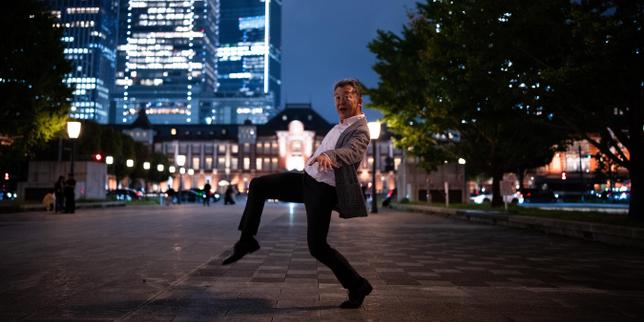
You will see them. Men in rumpled suits, standing alone or in small groups, practicing a footwork pattern they learned in class. They are checking their reflections, refining the angle of a head tilt, chasing the elusive feeling of complete, unadulterated physical freedom.
They do not look like rebels. They look like ordinary men carrying the weight of the world.
Until the music starts playing in their heads.
The shoulders drop. The gaze lifts. And for a few fleeting seconds, the uniform is just fabric, and the man inside it is entirely, wonderfully alive.