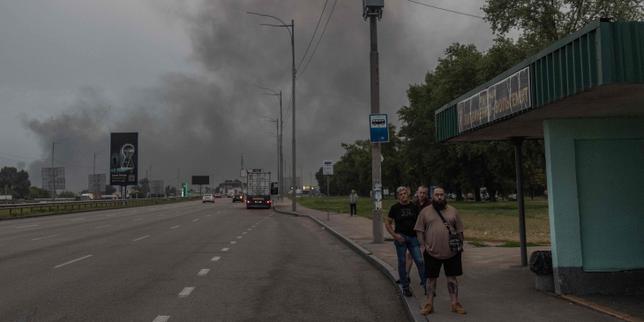
The Kinetic Threshold of Modern Air Defense
Military strategy in contemporary urban warfare relies on a continuous calculus of saturation and interception. When examining mass missile and drone strikes directed against major metropolitan centers like Kyiv, observers frequently misinterpret the objective as erratic destruction. Systematic targeting patterns demonstrate that high-volume bombardments function through a structured economic and physical attrition model designed to overwhelm layered interception architecture.
The mechanics of this attrition operate on a simple cost-imposition principle. Interceptor missiles deployed by defensive batteries carry disproportionately high financial and logistical replacement costs relative to incoming loitering munitions or ballistic systems. By compelling the defender to expend scarce surface-to-air inventory on low-cost vectors, the attacking force attempts to create structural gaps in the protective umbrella.
[Incoming Volley: Ballistic + Cruise + UAVs]
                 │
                 ▼
[Defensive Layer: Radar Acquisition & Fire Control]
                 │
                 ▼
[Resource Allocation Bottleneck: Interceptor Supply vs. Target Volume]
                 │
        ┌────────┴────────┐
        ▼                 ▼
[Successful Interception] [Kinetic Impact on Critical Infrastructure]
This dynamic explains why casualty events often occur despite the presence of advanced antimissile systems. Interception rates are probabilistic rather than absolute. A saturation threshold exists where the volume of simultaneous inbound signatures exceeds the processing capacity of fire-control radar networks and the physical reload limits of launcher rails. When that threshold breaks, kinetic energy transfers directly to urban infrastructure and civilian populations, manifesting as high-fatality incidents during morning or evening transit hours.
The Logistical Architecture of Regional Strikes
Analyzing structural impacts across the Kyiv metropolitan region requires separating strategic objectives into distinct operational vectors. Attacks targeting the capital are rarely tactical engagements with front-line military units. Instead, they represent a systemic campaign directed against the nodes of national continuity.
The Three Operational Vectors
- Energy Transmission Nodes: Substations and transformation hubs intended to disrupt regional power distribution grids, thereby cascading failures into municipal heating, water treatment, and public transit systems.
- Logistical Corridors: Rail junctions, highway bridges, and warehousing facilities designed to impede the lateral movement of materiel and personnel from Western supply lines toward eastern operational theaters.
- Psychological Pressure Points: Densely populated residential sectors situated adjacent to administrative or dual-use industrial zones, engineered to tax emergency response capabilities and generate systemic social friction.
The timing of these strikes often correlates with broader meteorological cycles and diplomatic timelines. Winter approaches elevate the value of energy infrastructure destruction, transforming thermal management into a primary variable of civilian endurance. Conversely, summer strikes leverage the vulnerability of surface-level transport networks and construction staging areas.
Emergency Response Optimization Under Fire
When multi-vector kinetic impacts occur in an urban core, the velocity and precision of municipal emergency response dictate the severity of the trailing humanitarian crisis. First responders face a compressed operational window where triage protocols must adapt to secondary hazard risks, including delayed-fuse ordnance, structural collapse, and hazardous material leaks from ruptured industrial mains.
The efficiency of emergency management in Kyiv rests on decentralized dispatch nodes coupled with redundant communication channels. Centralized command architectures frequently fail during heavy bombardments due to localized power outages and fiber-optic degradation. Resilient systems rely on autonomous precinct-level mobilization, allowing fire, medical, and heavy rescue units to self-deploy based on acoustic triangulation and direct structural damage reports before formal orders filter down from central headquarters.
However, repeated targeting of the same metropolitan grid creates systemic fatigue among first responder personnel. Equipment attrition, sleep deprivation, and the physical destruction of specialized heavy rescue vehicles compound over extended operational timelines. The limiting factor in casualty mitigation ceases to be medical expertise or hospital bed capacity; it becomes the sheer physical capacity of rescue workers to clear concrete rubble and secure unstable structures before secondary fires or structural collapses claim trapped individuals.
Long-Term Economic and Infrastructural Fallout
The accumulation of recurring missile impacts forces a fundamental restructuring of urban economic activity. Capital flight, property devaluation, and the disruption of commercial supply chains alter the financial viability of operating within the metropolitan zone. Businesses must amortize the cost of structural hardening, backup power generation, and distributed workforce models into their operational budgets.
Insurance markets respond to persistent aerial bombardment by withdrawing coverage or pricing risk at prohibitive rates, shifting the financial burden of asset protection entirely onto the property owners and the state. This creates an environment where physical reconstruction is outpaced by the rate of degradation.
The strategic implication extends beyond immediate structural repairs. As infrastructure is repeatedly struck, the resilience of the grid degrades non-linearly. Each subsequent repair utilizes lower-grade substitute materials or temporary bypass configurations, increasing vulnerability to future kinetic events. Managing this trajectory requires prioritizing hardening over rapid superficial reconstruction, shifting national resources toward deeply buried micro-grids, decentralized power generation, and hardened shelter networks capable of maintaining baseline human survival regardless of surface conditions.
Deploy resources toward subterranean structural hardening and decentralized municipal power grids to mitigate the systemic attrition of repeated urban bombardments.