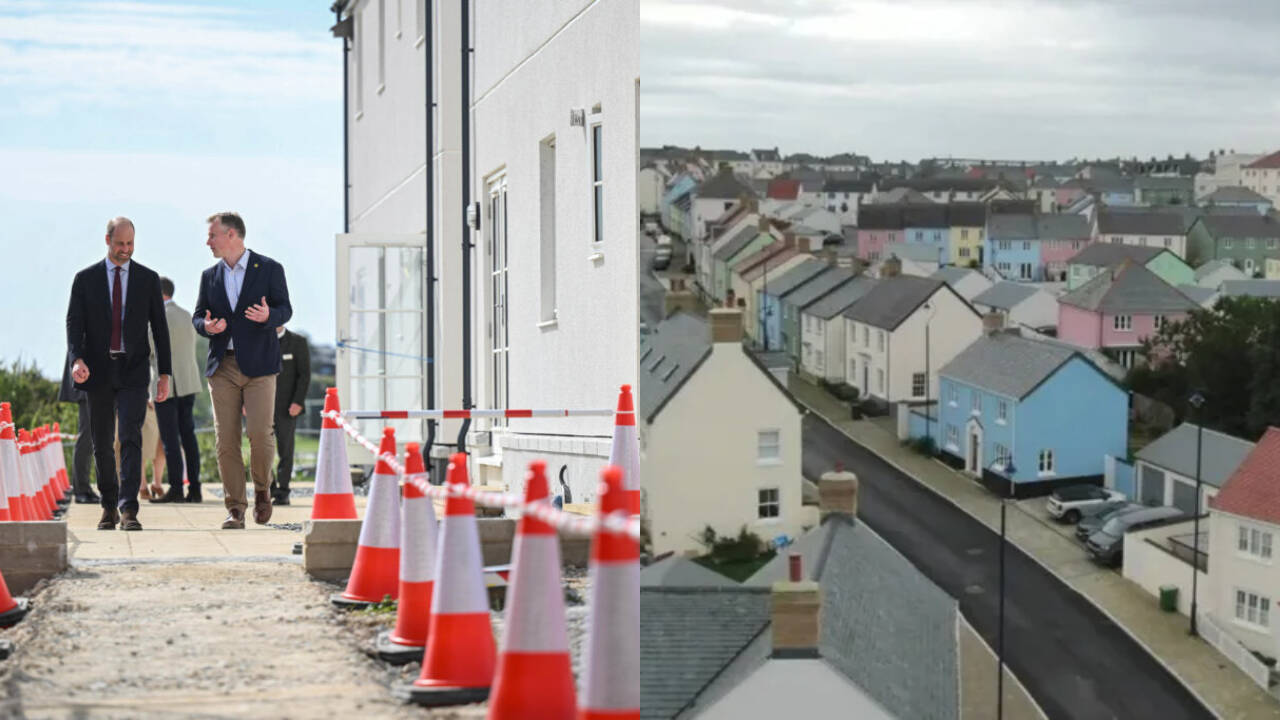
Capital allocation within the third sector suffers from a chronic structural defect: a preference for symbolic optics over scalable unit economics. When charitable organizations deploy high-net-worth patronage toward localized housing initiatives, the public discourse typically defaults to celebratory coverage of initial headcounts housed. Prince William’s intervention via the Duchy of Cornwall—allocating residential assets to shelter sixteen individuals facing housing precarity—provides a pristine case study for analyzing the mechanics, constraints, and systemic limitations of philanthropic real estate deployment.
Understanding the true efficacy of this initiative requires stripping away the narrative veneer of royal patronage and examining the operational framework through three distinct analytical lenses: asset liquidity and land cost, unit delivery efficiency, and the velocity of social return on investment. Philanthropy in the housing sector is not merely an act of benevolence; it is an exercise in resource arbitrage within a constrained macroeconomic environment.
The Asset Base and Land Cost Dynamics
The primary constraint on any housing intervention is not construction capability, but land acquisition cost. Real estate values in regions like Cornwall are heavily distorted by second-home ownership, tourist-driven short-term letting markets, and a structurally inelastic supply of zoned residential land.
When institutional landholders deploy existing assets rather than acquiring parcels on the open market, they bypass the most prohibitive capital barrier in modern real estate development. The Duchy of Cornwall operates as a vast landed estate with significant asset reserves. By utilizing surplus estate land or underutilized holdings, the initiative eliminates land acquisition costs from the development balance sheet.
Eliminating land acquisition cost alters the fundamental equation of residential development:
Development Cost = Land Acquisition + Hard Construction Costs + Soft Costs (Permitting, Legal, Financing)
By reducing the first variable to near zero, the project achieves a lower break-even threshold per residential unit. However, this model introduces a dependency on pre-existing asset ownership. Organizations lacking a legacy land bank cannot replicate this structure without substantial capital endowments or state-backed land grants. Consequently, the scalability of this model is bound strictly by the geographic footprint and asset portfolio of the sponsoring entity.
The Delivery Pipeline and Unit Economics
Housing sixteen individuals across a designated local development sounds modest when measured against national homelessness statistics, but scale must be evaluated relative to unit density and support infrastructure. Addressing chronic homelessness requires more than dry square footage; it requires integration with localized social services, mental health support, and employment pathways.
The delivery mechanism relies on modular or retrofitted construction methods paired with long-term asset stewardship. Retrofitting existing structures or utilizing prefabricated modular units minimizes construction timelines compared to traditional brick-and-mortar development. Yet, speed of delivery introduces trade-offs in long-term maintenance liabilities.
Lower upfront capital expenditure often correlates with higher lifecycle maintenance costs. When philanthropic initiatives absorb these units without establishing a perpetual maintenance endowment, the physical asset degrades over a fifteen-to-twenty-year horizon, shifting the financial burden back onto municipal authorities or forcing subsequent capital injections.
Systemic Displacement Versus Structural Reform
To evaluate the true impact of localized housing allocations, analysts must distinguish between mitigation and resolution. Providing residential units for sixteen people is a localized containment strategy. It removes individuals from acute risk profiles, stabilizing their immediate economic and health baselines.
However, philanthropic housing interventions operate within a broader macroeconomic failure. When regional housing markets exhibit systemic supply shortages and wage-to-rent divergence, private capital injections function as temporary dampers rather than permanent structural corrections.
The intervention fails to address the underlying drivers of housing precarity:
- Zoning restrictions that artificially constrain housing density.
- Wage stagnation relative to regional tourism-driven property appreciation.
- Inadequate municipal investment in social housing infrastructure.
When private or royal estates step in to fill the gap left by public housing disinvestment, it creates a dependency on benevolent capital. This shifts accountability from democratic institutions and public policy to discretionary philanthropy.
Strategic Metrics for Future Housing Interventions
Evaluating the viability of future micro-housing initiatives funded by private estates requires shifting from output metrics (number of people housed) to outcome metrics (long-term economic independence and systemic cost offsets).
The primary economic justification for supportive housing is the reduction of public expenditure in acute emergency services, including emergency room utilization, law enforcement intervention, and temporary shelter overhead. If a sixteen-unit housing project successfully transitions its residents into sustained employment and independent tenancy, the aggregate savings to public coffers can be quantified and modeled against the initial capital outlay.
Future residential initiatives sponsored by landed estates must transition from isolated charitable projects to replicable open-source housing blueprints. This requires publishing transparent cost-per-unit metrics, zoning navigation templates, and maintenance reserve models. Without open-source operational transparency, such projects remain isolated acts of charity rather than scalable models for national housing reform.